
植物中的脱落:从机制到应用
Abscission in plants: from mechanism to applications.
作者信息
Li Jiahuizi, Su Shihao
机构信息
School of Agriculture and Biotechnology, Sun Yat-sen University, Shenzhen, 518107, China.
出版信息
Adv Biotechnol (Singap). 2024 Aug 9;2(3):27. doi: 10.1007/s44307-024-00033-9.
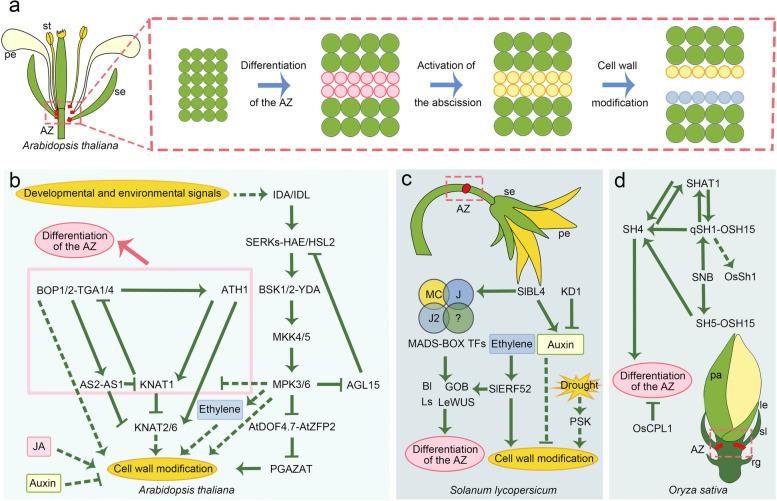
Abscission refers to the natural separation of plant structures from their parent plants, regulated by external environmental signals or internal factors such as stress and aging. It is an advantageous process as it enables plants to shed unwanted organs, thereby regulating nutrient allocation and ensuring the dispersal of fruits and seeds from the parent. However, in agriculture and horticulture, abscission can severely reduce crop quality and yield. In this review, we summarize the recent advances in plant abscission from the perspectives of developmental and molecular biology, emphasizing the diverse regulatory networks across different plant lineages, from model plants to crops. The sophisticated process of plant abscission involves several overlapping steps, including the differentiation of the abscission zone, activation of abscission, tissue detachment, and formation of a protective layer. Finally, we discuss the potential applications of physiological modifications and genetic manipulations of plant abscission in sustainable agriculture in the future.
脱落是指植物结构与其母体植物自然分离,受外部环境信号或内部因素(如胁迫和衰老)调控。这是一个有利的过程,因为它使植物能够脱落不需要的器官,从而调节养分分配,并确保果实和种子从母体传播。然而,在农业和园艺中,脱落会严重降低作物质量和产量。在本综述中,我们从发育生物学和分子生物学的角度总结了植物脱落的最新进展,强调了从模式植物到作物的不同植物谱系中的多种调控网络。植物脱落的复杂过程涉及几个重叠的步骤,包括脱落区的分化、脱落的激活、组织分离和保护层的形成。最后,我们讨论了未来植物脱落的生理修饰和基因操作在可持续农业中的潜在应用。
 Zotero 插件