
EZH2抑制剂用于癌症的安全性概况:一项系统评价与Meta分析
Safety profile of EZH2 inhibitors for cancer: a systematic review and meta-analysis.
作者信息
Zhao Zhou, Chen Xiufeng, Pang Huayang, Shi Yan, Sun Hao
机构信息
Chongqing Key Laboratory of Translational Research for Cancer Metastasis and Individualized Treatment, Chongqing University Cancer Hospital, Chongqing, China.
Department of General Surgery, Center for Minimally Invasive Gastrointestinal Surgery, Southwest Hospital, Third Military Medical University, Chongqing, China.
出版信息
PeerJ. 2025 Jan 27;13:e18871. doi: 10.7717/peerj.18871. eCollection 2025.
OBJECTIVE
To evaluate the safety profiles of EZH2-targeted inhibitors in cancer treatment, focusing on treatment-related adverse events (TRAEs) across various clinical trials.
METHODS
We conducted a systematic review and meta-analysis using data from clinical trials involving EZH2 inhibitors reported up to May 31, 2024. Databases searched included PubMed, Embase, CENTRAL (Cochrane Central Register of Controlled Trials), and ClinicalTrials.gov. Studies included were those involving patients treated with EZH2 inhibitors as monotherapy or in combination, specifically detailing the incidence of TRAEs. Data on all-grade TRAEs, grade 3 or higher TRAEs, and severe TRAEs were extracted and analyzed using random-effects models.
RESULTS
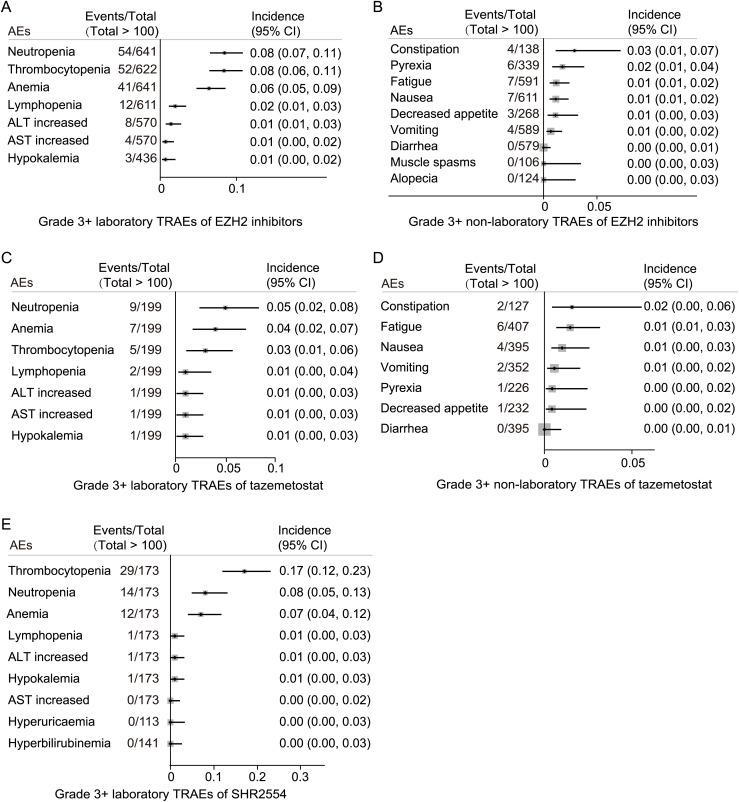
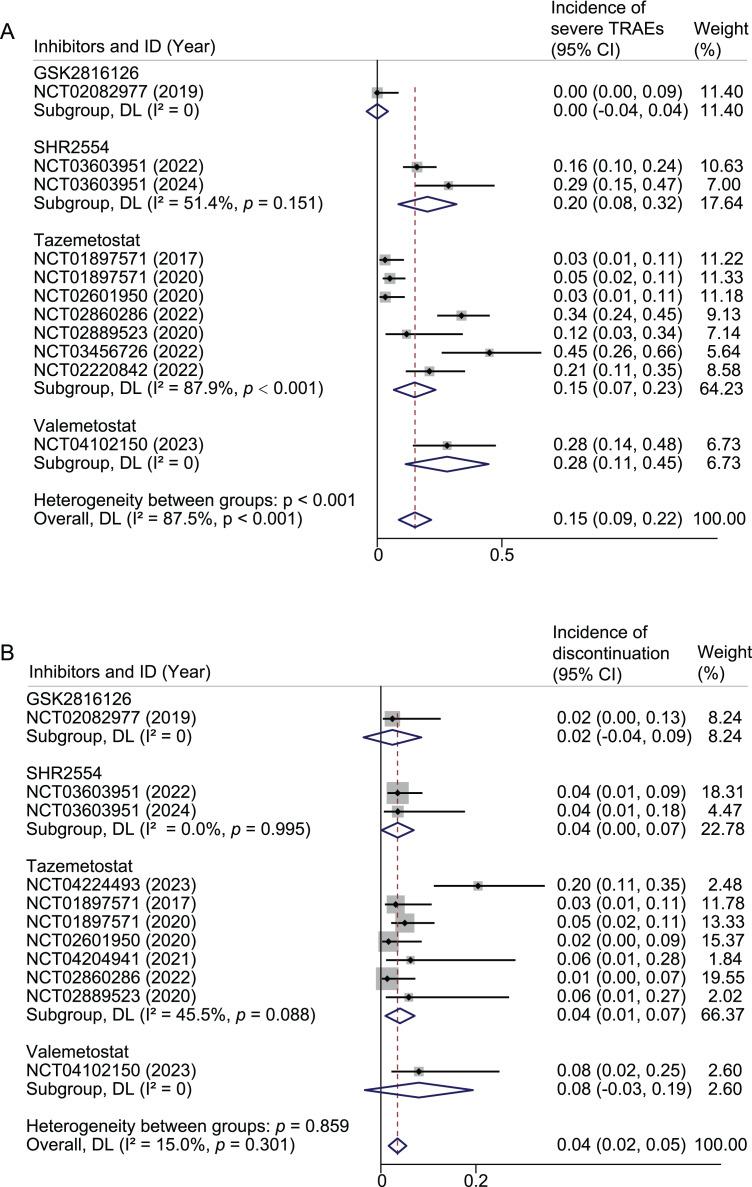
Our systematic review and meta-analysis included 22 studies encompassing 1,002 patients who met the inclusion criteria. TRAEs were commonly observed during EZH2 inhibitor therapy, affecting 86% of patients (95% CI [79-94%]%; I = 89.5%). The incidence of grade 3 or higher TRAEs was 33% (95% CI [21-44%]; I = 93.5%), while severe TRAEs occurred in 15% of the cases (95% CI [9-22%]; I = 87.5%). The most frequently reported grade 3 or higher TRAEs in the pooled analysis were neutropenia (8%), thrombocytopenia (8%), and anemia (6%). Specifically, for tazemetostat, the most common grade 3 or higher TRAE was neutropenia (5%). For SHR2554, the most prevalent grade 3 or higher TRAEs were thrombocytopenia (17%), neutropenia (8%), and anemia (7%). Notably, treatment-related fatalities were rare, with only 0.9% of patients experiencing potentially fatal outcomes due to therapy.
CONCLUSION
EZH2 inhibitors demonstrate a manageable safety profile with a low incidence of severe TRAEs, emphasizing their potential as safe therapeutic options in cancer treatment. The low rate of severe TRAEs and the rare occurrences of treatment-related deaths support the continued clinical use and further investigation of EZH2 inhibitors.
目的
评估EZH2靶向抑制剂在癌症治疗中的安全性,重点关注各类临床试验中与治疗相关的不良事件(TRAEs)。
方法
我们利用截至2024年5月31日报告的涉及EZH2抑制剂的临床试验数据进行了系统评价和荟萃分析。检索的数据库包括PubMed、Embase、CENTRAL(Cochrane对照试验中央登记册)和ClinicalTrials.gov。纳入的研究包括那些使用EZH2抑制剂单药治疗或联合治疗的患者,具体详细说明了TRAEs的发生率。使用随机效应模型提取并分析了所有级别的TRAEs、3级或更高级别TRAEs以及严重TRAEs的数据。
结果
我们的系统评价和荟萃分析纳入了22项研究,共1002例符合纳入标准的患者。在EZH2抑制剂治疗期间普遍观察到TRAEs,影响了86%的患者(95%置信区间[79 - 94%];I² = 89.5%)。3级或更高级别TRAEs的发生率为33%(95%置信区间[21 - 44%];I² = 93.5%),而严重TRAEs发生在15%的病例中(95%置信区间[9 - 22%];I² = 87.5%)。汇总分析中最常报告的3级或更高级别TRAEs是中性粒细胞减少(8%)、血小板减少(8%)和贫血(6%)。具体而言,对于他泽司他,最常见的3级或更高级别TRAEs是中性粒细胞减少(5%)。对于SHR2554,最常见的3级或更高级别TRAEs是血小板减少(17%)、中性粒细胞减少(8%)和贫血(7%)。值得注意的是,与治疗相关的死亡罕见,只有0.9%的患者因治疗出现潜在致命结果。
结论
EZH2抑制剂显示出可控的安全性,严重TRAEs发生率低,强调了它们作为癌症治疗中安全治疗选择的潜力。严重TRAEs发生率低以及与治疗相关死亡罕见支持了EZH2抑制剂的持续临床应用和进一步研究。



 Zotero 插件