
Roux-en-Y胃旁路术后体重减轻对癌症风险的影响:一项孟德尔随机化研究。
Effect of weight loss following Roux-en-Y gastric bypass on cancer risk: A Mendelian randomization study.
作者信息
Xue Jiaming, Chen Shuai, Wang Yu, Jiao Yuwen, Wang Dongmei, Zhao Jie, Zhou Yan, Tang Liming
机构信息
Department of Graduate School, Dalian Medical University, Dalian City, Liaoning Province, China.
Department of Gastrointestinal Surgery, Affiliated Changzhou No. 2 People's Hospital of Nanjing Medical University, The Third Affiliated Hospital of Nanjing Medical University, Changzhou Medical Center, Nanjing Medical University, Changzhou, People's Republic of China.
出版信息
Medicine (Baltimore). 2025 Jan 31;104(5):e41351. doi: 10.1097/MD.0000000000041351.
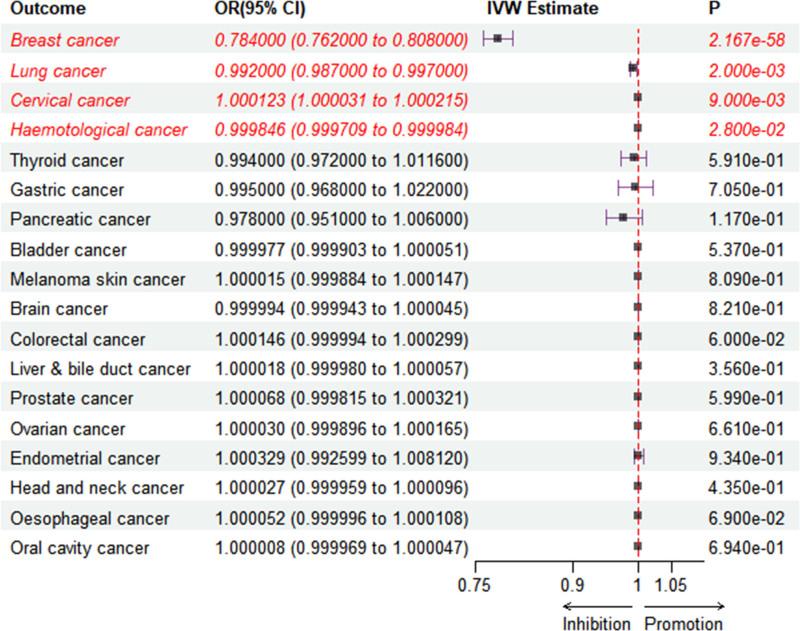
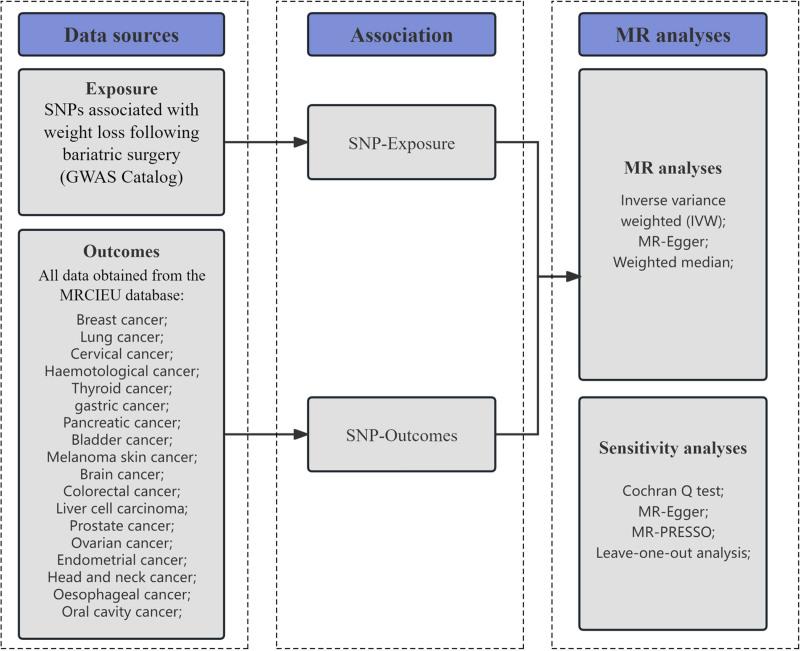
Cancer incidence and development are strongly correlated with obesity, however there is insufficient data to support a causal relationship between intentional weight loss and the prevention or promotion of cancer. We investigated the causal relationship between weight loss following Roux-en-Y gastric bypass (RYGB) and the incidence of 18 cancers using Mendelian randomization (MR). A genome-wide association studies (GWAS) data related to weight loss following RYGB from the GWAS catalog database were used as exposure, and GWAS data related to 18 cancers from the Medical Research Council integrative epidemiology unit open GWAS project were used as outcomes. In order to investigate the causal relationship between exposure and results, we used a two-sample MR approach. The primary analysis technique was inverse variance weighting, with weighted median, and MR-Egger regression utilized as supplemental techniques to confirm the findings. Heterogeneity and horizontal pleiotropy were investigated using a variety of sensitivity studies, including the Cochran Q test, MR-Egger regression pleiotropy test, MR pleiotropy residual sum and outlier, and leave-one-out analysis. We included a total of 4 single-nucleotide polymorphisms as instrumental variables through rigorous quality control screening. Under the limitations of Bonferroni correction threshold (P < 2.78 × 10⁻³), our results suggest that the weight loss following RYGB has a significant causal relationship with a reduced risk of breast (odds ratio [OR]: 0.784; 95% confidence interval [CI]: 0.762-0.808; P = 2.167e-58) and lung cancer (OR: 0.992; 95% CI: 0.987-0.997; P = .0023), and a potential causal relationship with a decreased risk of hematological cancer (OR: 0.9998462; 95% CI: 0.9997088-0.9999836; P = .028) and an increased risk of cervical cancer (OR: 1.000123; 95% CI: 1.0000313-1.000215; P = .009). Sensitivity analysis confirms the robustness of our analysis results. Genetically predicted weight loss following RYGB has significant causal effects in reducing the risk of breast and lung cancer. It also has potential benefits in lowering the risk of hemotological cancers and increasing the risk of cervical cancer. Considering the limitations of our study, the reliability of its results and the underlying mechanisms require further investigation.
癌症的发病率和发展与肥胖密切相关,然而,目前尚无足够的数据支持刻意减肥与预防或促进癌症之间存在因果关系。我们使用孟德尔随机化(MR)方法研究了Roux-en-Y胃旁路术(RYGB)后体重减轻与18种癌症发病率之间的因果关系。来自GWAS目录数据库的与RYGB后体重减轻相关的全基因组关联研究(GWAS)数据用作暴露因素,来自医学研究理事会综合流行病学单位开放GWAS项目的与18种癌症相关的GWAS数据用作结局。为了研究暴露因素与结果之间的因果关系,我们采用了两样本MR方法。主要分析技术是逆方差加权法,加权中位数法以及MR-Egger回归法用作补充技术以确认研究结果。使用多种敏感性研究方法调查了异质性和水平多效性,包括Cochran Q检验、MR-Egger回归多效性检验、MR多效性残差和离群值分析以及留一法分析。通过严格的质量控制筛选,我们总共纳入了4个单核苷酸多态性作为工具变量。在Bonferroni校正阈值(P < 2.78 × 10⁻³)的限制下,我们的结果表明,RYGB后体重减轻与降低乳腺癌风险(优势比[OR]:0.784;95%置信区间[CI]:0.762 - 0.808;P = 2.167e-58)和肺癌风险(OR:0.992;95% CI:0.987 - 0.997;P = 0.0023)具有显著的因果关系,与降低血液系统癌症风险(OR:0.9998462;95% CI:0.9997088 - 0.9999836;P = 0.028)和增加宫颈癌风险(OR:1.000123;95% CI:1.0000313 - 1.000215;P = 0.009)存在潜在因果关系。敏感性分析证实了我们分析结果的稳健性。基因预测的RYGB后体重减轻在降低乳腺癌和肺癌风险方面具有显著的因果效应。在降低血液系统癌症风险和增加宫颈癌风险方面也具有潜在益处。考虑到我们研究的局限性,其结果的可靠性以及潜在机制需要进一步研究。

 Zotero 插件