
实施《2023年北欧营养建议》所带来的预期寿命增长:来自8个北欧和波罗的海国家的模型分析
Life Expectancy Gain of Implementing the Nordic Nutrition Recommendations 2023: Modeling From 8 Nordic and Baltic Countries.
作者信息
Javadi Arjmand Elaheh, Arnesen Erik K, Haaland Øystein Ariansen, Økland Jan-Magnus, Livingstone Katherine M, Mathers John C, Celis-Morales Carlos, Johansson Kjell Arne, Fadnes Lars T
机构信息
Department of Global Public Health and Primary Care, University of Bergen, Bergen, Norway.
Bergen Addiction Research, Department of Addiction Medicine, Haukeland University Hospital, Bergen, Norway.
出版信息
Curr Dev Nutr. 2024 Dec 28;9(2):104540. doi: 10.1016/j.cdnut.2024.104540. eCollection 2025 Feb.
BACKGROUND
Dietary guidelines play a key role in promoting health and preventing chronic diseases. The Nordic Nutrition Recommendations (NNR) 2023 provide updated recommendations for healthy eating relevant for the Nordic and Baltic countries, but the potential benefits have yet to be quantified.
OBJECTIVES
This study aimed to project the population health benefits, specifically, potential gains in life expectancy in Nordic and Baltic countries resulting from long-term dietary changes from current dietary patterns within each country to NNR2023.
METHODS
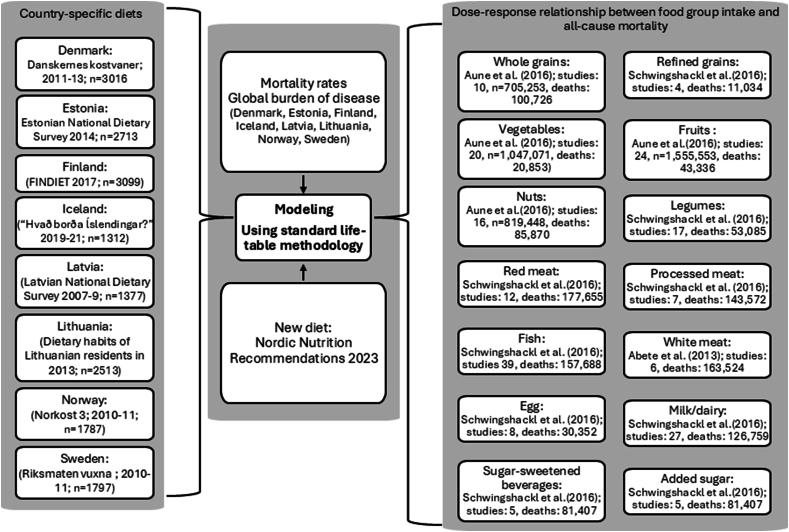
For this population-based mathematical model, using the Food4HealthyLife 2.0 calculator, data were obtained from meta-analyses on associations between each food group and mortality, and background mortality data were derived from the Global Burden of Disease study. Standard life-table methods were used, accounting for the correlation between 14 food groups and the anticipated time delay between dietary changes and health effects.
RESULTS
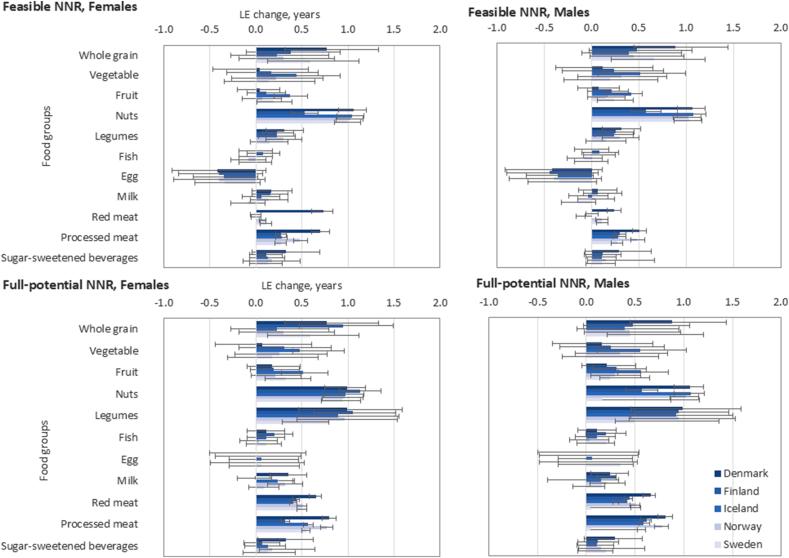
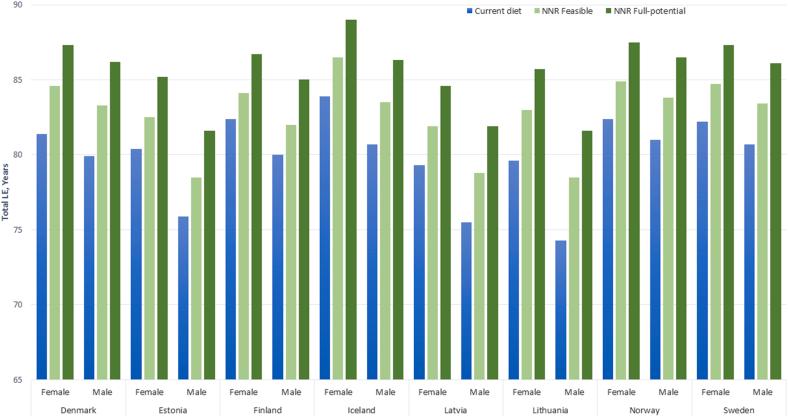
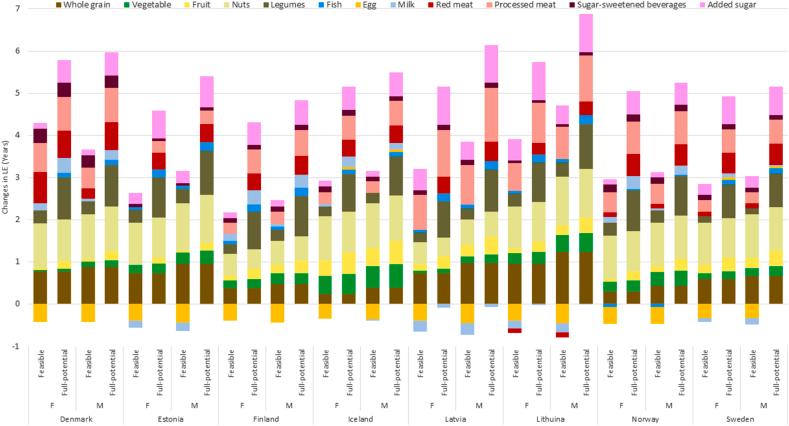
For 40-y-old females and males, projected life expectancy gains were from 1.8 and 2.1 y in Finland to 3.4 and 4.1 y, respectively, in Lithuania, changing to feasible NNR2023. Correspondingly, when changing to full-potential NNR2023, gains ranged from 4.4 and 5.0 y in Finland to 6.1 and 7.3 y, respectively, in Lithuania. The largest gains in life expectancy were linked to consuming more legumes (18%), nuts (17%), whole grains (12%), and less processed meat (14%) and added sugars (13%).
CONCLUSIONS
Adopting dietary patterns in line with the NNR2023 is associated with considerable gains in life expectancy in the Nordic and Baltic countries. The study contributes to the evidence base to support policy measures to achieve NNR2023.
背景
饮食指南在促进健康和预防慢性病方面发挥着关键作用。《2023年北欧营养建议》(NNR)为北欧和波罗的海国家提供了与健康饮食相关的最新建议,但其潜在益处尚未得到量化。
目的
本研究旨在预测人口健康效益,具体而言,是北欧和波罗的海国家因各国从当前饮食模式长期转变为符合《2023年北欧营养建议》的饮食模式而在预期寿命方面的潜在增加。
方法
对于这个基于人群的数学模型,使用Food4HealthyLife 2.0计算器,数据来自各食物组与死亡率之间关联的荟萃分析,背景死亡率数据来自全球疾病负担研究。采用标准生命表方法,考虑了14个食物组之间的相关性以及饮食变化与健康影响之间的预期时间延迟。
结果
对于40岁的女性和男性,将饮食转变为可行的《2023年北欧营养建议》后,预期寿命增加幅度从芬兰的1.8年和2.1年分别到立陶宛的3.4年和4.1年。相应地,当转变为完全符合《2023年北欧营养建议》时,预期寿命增加幅度从芬兰的4.4年和5.0年分别到立陶宛的6.1年和7.3年。预期寿命增加幅度最大的与食用更多豆类(18%)、坚果(17%)、全谷物(12%)以及减少加工肉类(14%)和添加糖(13%)的摄入有关。
结论
采用符合《2023年北欧营养建议》的饮食模式与北欧和波罗的海国家预期寿命的显著增加相关。该研究为支持实现《2023年北欧营养建议》的政策措施提供了证据基础。

 Zotero 插件