
温度、湿度与颗粒物对慢性阻塞性肺疾病的联合影响
Joint effects of temperature and humidity with PM on COPD.
作者信息
Tran Huan Minh, Tsai Feng-Jen, Wang Yuan-Hung, Lee Kang-Yun, Chang Jer-Hwa, Chung Chi-Li, Tseng Chien-Hua, Su Chien-Ling, Lin Yuan-Chien, Chen Tzu-Tao, Chen Kuan-Yuan, Ho Shu-Chuan, Yang Feng-Ming, Wu Sheng-Ming, Chung Kian Fan, Ho Kin-Fai, Chuang Kai-Jen, Chuang Hsiao-Chi
机构信息
College of Public Health, Program in Global Health and Health Security, Taipei Medical University, Taipei, Taiwan.
Faculty of Public Health, Da Nang University of Medical Technology and Pharmacy, Da Nang, Viet Nam.
出版信息
BMC Public Health. 2025 Feb 3;25(1):424. doi: 10.1186/s12889-025-21564-3.
BACKGROUND
Particulate matter less than 2.5 microns in aerodynamic diameter (PM) is a significant air pollutant known to adversely affect respiratory health and increase the incidence of chronic obstructive pulmonary disease (COPD). Furthermore, climate change exacerbates these impacts, as extreme temperatures and relative humidity (RH) levels can intensify the effects of PM. This study aims to examine the joint effects of PM, temperature, and RH on the risk of COPD.
METHODS
A case-control study was conducted among 1,828 participants from 2017 to 2022 (995 COPD patients and 833 controls). The radial basis function interpolation was utilized to estimate participants' individual mean and differences in PM, temperature, and RH in 1-day, 7-day, and 1-month periods. Logistic regression models examined the associations of environmental exposures with the risk of COPD adjusting for confounders. Joint effects of PM by quartiles of temperature and RH were also examined.
RESULTS
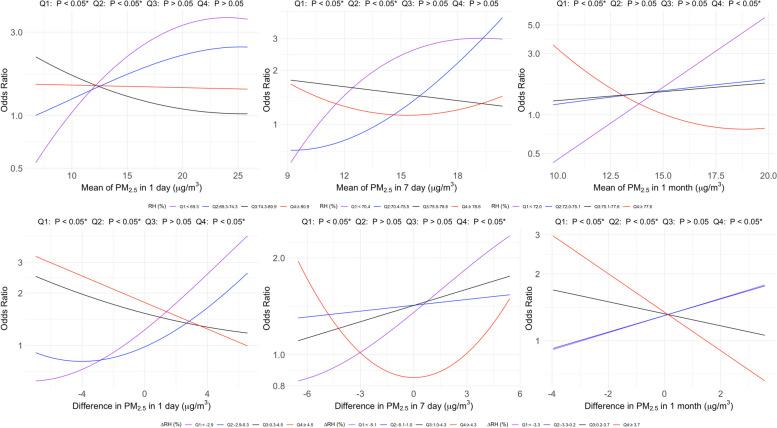
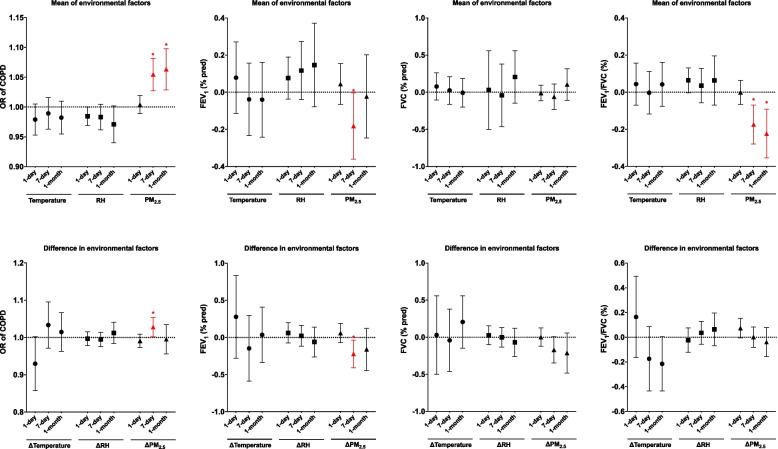
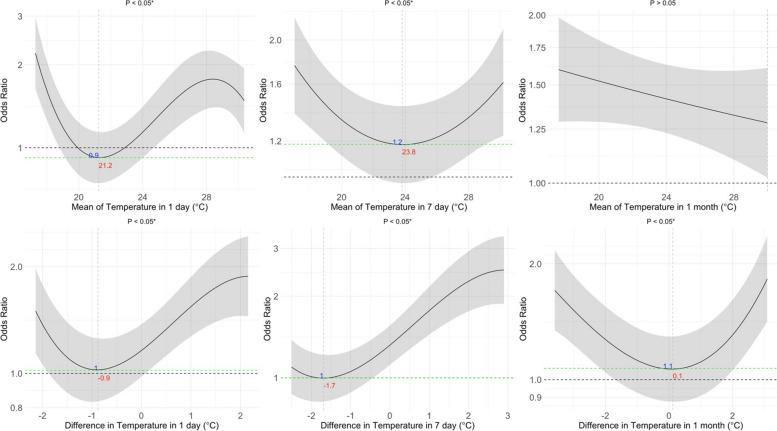
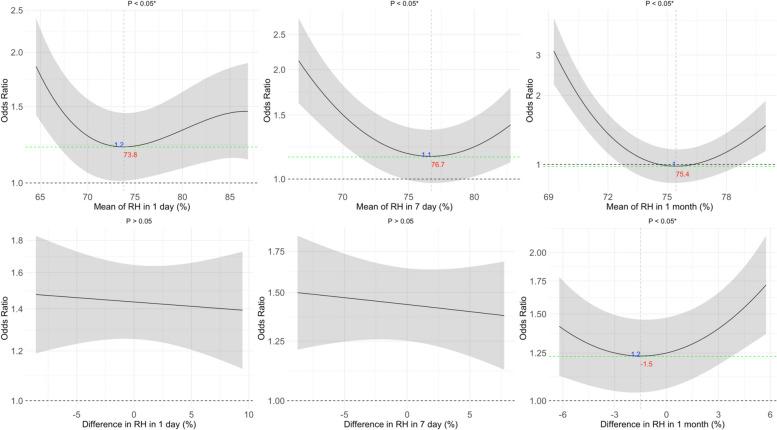
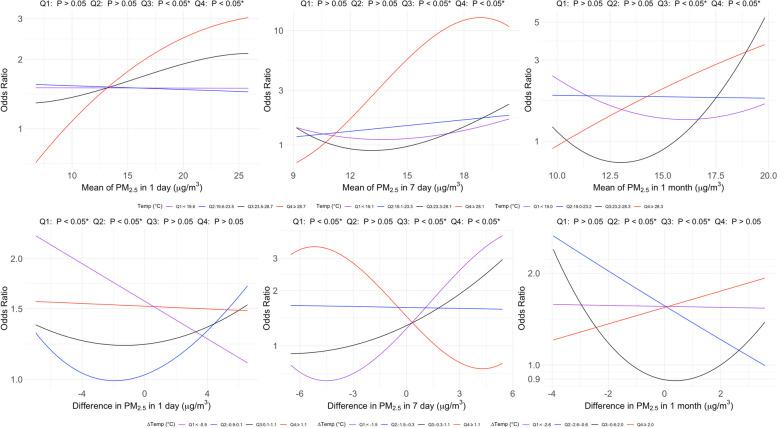
We observed that a 1 µg/m increase in PM 7-day and 1-month mean was associated with a 1.05-fold and 1.06-fold increase in OR of COPD (p < 0.05). For temperature and RH, we observed U-shaped effects on OR for COPD with optimal temperatures identified as 21.2 °C, 23.8 °C, and 23.8 °C for 1-day, 7-day, and 1-month mean temperature, respectively, and optimal RH levels identified as 73.8%, 76.7%, and 75.4% for 1-day, 7-day, and 1-month mean RH, respectively (p < 0.05). The joint effect models show that high temperatures (> 23.5 °C) and both extremely low (69.3%) and high (80.9%) RH levels generally exacerbate the effects of PM on OR for COPD, especially over longer exposure durations.
CONCLUSION
The joint effects of PM, temperature, and RH on the risk of COPD underscore the importance of air pollution control and comprehensive research to mitigate COPD risk in the context of climate change.
背景
空气动力学直径小于2.5微米的颗粒物(PM)是一种重要的空气污染物,已知会对呼吸健康产生不利影响,并增加慢性阻塞性肺疾病(COPD)的发病率。此外,气候变化会加剧这些影响,因为极端温度和相对湿度(RH)水平会增强PM的影响。本研究旨在探讨PM、温度和RH对COPD风险的联合作用。
方法
2017年至2022年期间,对1828名参与者(995名COPD患者和833名对照)进行了病例对照研究。利用径向基函数插值法估计参与者在1天、7天和1个月期间的PM、温度和RH的个体均值及差异。逻辑回归模型在调整混杂因素后,研究环境暴露与COPD风险的关联。还研究了按温度和RH四分位数划分的PM的联合作用。
结果
我们观察到,PM 7天和1个月均值每增加1μg/m³,COPD的比值比(OR)分别增加1.05倍和1.06倍(p<0.05)。对于温度和RH,我们观察到它们对COPD的OR呈U形影响,1天、7天和1个月平均温度的最佳温度分别确定为21.2℃、23.8℃和23.8℃,1天、7天和1个月平均RH的最佳RH水平分别确定为73.8%、76.7%和75.4%(p<0.05)。联合效应模型表明,高温(>23.5℃)以及极低(69.3%)和极高(80.9%)的RH水平通常会加剧PM对COPD的OR的影响,尤其是在较长暴露时间内。
结论
PM、温度和RH对COPD风险的联合作用强调了在气候变化背景下控制空气污染和进行综合研究以降低COPD风险的重要性。

 Zotero 插件