
支持近期柯萨奇病毒B感染的血清学与儿童多系统炎症综合征(MIS-C)相关。
Serology supportive of recent coxsackievirus B infection is correlated with multisystem inflammatory syndrome in children (MIS-C).
作者信息
Kordi Ramesh, Chang Arthur J, Hicar Mark D
机构信息
Department of Pediatrics, Division of Infectious Diseases, State University of New York at Buffalo, Buffalo, New York, USA.
Division of Pediatric Infectious Diseases, University of Nebraska Medical Center, Omaha, Nebraska, USA.
出版信息
Microbiol Spectr. 2025 Mar 4;13(3):e0174124. doi: 10.1128/spectrum.01741-24. Epub 2025 Feb 5.
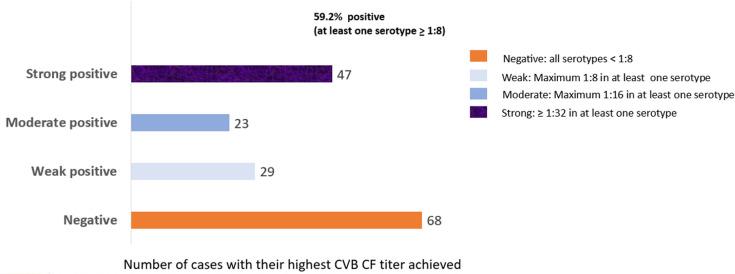
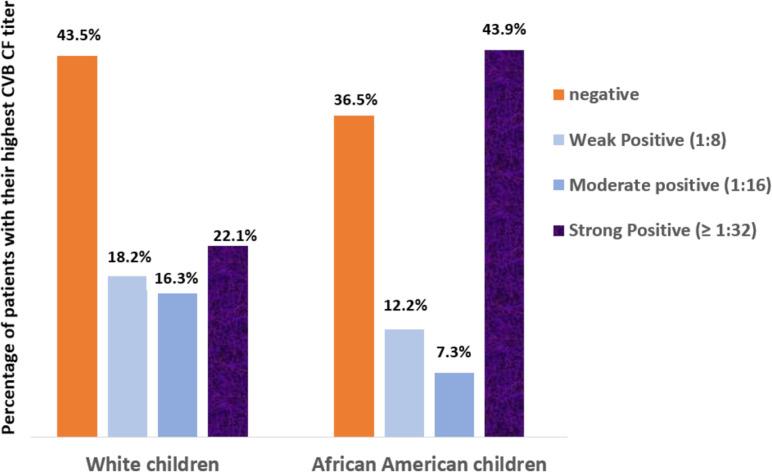
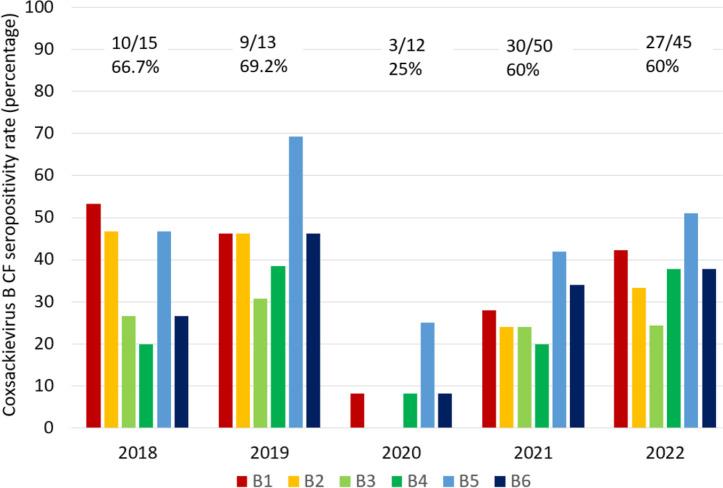
Rarely, severe acute respiratory syndrome coronavirus 2 (SARS-CoV-2) will lead to myocarditis associated with multisystem inflammatory syndrome in children (MIS-C). It remains unclear why MIS-C only targets specific children. To explore an association between coxsackievirus infections with MIS-C, we investigated the sero-epidemiology of CV in admitted pediatric patients in relation to the pandemic. This retrospective case-control study was performed by chart review of children (age ≤21 years) admitted to a tertiary care hospital with CV serological testing from January 2017 to August 2023. Clinical, laboratory, and imaging findings were used to classify patients as MIS-C and CV-unlikely or CV-possible for non-MIS-C patients. Out of 182 admissions (179 patients, median age, 6), CVB complement fixation (CF) assay on serotypes B1-B6 and CVA immunofluorescence assay IgG on serotypes A7, A9, A16, and A24 were positive in at least one serotype in 59.2% and 80.7% of cases, respectively. We observed a significant drop in CVB CF seropositivity during the peak of social distancing in 2020. The likelihood of elevated CVB CF titers was significantly higher in MIS-C than the CV-unlikely group (OR: 1.92, 95% CI: 1.02-3.63, : 0.04) and showed a trend toward higher values in African Americans than Whites (OR: 1.57, 95% CI: 0.98-2.50, : 0.057). The frequency of MIS-C was considerably higher in African Americans than Whites (18.1% versus 9%, : 0.1). A higher likelihood of elevated CVB CF titers in patients with MIS-C compared with those unlikely to have acute CV infection along with a relatively higher frequency of MIS-C in African Americans warrants further investigation into the role of CVB infection in MIS-C development.IMPORTANCEThe emergence of multisystem inflammatory syndrome in children (MIS-C) during the SARS-CoV-2 pandemic raised major concerns in providers caring for children. This condition presents a hyper-inflammation state that can lead to severe complications, including myocarditis and cardiogenic shock. The pathogenesis of MIS-C has not been fully understood. Understanding the pathogenesis of this condition is not only important for developing effective treatments but also for applying preventive strategies. A two-hit hypothesis leading to MIS-C has been proposed. Coxsackievirus infections are prevalent during childhood and can also cause myocarditis, and coxsackievirus B specifically has been shown to cause persistent RNA presence in host cells, leading to continued inflammation. Herein, we show that elevated coxsackievirus B titers are associated with MIS-C cases, implying a role of successive infections with these viruses contributing to such a hyperinflammatory state. This study supports the need for larger investigations into this association.
严重急性呼吸综合征冠状病毒2(SARS-CoV-2)极少会导致与儿童多系统炎症综合征(MIS-C)相关的心肌炎。目前尚不清楚为何MIS-C仅针对特定儿童。为了探究柯萨奇病毒感染与MIS-C之间的关联,我们调查了住院儿科患者中柯萨奇病毒(CV)的血清流行病学与疫情的关系。这项回顾性病例对照研究通过对2017年1月至2023年8月在一家三级护理医院住院且进行了CV血清学检测的儿童(年龄≤21岁)的病历进行审查来开展。临床、实验室和影像学检查结果被用于将患者分类为MIS-C以及非MIS-C患者中的CV可能性不大或CV可能性较大的情况。在182例入院病例(179名患者,中位年龄6岁)中,B1 - B6型柯萨奇病毒B(CVB)补体结合(CF)试验以及A7、A9、A16和A24型柯萨奇病毒A(CVA)免疫荧光试验IgG在至少一种血清型中的阳性率分别为59.2%和80.7%。我们观察到2020年社交距离措施高峰期CVB CF血清阳性率显著下降。MIS-C患者中CVB CF滴度升高的可能性显著高于CV可能性不大的组(比值比:1.92,95%置信区间:1.02 - 3.63,P = 0.04),并且在非裔美国人中显示出高于白人的趋势(比值比:1.57,95%置信区间:0.98 - 2.50,P = 0.057)。非裔美国人中MIS-C的发生率显著高于白人(18.1%对9%,P = 0.1)。与不太可能发生急性CV感染的患者相比,MIS-C患者中CVB CF滴度升高的可能性更高,以及非裔美国人中MIS-C的发生率相对较高,这使得有必要进一步研究CVB感染在MIS-C发病中的作用。
重要性
在SARS-CoV-2大流行期间儿童多系统炎症综合征(MIS-C)的出现引起了照顾儿童的医护人员的重大关注。这种情况呈现出一种高炎症状态,可导致严重并发症,包括心肌炎和心源性休克。MIS-C的发病机制尚未完全了解。了解这种疾病的发病机制不仅对于开发有效的治疗方法很重要,而且对于应用预防策略也很重要。已经提出了一种导致MIS-C的双打击假说。柯萨奇病毒感染在儿童时期很常见,并且也可引起心肌炎,特别是柯萨奇病毒B已被证明可导致宿主细胞中持续存在RNA,从而导致持续炎症。在此,我们表明柯萨奇病毒B滴度升高与MIS-C病例相关,这意味着这些病毒的连续感染在导致这种高炎症状态中起作用。这项研究支持对这种关联进行更大规模调查的必要性。


 Zotero 插件