
单链可变片段亲和力调节可优化抗急性髓系白血病嵌合抗原受体自然杀伤细胞的功能。
Single-chain variable fragment affinity tuning can optimize anti-AML CAR-NK cell functionality.
作者信息
Rahnama Ruyan, Kizerwetter Monika, Yang Huilin, Christodoulou Ilias, Guaraca Christian, Holl Natalie Jordan, Choe Jun, Vorri Stamatia C, Zinsky Megan, Jones Danielle G, Garcia Espinoza Nikol, Kuo Yun-Huai, Zahurak Marianna, Varadhan Ravi, Spangler Jamie B, Bonifant Challice L
机构信息
Oncology, Johns Hopkins Medicine Sidney Kimmel Comprehensive Cancer Center, Baltimore, Maryland, USA.
Department of Biomedical Engineering, Johns Hopkins University School of Medicine, Baltimore, Maryland, USA.
出版信息
J Immunother Cancer. 2025 Feb 6;13(2):e010763. doi: 10.1136/jitc-2024-010763.
BACKGROUND
Natural Killer (NK) cells have intrinsic anticancer activity that can be redirected toward acute myeloid leukemia (AML) with chimeric antigen receptor (CAR) engineering. Here, we study the functional consequences of CAR binding affinity and targeted epitope on CAR-NK cell activation, cytolytic synapse formation, and antitumor activity.
METHODS
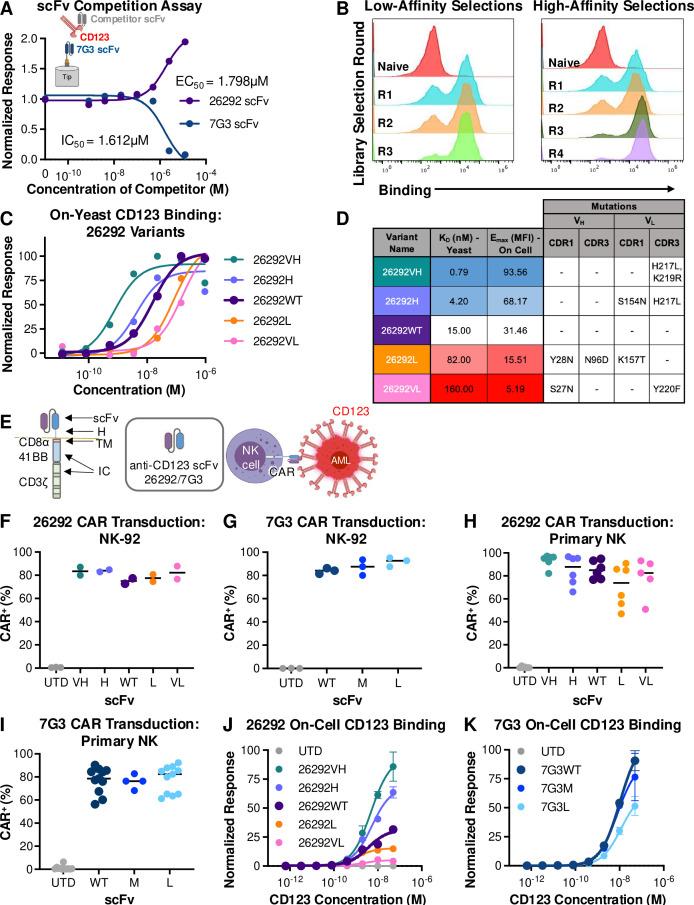
We characterized NK-92 and primary NK cell populations expressing variant affinity AML-specific CARs containing single-chain variable fragments (scFvs, 26292 or 7G3) targeting two epitopes on CD123. 26292 affinity variants were discovered through directed evolution of an error-prone mutagenic library, while 7G3 affinity variants were previously reported. The resulting CAR-NK cell panel was studied with in vitro binding, activation, and cytotoxicity studies and in mouse xenograft models.
RESULTS
26292 and 7G3 CARs of variable CD123 binding affinities were highly expressed in NK cells and conferred antigen-specific activation in vitro. High-resolution imaging demonstrated greater clustering of high-affinity 7G3 CAR-NK cells and consequent AML target cell death in a short-term time lapse. Low-affinity 7G3 CAR-NK cells exhibited enhanced antigen density discrimination with greater membrane-proximal signaling, cytokine production, and cytotoxicity. In longer-term assays, low-affinity 7G3 CAR-NK cells demonstrated more sustained killing of AML cells. In vivo testing highlighted greater expansion of low-affinity 7G3 CAR-NK cells in two xenograft models.
CONCLUSIONS
Expression of 26292 and 7G3 CARs with a range of CD123 binding affinities in NK cells leads to antigen-specific activation and cytotoxicity against AML. Affinity-based differences in functional activation and antitumor activity are dependent on time course and are scFv/epitope specific.
背景
自然杀伤(NK)细胞具有内在的抗癌活性,通过嵌合抗原受体(CAR)工程可将其重定向至急性髓系白血病(AML)。在此,我们研究CAR结合亲和力和靶向表位对CAR-NK细胞活化、溶细胞性突触形成及抗肿瘤活性的功能影响。
方法
我们对表达可变亲和力AML特异性CAR的NK-92和原代NK细胞群体进行了表征,这些CAR包含靶向CD123上两个表位的单链可变片段(scFv,26292或7G3)。26292亲和力变体是通过易错诱变文库的定向进化发现的,而7G3亲和力变体先前已有报道。通过体外结合、活化和细胞毒性研究以及小鼠异种移植模型对所得的CAR-NK细胞组进行了研究。
结果
具有可变CD123结合亲和力的26292和7G3 CAR在NK细胞中高表达,并在体外赋予抗原特异性活化。高分辨率成像显示,高亲和力的7G3 CAR-NK细胞在短期时间推移中聚集程度更高,从而导致AML靶细胞死亡。低亲和力的7G3 CAR-NK细胞表现出增强的抗原密度辨别能力,具有更强的膜近端信号传导、细胞因子产生和细胞毒性。在长期试验中,低亲和力的7G3 CAR-NK细胞对AML细胞的杀伤作用更持久。体内试验突出了低亲和力的7G3 CAR-NK细胞在两种异种移植模型中的更大扩增。
结论
NK细胞中表达具有一系列CD123结合亲和力的26292和7G3 CAR可导致对AML的抗原特异性活化和细胞毒性。基于亲和力的功能活化和抗肿瘤活性差异取决于时间进程,且是scFv/表位特异性的。



 Zotero 插件