
用于预测10年动脉粥样硬化性心血管风险的PREVENT方程与合并队列方程的评估及比较
Evaluation and Comparison of the PREVENT and Pooled Cohort Equations for 10-Year Atherosclerotic Cardiovascular Risk Prediction.
作者信息
Zhou Hui, Zhang Yiyi, Zhou Matt M, Choi Soon Kyu, Reynolds Kristi, Harrison Teresa N, Bellows Brandon K, Moran Andrew E, Colantonio Lisandro D, Allen Norrina B, Safford Monika M, An Jaejin
机构信息
Department of Research and Evaluation Kaiser Permanente Southern California Pasadena CA.
Department of Health Systems Science Kaiser Permanente Bernard J. Tyson School of Medicine Pasadena CA.
出版信息
J Am Heart Assoc. 2025 Feb 18;14(4):e039454. doi: 10.1161/JAHA.124.039454. Epub 2025 Feb 8.
BACKGROUND
We compared the atherosclerotic cardiovascular disease (ASCVD) risk prediction performance of the American Heart Association's Predicting Risk of Cardiovascular Disease Events (PREVENT) Base and PREVENT Full equations (includes urine albumin/creatinine ratio, glycated hemoglobin, and social deprivation index) with the pooled cohort equations (PCEs).
METHODS
We included adults, aged 40 to 75 years, with no history of ASCVD, diabetes, or statin use in 2009 from Kaiser Permanente Southern California and followed up through 2019. ASCVD was defined as myocardial infarction, fatal coronary heart disease, and fatal and nonfatal ischemic stroke. We compared model discrimination (Harrell C), mean calibration (estimated as the ratio of predicted/observed event rates), and calibration curve among the overall population and stratified by sex and race and ethnicity.
RESULTS
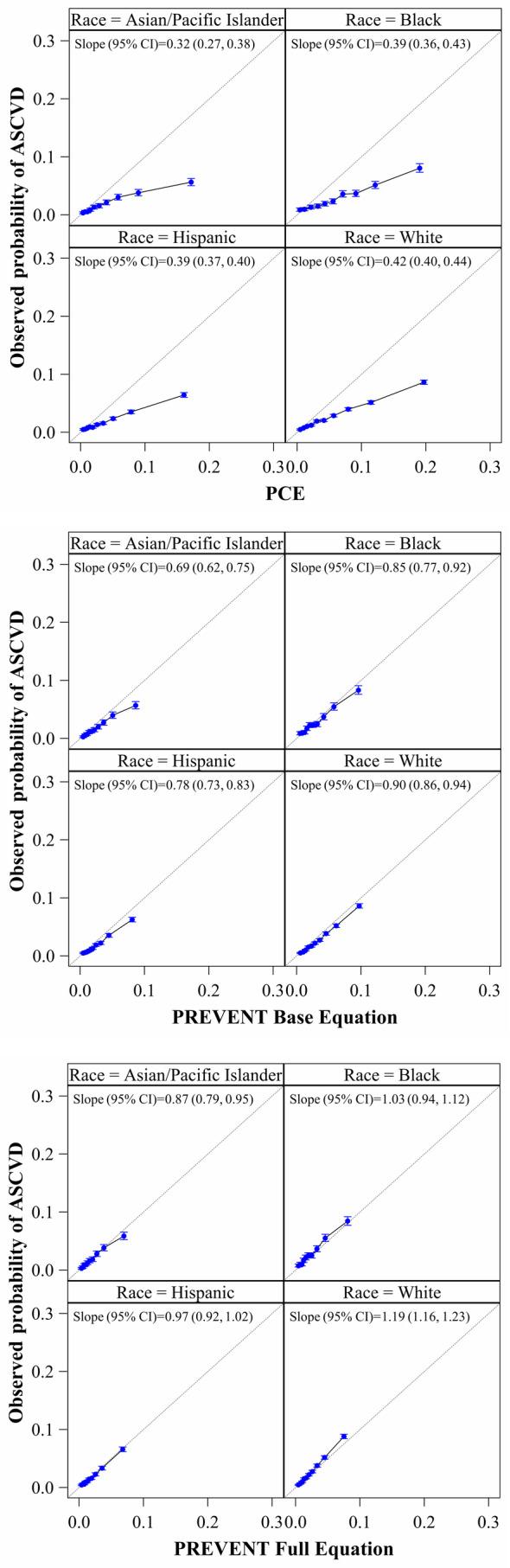
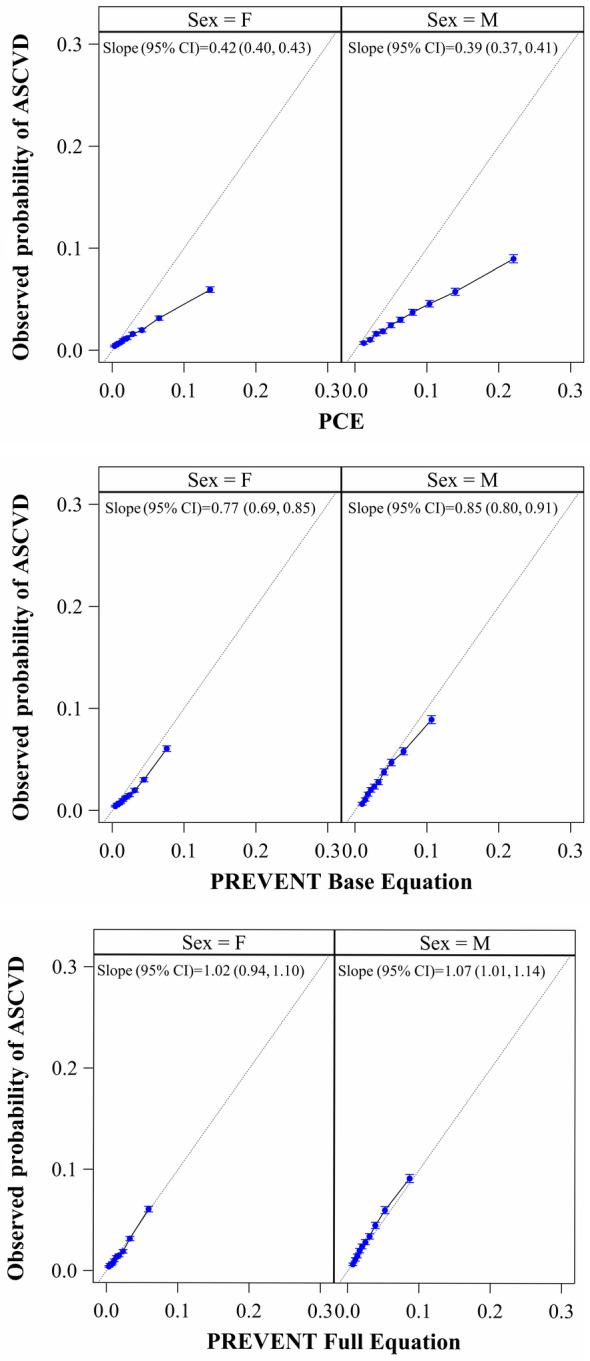
Of the 559 241 adults (mean age, 54 years; 11% Asian, 11% non-Hispanic Black, and 32% Hispanic), 10 695 developed an ASCVD event (median follow-up, 10 years). Harrell C was 0.741 (95% CI, 0.736-0.745) for PREVENT Base, 0.743 (95% CI, 0.738-0.748) for PREVENT Full, and 0.741 (95% CI, 0.736-0.746) for the PCEs. Compared with the PCEs, both PREVENT equations improved Harrell C in men but not women, and in non-Hispanic Black adults but not in other races and ethnicities. Both PREVENT equations were well calibrated (mean calibration, 0.85-1.36; calibration slope, 0.69-1.27), whereas the PCEs overestimated 10-year ASCVD risk (mean calibration, 1.80-2.18; calibration slope, 0.32-0.45).
CONCLUSIONS
Compared with the PCEs, PREVENT Base and Full equations better predict absolute 10-year ASCVD risk across sex and racial and ethnic groups in a contemporary US adult population.
背景
我们比较了美国心脏协会的心血管疾病事件预测(PREVENT)基础方程和PREVENT完整方程(包括尿白蛋白/肌酐比值、糖化血红蛋白和社会剥夺指数)与汇总队列方程(PCEs)对动脉粥样硬化性心血管疾病(ASCVD)的风险预测性能。
方法
我们纳入了2009年来自南加州凯撒医疗集团的40至75岁、无ASCVD、糖尿病或他汀类药物使用史的成年人,并随访至2019年。ASCVD定义为心肌梗死、致命性冠心病以及致命和非致命性缺血性卒中。我们比较了总体人群以及按性别、种族和民族分层后的模型辨别力(Harrell C)、平均校准度(估计为预测事件率与观察事件率之比)和校准曲线。
结果
在559241名成年人(平均年龄54岁;11%为亚洲人,11%为非西班牙裔黑人,32%为西班牙裔)中,10695人发生了ASCVD事件(中位随访时间10年)。PREVENT基础方程的Harrell C为0.741(95%CI,0.736 - 0.745),PREVENT完整方程为0.743(95%CI,0.738 - 0.748),PCEs为0.741(95%CI,0.736 - 0.746)。与PCEs相比,两个PREVENT方程在男性中提高了Harrell C,但在女性中未提高;在非西班牙裔黑人成年人中提高了Harrell C,但在其他种族和民族中未提高。两个PREVENT方程校准良好(平均校准度为0.85 - 1.36;校准斜率为0.69 - 1.27),而PCEs高估了10年ASCVD风险(平均校准度为1.80 - 2.18;校准斜率为0.32 - 0.45)。
结论
与PCEs相比,PREVENT基础方程和完整方程能更好地预测当代美国成年人群中不同性别、种族和民族的10年ASCVD绝对风险。

 Zotero 插件