
美国心脏协会预防心血管疾病风险方程的外部验证。
External Validation of the American Heart Association PREVENT Cardiovascular Disease Risk Equations.
机构信息
College of Health and Human Sciences, Kansas State University, Manhattan.
Department of Biostatistics and Data Science, University of Kansas Medical Center, Kansas City.
出版信息
JAMA Netw Open. 2024 Oct 1;7(10):e2438311. doi: 10.1001/jamanetworkopen.2024.38311.
IMPORTANCE
The American Heart Association's Predicting Risk of Cardiovascular Disease Events (PREVENT) equations were developed to extend and improve on previous cardiovascular disease (CVD) risk assessments for the purpose of treatment initiation and patient-clinician communication.
OBJECTIVE
To assess prognostic capabilities, calibration, and discrimination of the PREVENT equations in a study sample representative of the noninstitutionalized, US general population.
DESIGN, SETTING, AND PARTICIPANTS: This prognostic study used data from the National Health and Nutrition Examination Survey (NHANES) 1999 to 2010 data cycles. Participants included adults for whom 10-year follow-up data were available. Data curation and analyses took place from December 2023 through May 2024.
MAIN OUTCOMES AND MEASURES
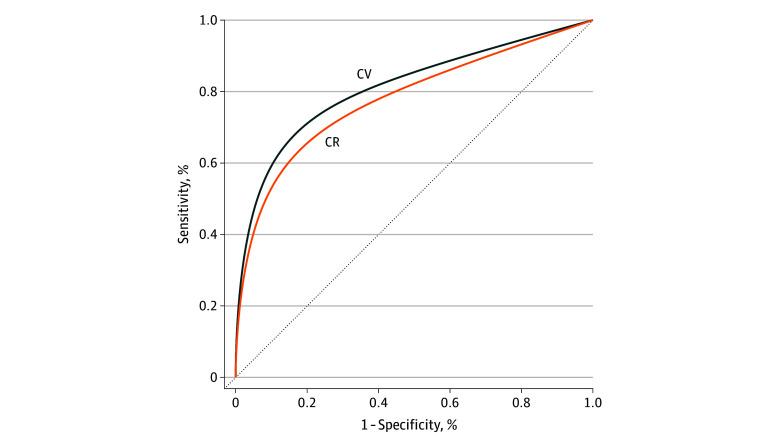
Primary measures were risk estimated by the PREVENT equations, as well as risk estimates from the previous Pooled Cohort Equations (PCEs). The primary outcome was composite CVD-related mortality at 10 years of follow-up. Additional analyses compared the PREVENT equations against the PCEs. Model discrimination was assessed with receiver-operator characteristic curves and Harrell C statistic from proportional hazard regression; model calibration was determined as the slope of predicted versus observed risk.
RESULTS
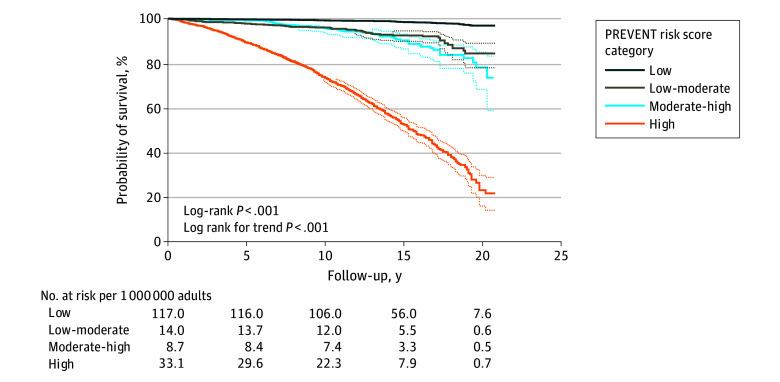
The study cohort, accounting for NHANES complex survey design, consisted of 172.9 million participants (mean age, 45.0 years [95% CI, 44.6-45.4 years]; 52.1% women [95% CI, 51.5%-52.6%]). In analyses adjusted for the NHANES survey design, a 1% increase in PREVENT risk estimates was statistically significantly associated with increased CVD mortality risk (hazard ratio, 1.090; 95% CI, 1.087-1.094). PREVENT risk scores demonstrated excellent discrimination (C statistic, 0.890; 95% CI, 0.881-0.898) but moderate underfitting of the model (calibration slope, 1.13; 95% CI, 1.06-1.21). PREVENT risk models performed statistically significantly better than the PCEs, as assessed by the net reclassification index (0.093; 95% CI, 0.073-0.115).
CONCLUSIONS AND RELEVANCE
In this prognostic study of the PREVENT equations, PREVENT risk estimates demonstrated excellent discrimination and only modest discrepancies in calibration. These findings provided evidence supporting utilization of the PREVENT equations for application in the intended population as suggested by the American Heart Association.
重要性
美国心脏协会的心血管疾病事件预测风险(PREVENT)方程旨在扩展和改进先前的心血管疾病(CVD)风险评估,以便启动治疗和医患沟通。
目的
评估 PREVENT 方程在代表非机构化的美国普通人群的研究样本中的预后能力、校准和区分能力。
设计、地点和参与者:这项预后研究使用了 1999 年至 2010 年国家健康和营养检查调查(NHANES)数据周期的数据。参与者包括有 10 年随访数据的成年人。数据编纂和分析于 2023 年 12 月至 2024 年 5 月进行。
主要结果和措施
主要措施是由 PREVENT 方程以及之前的 pooled cohort equations(PCEs)预测的风险。主要结果是 10 年随访时复合 CVD 相关死亡率。其他分析比较了 PREVENT 方程与 PCEs。通过比例风险回归的接收者操作特征曲线和 Harrell C 统计量评估模型区分度;通过预测风险与观察风险的斜率确定模型校准。
结果
在考虑 NHANES 复杂调查设计的情况下,研究队列包括 1.729 亿参与者(平均年龄为 45.0 岁[95%置信区间,44.6-45.4 岁];52.1%为女性[95%置信区间,51.5%-52.6%])。在调整 NHANES 调查设计的分析中,PREVENT 风险估计值每增加 1%,CVD 死亡率风险就会有统计学意义地增加(风险比,1.090;95%置信区间,1.087-1.094)。PREVENT 风险评分显示出优异的区分度(C 统计量,0.890;95%置信区间,0.881-0.898),但模型拟合度略低(校准斜率,1.13;95%置信区间,1.06-1.21)。如净重新分类指数(0.093;95%置信区间,0.073-0.115)所评估的那样,与 PCEs 相比,PREVENT 风险模型的表现具有统计学意义上的优势。
结论和相关性
在这项对 PREVENT 方程的预后研究中,PREVENT 风险估计显示出优异的区分度和适度的校准差异。这些发现为在美国心脏协会建议的预期人群中应用 PREVENT 方程提供了证据支持。

 Zotero 插件