
对于院外心脏骤停存活而言,哪个因素更重要:有人目睹骤停还是旁观者心肺复苏?
Which Matters More for Out-of-Hospital Cardiac Arrest Survival: Witnessed Arrest or Bystander Cardiopulmonary Resuscitation?
作者信息
Fan Cheng-Yi, Liang Ya-Ting, Huang Edward Pei-Chuan, Chen Jiun-Wei, Chiang Wen-Chu, Wang Charlotte, Sung Chih-Wei
机构信息
Department of Emergency Medicine National Taiwan University Hospital Hsin-Chu Branch Hsinchu Taiwan.
Institute of Epidemiology and Preventive Medicine, College of Public Health National Taiwan University Taipei Taiwan.
出版信息
J Am Heart Assoc. 2025 Feb 18;14(4):e038427. doi: 10.1161/JAHA.124.038427. Epub 2025 Feb 8.
BACKGROUND
Despite the well-known importance of witnessed arrest and bystander cardiopulmonary resuscitation (CPR) for out-of-hospital cardiac arrest outcomes, previous studies have shown significant statistical inconsistencies. We hypothesized an interaction effect and conducted stratified analyses to investigate whether witnessed arrest is more important than bystander CPR.
METHODS
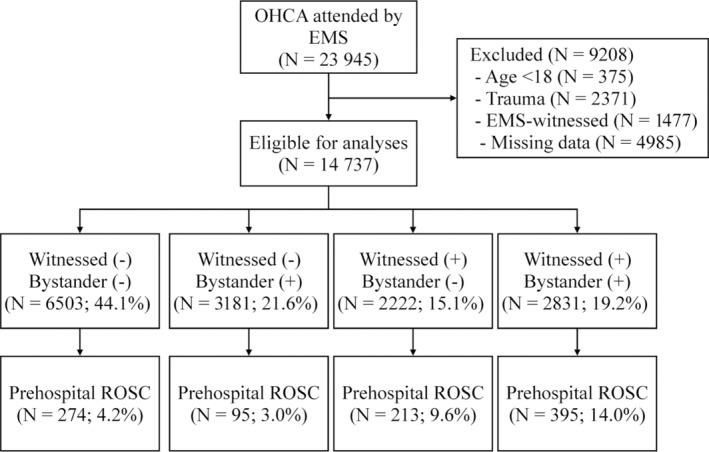
This study enrolled patients with out-of-hospital cardiac arrest between January 2010 and December 2022 in 3 emergency medical service (systems in Taiwan). Data were extracted from emergency medical service dispatch reports, including patient characteristics, witnessed arrest, bystander CPR, time for each dispatch, and prehospital interventions. The outcome measure was prehospital return of spontaneous circulation (ROSC). Patients were categorized into 4 groups: witnessed and bystander CPR present (W+B+), witnessed present but bystander CPR absent (W+B-), witnessed absent but bystander CPR present (W-B+), and witnessed and bystander CPR absent (W-B-). Multiple logistic regression on prehospital ROSC were performed in the 4 subgroups separately.
RESULTS
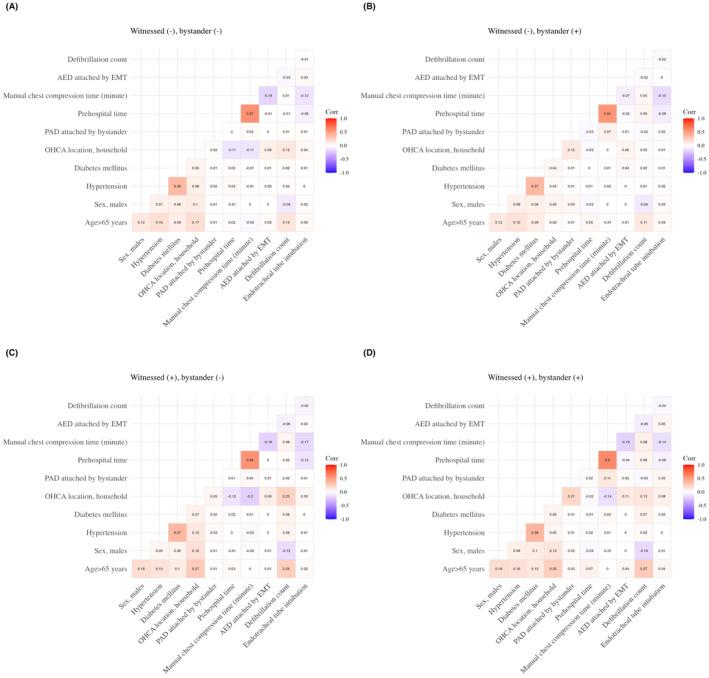
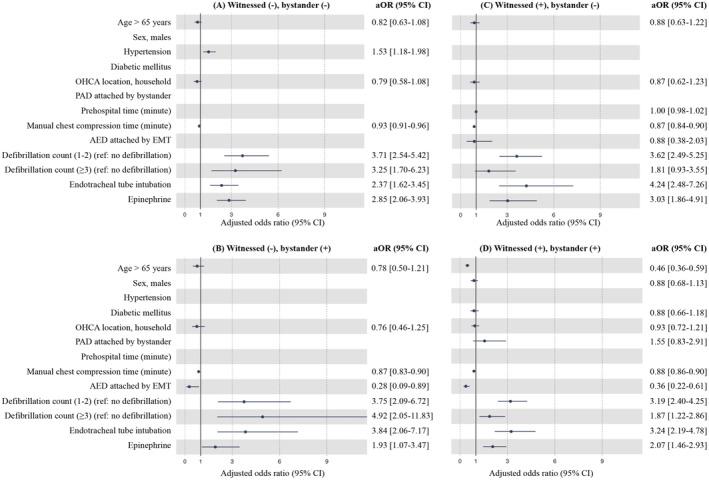
A total of 14 737 patients with out-of-hospital cardiac arrest were identified, of whom 977 (6.6%) achieved prehospital ROSC. The W+B+ group exhibited the highest prehospital ROSC rate (14.0%). Stratification confirmed a statistically significant interaction between witnessed arrest and bystander CPR. Defibrillation, endotracheal intubation, and epinephrine administration were significantly associated with prehospital ROSC in all subgroups. Most explanatory variables significant in the witnessed arrest group were adjusted for in the nonwitnessed arrest group. Younger age was associated with prehospital ROSC only in the W+B+ group.
CONCLUSIONS
Witnessed arrest and bystander CPR may interact to predict prehospital ROSC in out-of-hospital cardiac arrest, with witnessed arrest likely having more significant impact on outcomes.
背景
尽管目击心脏骤停及旁观者实施心肺复苏(CPR)对于院外心脏骤停的预后具有众所周知的重要性,但既往研究显示存在显著的统计学不一致性。我们推测存在交互作用,并进行分层分析以探究目击心脏骤停是否比旁观者实施心肺复苏更重要。
方法
本研究纳入了2010年1月至2022年12月期间台湾3个紧急医疗服务系统中的院外心脏骤停患者。数据从紧急医疗服务调度报告中提取,包括患者特征、目击心脏骤停情况、旁观者实施心肺复苏情况、每次调度时间以及院前干预措施。结局指标是院前自主循环恢复(ROSC)。患者被分为4组:目击且旁观者实施心肺复苏(W+B+)、目击但旁观者未实施心肺复苏(W+B-)、未目击但旁观者实施心肺复苏(W-B+)以及未目击且旁观者未实施心肺复苏(W-B-)。分别在4个亚组中对院前ROSC进行多因素逻辑回归分析。
结果
共识别出14737例院外心脏骤停患者,其中977例(6.6%)实现了院前ROSC。W+B+组的院前ROSC率最高(14.0%)。分层分析证实目击心脏骤停与旁观者实施心肺复苏之间存在统计学显著的交互作用。除颤、气管插管和肾上腺素给药在所有亚组中均与院前ROSC显著相关。在目击心脏骤停组中具有显著意义的大多数解释变量在未目击心脏骤停组中进行了校正。仅在W+B+组中,较年轻的年龄与院前ROSC相关。
结论
目击心脏骤停和旁观者实施心肺复苏可能相互作用以预测院外心脏骤停的院前ROSC,其中目击心脏骤停可能对预后有更显著的影响。
 Zotero 插件