
ABO血型与心脏骤停后预后的关联:一项多中心观察性研究。
The association between ABO blood type and outcomes following sudden cardiac arrest: a multicenter observational study.
作者信息
Chen Jiun-Wei, Tsai Ren-Jie, Fan Cheng-Yi, Huang Sih-Shiang, Chen Ching-Yu, Chen Chi-Hsin, Chang Jia-How, Huang Edward Pei-Chuan, Chang Wei-Tien, Sung Chih-Wei
机构信息
Department of Emergency Medicine, National Taiwan University Hospital Hsin-Chu Branch, Hsinchu, Taiwan.
Institute of Molecular Medicine, National Tsing Hua University, Hsinchu, Taiwan.
出版信息
Front Med (Lausanne). 2025 Apr 8;12:1525575. doi: 10.3389/fmed.2025.1525575. eCollection 2025.
BACKGROUND
ABO blood type has been associated with various disease outcomes, but its relationship with outcomes in patients with sudden cardiac arrest (SCA) remains unexplored.
METHODS
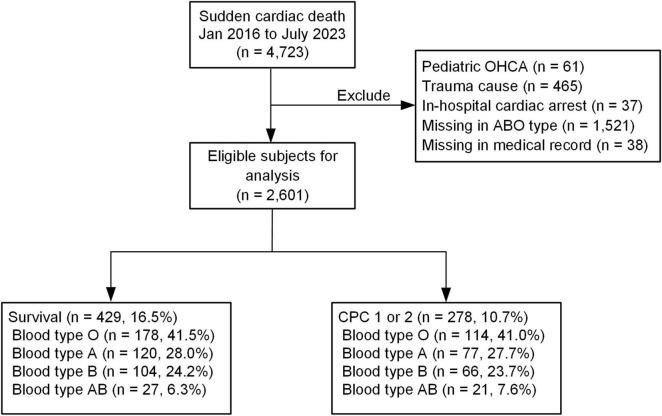
This was a retrospective analysis of adult out-of-hospital cardiac arrest patients with SCA treated at three major branches of the National Taiwan University Hospital between January 2016 and July 2023. The variables examined for their possible influence on the neurological and survival outcomes of patients with SCA were sociodemographic characteristics, pre-existing diseases, resuscitation events, and blood type. The results of a multivariable logistic regression were reported as adjusted odds ratios (aORs) and 95% confidence intervals (CIs). Neurological outcomes were determined by the Cerebral Performance Category (CPC) scale at hospital discharge.
RESULTS
No significant differences were found in the prevalence of each blood type between those who survived and those who did not or between those with good (CPC 1-2) or poor (CPC 3-5) neurological outcomes. There was no significant association between survival and blood type; however, patients with blood type AB had a higher probability of good neurological outcomes than those with blood type O (aOR: 1.98, 95% CI: 1.02-3.83, = 0.042). A sensitivity analysis of the data from patients with aseptic etiologies also showed a significantly higher likelihood of good neurological outcomes among those with blood type AB (aOR: 2.21, 95% CI: 1.12-4.35, = 0.023).
CONCLUSION
ABO blood type is not associated with survival in patients with SCA, but blood type AB is associated with better neurological outcomes than type O.
背景
ABO血型与多种疾病结局相关,但其与心搏骤停(SCA)患者结局的关系仍未得到探索。
方法
这是一项对2016年1月至2023年7月在台湾大学医院三个主要分院接受治疗的成年院外心搏骤停SCA患者的回顾性分析。研究考察了社会人口统计学特征、既往疾病、复苏事件和血型等变量对SCA患者神经功能和生存结局的可能影响。多变量逻辑回归结果以调整优势比(aOR)和95%置信区间(CI)表示。神经功能结局通过出院时的脑功能分类(CPC)量表确定。
结果
存活者与未存活者之间或神经功能结局良好(CPC 1 - 2)与不良(CPC 3 - 5)者之间,各血型的患病率无显著差异。生存与血型之间无显著关联;然而,AB血型患者神经功能结局良好的概率高于O血型患者(aOR:1.98,95% CI:1.02 - 3.83,P = 0.042)。对无菌病因患者数据的敏感性分析也显示,AB血型患者神经功能结局良好的可能性显著更高(aOR:2.21,95% CI:1.12 - 4.35,P = 0.023)。
结论
ABO血型与SCA患者的生存无关,但AB血型比O血型与更好的神经功能结局相关。
 Zotero 插件