
通过多流级联絮凝浮选反应器提高污染物去除效率:详细的流场分析
Enhancing pollutant removal efficiency through multi-flow cascade flocculation and flotation reactor: a detailed flow field analysis.
作者信息
Wang Qingji, Wang Hao, Sun Xiumei, Li Liang, Liang Xing
机构信息
CNPC Research Institute of Safety and Environment Technology Beijing 102206 China.
State Key Laboratory of Petroleum Pollution Control Beijing 102206 China.
出版信息
RSC Adv. 2025 Feb 7;15(6):4187-4202. doi: 10.1039/d4ra07770a. eCollection 2025 Feb 6.
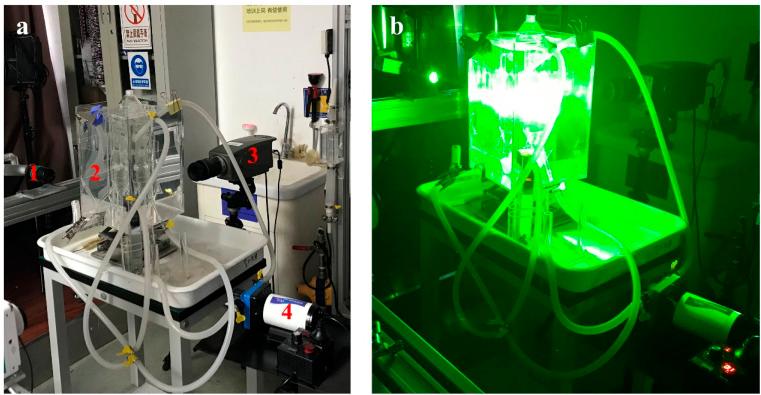
The treatment of oilfield wastewater, characterized by high oil content and complex composition, presents significant challenges in environmental protection. This study developed a novel multi-stage cascade flocculation and flotation reactor (MCFR) to enhance pollutant removal from oilfield wastewater. Particle image velocimetry was used to investigate the internal flow fluid distribution within the reactor. Results show that inlet flow rates of 100 and 150 L h create a high velocity and energy mixing environment near the inlet, facilitating thorough interaction between flocculants and wastewater. This promotes the rapid formation of small flocs and the coalescence of oil droplets. Under the influence of evenly distributed vortex generators, both flocs and oil droplets increase in size, with large oil droplets separated by flotation and dense flocs through sedimentation. In flocculation experiments, the MCFR, operating at 70 mg L of polymerized ferrous sulfate (PFS), 0.6 mg L of polyacrylamide (PAM), and an inlet flow rate of 100 L h, achieved turbidity and oil removal rates of 95% and 94%, respectively. In comparison, a traditional stirred flocculation reactor achieves 82% and 78% removal rates for turbidity and oil, respectively, but requires a longer treatment time of up to 21 minutes. Additionally, the MCFR operates continuously with a treatment time of less than 1 minute, offering a faster and more efficient solution for gas and oil field wastewater treatment. These findings provide critical insights for designing advanced flocculation-flotation systems for the complex wastewater treatment needs of the oil and gas industry.
油田废水具有含油量大、成分复杂的特点,其处理在环境保护方面面临重大挑战。本研究开发了一种新型多级串联絮凝气浮反应器(MCFR),以提高油田废水污染物的去除率。采用粒子图像测速技术研究了反应器内的内部流体流动分布。结果表明,100和150 L/h的进水流量在进水口附近营造了一个高速且能量混合的环境,有利于絮凝剂与废水充分相互作用。这促进了小絮凝体的快速形成以及油滴的聚并。在均匀分布的涡流发生器的影响下,絮凝体和油滴尺寸均增大,大油滴通过气浮分离,密实的絮凝体通过沉淀分离。在絮凝实验中,MCFR在聚合硫酸铁(PFS)投加量为70 mg/L、聚丙烯酰胺(PAM)投加量为0.6 mg/L且进水流量为100 L/h的条件下运行,浊度去除率和除油率分别达到95%和94%。相比之下,传统搅拌絮凝反应器的浊度和油去除率分别为82%和78%,但处理时间长达21分钟。此外,MCFR连续运行,处理时间不到1分钟,为油气田废水处理提供了一种更快、更高效的解决方案。这些研究结果为设计满足油气行业复杂废水处理需求的先进絮凝 - 气浮系统提供了关键见解。




 Zotero 插件