
对人体血浆和椎间盘组织进行蛋白质组分析,发现基质成分而非血浆成分是椎间盘退变的生物标志物。
Proteomic profiling of human plasma and intervertebral disc tissue reveals matrisomal, but not plasma, biomarkers of disc degeneration.
作者信息
Dube Christabel Thembela, Gilbert Hamish T J, Rabbitte Niamh, Baird Pauline, Patel Sonal, Herrera Jeremy A, Baricevic-Jones Ivona, Unwin Richard D, Chan Danny, Gnanalingham Kanna, Hoyland Judith A, Richardson Stephen M
机构信息
Division of Cell Matrix Biology and Regenerative Medicine, School of Biological Sciences, Faculty of Biology, Medicine and Health, The University of Manchester, Manchester, M13 9PT, UK.
Manchester Cell-Matrix Centre, Division of Cell Matrix Biology and Regenerative Medicine, School of Biological Sciences, Faculty of Biology, Medicine and Health, The University of Manchester, Oxford Road, Manchester, M13 9PT, UK.
出版信息
Arthritis Res Ther. 2025 Feb 10;27(1):28. doi: 10.1186/s13075-025-03489-9.
BACKGROUND
Intervertebral disc (IVD) degeneration is a common cause of low back pain, and the most symptomatic patients with neural compression need surgical intervention to relieve symptoms. Current techniques used to diagnose IVD degeneration, such as magnetic resonance imaging (MRI), do not detect changes in the tissue extracellular matrix (ECM) as degeneration progresses. Improved techniques, such as a combination of tissue and blood biomarkers, are needed to monitor the progression of IVD degeneration for more effective treatment plans.
METHODS
To identify tissue and blood biomarkers associated with degeneration progression, we histologically graded 35 adult human degenerate IVD tissues and matched plasma from the individuals into two groups: mild degenerate and severe degenerate. Mass spectrometry was utilised to characterise proteomic differences in tissue and plasma between the two groups. Top differentially distributed proteins were further validated using immunohistochemistry and qRT-PCR. Additionally, correlational analyses were conducted to define similarities and differences between tissue and plasma protein changes in individuals with mild and severe IVD degeneration.
RESULTS
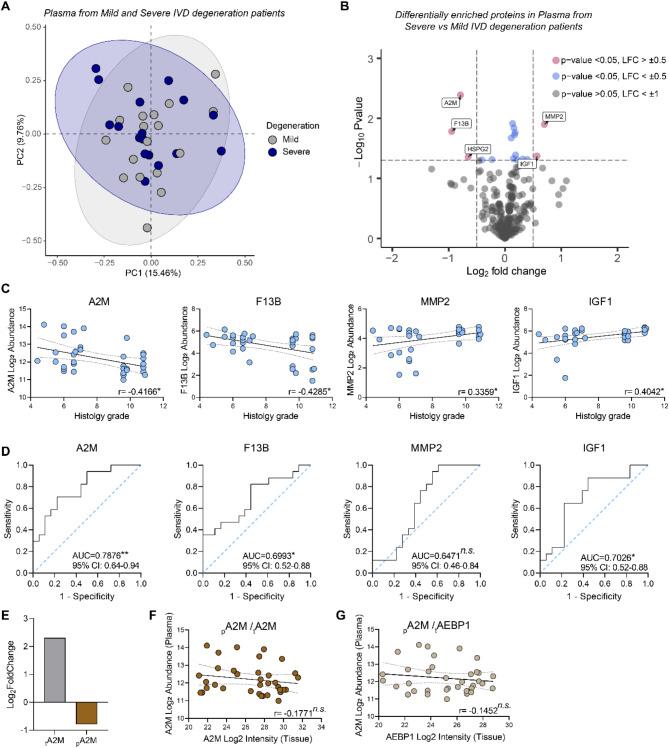
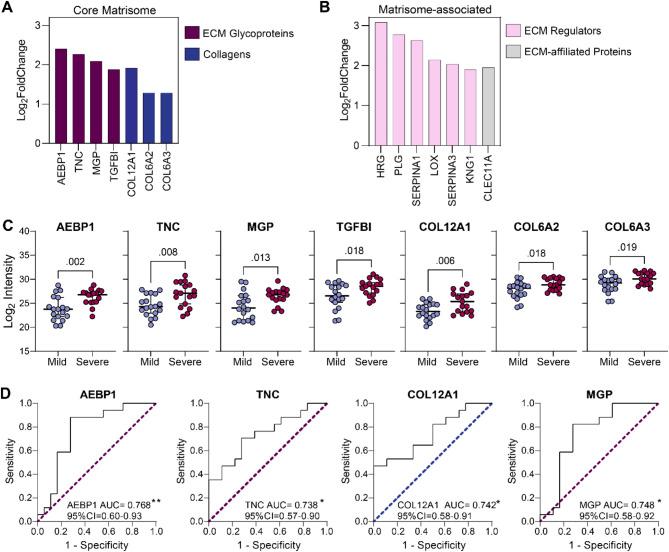
Our data revealed that the abundance of 31 proteins was significantly increased in severe degenerated IVD tissues compared to mild. Functional analyses showed that more than 40% of these proteins were matrisome-related, indicating differences in ECM protein composition between severe and mild degenerate IVD tissues. We confirmed adipocyte enhancer-binding protein 1 (AEBP1) as one of the most significantly enriched core matrisome genes and proteins as degeneration progressed. Compared to others, AEBP1 protein levels best distinguished between mild and severe degenerated IVD tissues with an area under the curve score of 0.768 (95% CI: 0.60-0.93). However, we found that protein changes from associated plasma exhibited a weak relationship with histological grading and AEBP1 tissue levels. Given that systemic plasma changes are complex, a larger sample cohort may be required to identify patterns in blood relating to IVD degeneration progression.
CONCLUSIONS
In this study, we have identified AEBP1 as a tissue marker for monitoring the severity of disc degeneration in humans. Further work to link alterations in tissue AEBP1 levels to changes in blood-related proteins will be beneficial for detailed monitoring of IVD degeneration thereby enabling more personalised treatment approaches.
背景
椎间盘(IVD)退变是腰痛的常见原因,大多数有神经受压症状的患者需要手术干预以缓解症状。目前用于诊断IVD退变的技术,如磁共振成像(MRI),无法检测到随着退变进展组织细胞外基质(ECM)的变化。需要改进技术,如组织和血液生物标志物的联合应用,以监测IVD退变的进展,从而制定更有效的治疗方案。
方法
为了确定与退变进展相关的组织和血液生物标志物,我们对35个成人退变IVD组织进行了组织学分级,并将个体的匹配血浆分为两组:轻度退变组和重度退变组。利用质谱法表征两组组织和血浆中的蛋白质组差异。使用免疫组织化学和qRT-PCR进一步验证差异分布最明显的蛋白质。此外,进行相关性分析以确定轻度和重度IVD退变个体的组织和血浆蛋白变化之间的异同。
结果
我们的数据显示,与轻度退变的IVD组织相比,重度退变的IVD组织中31种蛋白质的丰度显著增加。功能分析表明,这些蛋白质中超过40%与基质组相关,表明重度和轻度退变的IVD组织之间ECM蛋白组成存在差异。我们证实,随着退变进展,脂肪细胞增强子结合蛋白1(AEBP1)是最显著富集的核心基质组基因和蛋白质之一。与其他蛋白相比,AEBP1蛋白水平在区分轻度和重度退变的IVD组织方面表现最佳,曲线下面积得分为0.768(95%CI:0.60-0.93)。然而,我们发现相关血浆中的蛋白质变化与组织学分级和AEBP1组织水平之间的关系较弱。鉴于全身血浆变化复杂,可能需要更大的样本队列来确定与IVD退变进展相关的血液模式。
结论
在本研究中,我们已确定AEBP1作为监测人类椎间盘退变严重程度的组织标志物。进一步将组织AEBP1水平的变化与血液相关蛋白的变化联系起来的工作,将有助于详细监测IVD退变,从而实现更个性化的治疗方法。




 Zotero 插件