
美国新冠疫情之前及期间胆道闭锁的发病率
Incidence of biliary atresia in the United States before and during the COVID-19 pandemic.
作者信息
Qwaider Yasmeen Z, Amarin Justin Z, Spieker Andrew J, Hayek Haya, Chappell James D, Halasa Natasha B, Lovvorn Harold N
机构信息
Department of Pediatric Surgery, Vanderbilt University Medical Center, Nashville, Tennessee, USA.
Division of Pediatric Infectious Diseases, Department of Pediatrics, Vanderbilt University Medical Center, Nashville, Tennessee, USA.
出版信息
J Pediatr Gastroenterol Nutr. 2025 Jun;80(6):943-949. doi: 10.1002/jpn3.70009. Epub 2025 Feb 10.
OBJECTIVES
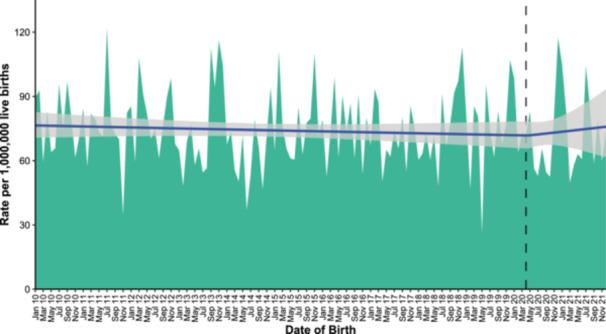
The etiology of biliary atresia (BA) is unclear and potentially involves viral triggers. We aimed to compare the incidence of BA in the United States before and during the coronavirus disease 2019 (COVID-19) pandemic, focusing on potential associations with viral circulation disruptions caused by nonpharmaceutical interventions (NPIs).
METHODS
We queried the Pediatric Health Information System® (PHIS) for all patients discharged with BA between January 1, 2010, and January 31, 2024. Using CDC WONDER, we calculated monthly and overall incidence rates of BA per 1,000,000 live births. We fit a Poisson regression model to assess the association between the widespread implementation of stay-at-home orders (using April 1, 2020, as the cutoff date) and the incidence of BA, accounting for national natality fluctuations.
RESULTS
We identified 3456 newborns with BA from 42 hospitals; 2997 (86.7%) were born before and 459 (13.3%) were born during the pandemic. The mean monthly number of newborns with BA was 24.0 (95% confidence interval, 23.0-25.0) for an overall incidence rate of 74.4 (71.5-77.4) per 1,000,000 live births. We did not identify a statistically significant year-to-year contrast in the incidence of BA before (incidence rate ratio [IRR] = 0.995 [0.983-1.008]; p = 0.49) or after the cutoff date (IRR = 0.999 [0.895-1.116]; p = 0.99). In addition, we did not identify sufficient evidence that trends differed between the two periods (IRR = 1.004 [0.893-1.128]; p = 0.95). [Correction added on 26 February 2025, after the first online publication: The point estimate for the IRR has been updated to 1.004.] CONCLUSIONS: The NPIs implemented during the COVID-19 pandemic were not significantly associated with changes in the incidence or temporal pattern of BA.
目的
胆道闭锁(BA)的病因尚不清楚,可能涉及病毒触发因素。我们旨在比较2019冠状病毒病(COVID-19)大流行之前和期间美国BA的发病率,重点关注与非药物干预(NPI)导致的病毒传播中断之间的潜在关联。
方法
我们查询了儿科健康信息系统(PHIS),以获取2010年1月1日至2024年1月31日期间所有因BA出院的患者信息。使用疾病控制与预防中心(CDC)的WONDER工具,我们计算了每100万活产儿中BA的月度和总体发病率。我们拟合了一个泊松回归模型,以评估居家令广泛实施(以2020年4月1日为截止日期)与BA发病率之间的关联,并考虑了全国出生人数的波动。
结果
我们从42家医院中识别出3456例患有BA的新生儿;其中2997例(86.7%)在大流行之前出生,459例(13.3%)在大流行期间出生。患有BA的新生儿的平均每月数量为24.0(95%置信区间,23.0 - 25.0),每100万活产儿的总体发病率为74.4(71.5 - 77.4)。我们未发现截止日期之前(发病率比[IRR] = 0.995 [0.983 - 1.008];p = 0.49)或之后(IRR = 0.999 [0.895 - 1.116];p = 0.99)BA发病率在统计学上有显著的逐年差异。此外,我们没有找到充分证据表明两个时期的趋势有所不同(IRR = 1.004 [0.893 - 1.128];p = 0.95)。[2025年2月26日首次在线发表后添加的更正:IRR的点估计值已更新为1.004。]结论:COVID-19大流行期间实施的NPI与BA发病率或时间模式的变化没有显著关联。

 Zotero 插件