
深度学习模型分析长期使用角膜塑形术儿童的眨眼特征及其与泪膜稳定性的关系。
Blinking characteristics analyzed by a deep learning model and the relationship with tear film stability in children with long-term use of orthokeratology.
作者信息
Wu Yue, Wu Siyuan, Yu Yinghai, Hu Xiaojun, Zhao Ting, Jiang Yan, Ke Bilian
机构信息
Department of Ophthalmology, Renji Hospital, Shanghai Jiao Tong University School of Medicine, Shanghai, China.
Department of Ophthalmology, Shanghai General Hospital, Shanghai Jiao Tong University School of Medicine, National Clinical Research Center for Eye Diseases, Shanghai, China.
出版信息
Front Cell Dev Biol. 2025 Jan 28;12:1517240. doi: 10.3389/fcell.2024.1517240. eCollection 2024.
PURPOSE
Using deep learning model to observe the blinking characteristics and evaluate the changes and their correlation with tear film characteristics in children with long-term use of orthokeratology (ortho-K).
METHODS
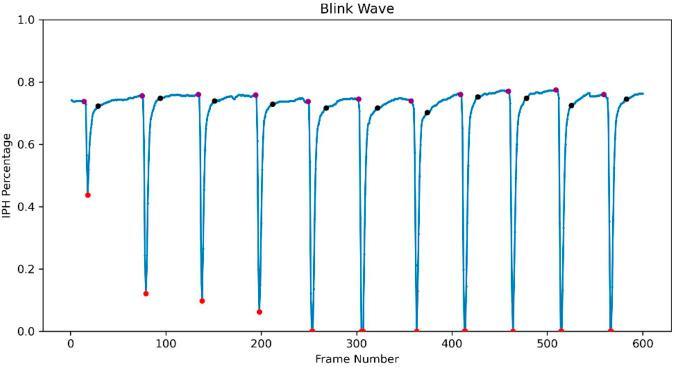
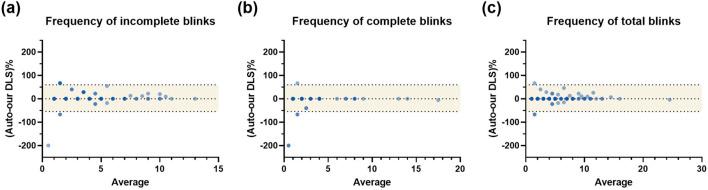
31 children (58 eyes) who had used ortho-K for more than 1 year and 31 age and gender-matched controls were selected for follow-up in our ophthalmology clinic from 2021/09 to 2023/10 in this retrospective case-control study. Both groups underwent comprehensive ophthalmological examinations, including Ocular Surface Disease Index (OSDI) scoring, Keratograph 5M, and LipiView. A deep learning system based on U-Net and Swim-Transformer was proposed for the observation of blinking characteristics. The frequency of incomplete blinks (IB), complete blinks (CB) and incomplete blinking rate (IBR) within 20 s, as well as the duration of the closing, closed, and opening phases in the blink wave were calculated by our deep learning system. Relative IPH% was proposed and defined as the ratio of the mean of IPH% within 20 s to the maximum value of IPH% to indicate the extent of incomplete blinking. Furthermore, the accuracy, precision, sensitivity, specificity, F1 score of the overall U-Net-Swin-Transformer model, and its consistency with built-in algorithm were evaluated as well. Independent t-test and Mann-Whitney test was used to analyze the blinking patterns and tear film characteristics between the long-term ortho-K wearer group and the control group. Spearman's rank correlation was used to analyze the relationship between blinking patterns and tear film stability.
RESULTS
Our deep learning system demonstrated high performance (accuracy = 98.13%, precision = 96.46%, sensitivity = 98.10%, specificity = 98.10%, F1 score = 0.9727) in the observation of blinking patterns. The OSDI scores, conjunctival redness, lipid layer thickness (LLT), and tear meniscus height did not change significantly between two groups. Notably, the ortho-K group exhibited shorter first (11.75 ± 7.42 s vs. 14.87 ± 7.93 s, p = 0.030) and average non-invasive tear break-up times (NIBUT) (13.67 ± 7.0 s vs. 16.60 ± 7.24 s, p = 0.029) compared to the control group. They demonstrated a higher IB (4.26 ± 2.98 vs. 2.36 ± 2.55, p < 0.001), IBR (0.81 ± 0.28 vs. 0.46 ± 0.39, p < 0.001), relative IPH% (0.3229 ± 0.1539 vs. 0.2233 ± 0.1960, p = 0.004) and prolonged eye-closing phase (0.18 ± 0.08 s vs. 0.15 ± 0.07 s, p = 0.032) and opening phase (0.35 ± 0.12 s vs. 0.28 ± 0.14 s, p = 0.015) compared to controls. In addition, Spearman's correlation analysis revealed a negative correlation between incomplete blinks and NIBUT (for first-NIBUT, r = -0.292, p = 0.004; for avg-NIBUT, r = -0.3512, p < 0.001) in children with long-term use of ortho-K.
CONCLUSION
The deep learning system based on U-net and Swim-Transformer achieved optimal performance in the observation of blinking characteristics. Children with long-term use of ortho-K presented an increase in the frequency and rate of incomplete blinks and prolonged eye closing phase and opening phase. The increased frequency of incomplete blinks was associated with decreased tear film stability, indicating the importance of monitoring children's blinking patterns as well as tear film status in clinical follow-up.
目的
利用深度学习模型观察长期使用角膜塑形镜(ortho-K)的儿童的眨眼特征,评估其变化以及与泪膜特征的相关性。
方法
在这项回顾性病例对照研究中,于2021年9月至2023年10月期间,选取31名使用ortho-K超过1年的儿童(58只眼)以及31名年龄和性别匹配的对照组儿童在我们的眼科诊所进行随访。两组均接受全面的眼科检查,包括眼表疾病指数(OSDI)评分、角膜地形图仪5M检查和脂质成像仪检查。提出了一种基于U-Net和Swim-Transformer的深度学习系统用于观察眨眼特征。由我们的深度学习系统计算20秒内不完全眨眼(IB)、完全眨眼(CB)的频率以及不完全眨眼率(IBR),以及眨眼波形中闭眼、闭合和睁眼阶段的持续时间。提出并定义相对IPH%,即20秒内IPH%的平均值与IPH%最大值的比值,以表明不完全眨眼的程度。此外,还评估了整体U-Net-Swin-Transformer模型的准确性、精确性、敏感性、特异性、F1分数及其与内置算法的一致性。采用独立t检验和曼-惠特尼检验分析长期佩戴ortho-K组与对照组之间的眨眼模式和泪膜特征。采用Spearman等级相关性分析眨眼模式与泪膜稳定性之间的关系。
结果
我们的深度学习系统在观察眨眼模式方面表现出高性能(准确率=98.13%,精确率=96.46%,敏感性=98.10%,特异性=98.10%,F1分数=0.9727)。两组之间的OSDI评分、结膜充血、脂质层厚度(LLT)和泪河高度无显著变化。值得注意的是,与对照组相比,ortho-K组的首次(11.75±7.42秒对14.87±7.93秒,p=0.030)和平均非侵入性泪膜破裂时间(NIBUT)(13.67±7.0秒对16.60±7.24秒,p=0.029)较短。与对照组相比,他们表现出更高的IB(4.26±2.98对2.36±2.55,p<0.001)、IBR(0.81±0.28对0.46±0.39,p<0.001)、相对IPH%(0.3229±0.1539对0.2233±0.1960,p=0.004)以及延长的闭眼阶段(0.18±0.08秒对0.15±0.07秒,p=0.032)和睁眼阶段(0.35±0.12秒对0.28±0.14秒,p=0.015)。此外,Spearman相关性分析显示,长期使用ortho-K的儿童中,不完全眨眼与NIBUT之间存在负相关(首次-NIBUT,r=-0.292,p=0.004;平均-NIBUT,r=-0.3512,p<0.001)。
结论
基于U-net和Swim-Transformer的深度学习系统在观察眨眼特征方面取得了最佳性能。长期使用ortho-K的儿童表现出不完全眨眼的频率和速率增加,以及闭眼阶段和睁眼阶段延长。不完全眨眼频率增加与泪膜稳定性降低相关,表明在临床随访中监测儿童眨眼模式以及泪膜状态的重要性。




 Zotero 插件