
通过血浆生物标志物和临床变量预测额颞叶变性相关综合征的生存率。
Predicting survival rate by plasma biomarkers and clinical variables in syndromes associated with frontotemporal lobar degeneration.
作者信息
Cotelli Maria Sofia, Tarantino Barbara, Tan Kübra, Huber Hanna, Cantoni Valentina, Bracca Valeria, Gasparotti Roberto, Premi Enrico, Logroscino Giancarlo, Benedet Andrea L, Blennow Kaj, Zetterberg Henrik, Grassi Mario, Ashton Nicholas J, Borroni Barbara
机构信息
Department of Continuity of Care and Frailty, ASST Spedali Civili, Brescia, Italy.
Department of Brain and Behavioural Sciences, Medical and Genomic Statistics Unit, University of Pavia, Pavia, Italy.
出版信息
Alzheimers Dement. 2025 Feb;21(2):e14558. doi: 10.1002/alz.14558.
INTRODUCTION
Modeling the survival rate in syndromes associated with frontotemporal lobar degeneration (FTLD) is essential to assess disease trajectories.
METHODS
In 262 patients with FTLD, we considered plasma neurofilament light chain (NfL), glial fibrillary acidic protein, brain-derived tau, phosphorylated tau217 and amyloid beta (Aβ42/Aβ40). The FTLD Survival Score (FTLD-SS) was calculated by the β coefficients of the variables independently associated with survival rate.
RESULTS
Increased plasma NfL levels (p < 0.001), older age at evaluation (p = 0.002), positive family history (p = 0.04), and motor phenotypes (p < 0.001) were associated with reduced survival. The predictive validity of FTLD-SS was 0.75 (95% confidence interval, 0.59-0.91) at 1 year.
DISCUSSION
Survival rate in FTLD is shaped by intensity of neurodegeneration (using plasma NfL as proxy) together with certain clinical variables. The FTLD-SS may serve as a simple tool for survival rate estimation and for patient stratification in clinical trials.
HIGHLIGHTS
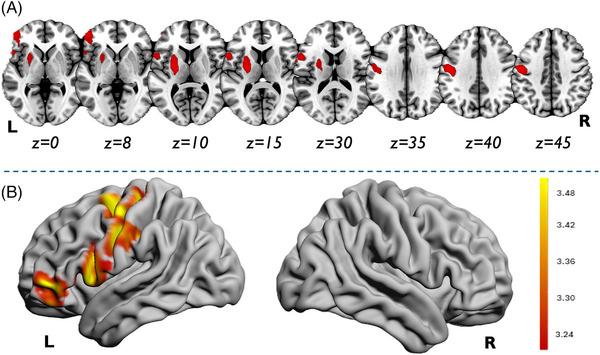
Plasma neurofilament light chain and clinical variables can predict survival in frontotemporal lobar degeneration (FTLD)-associated syndromes. FTLD Survival Score (FTLD-SS), computed with survival predictors, may serve as a simple tool for patient stratification. FTLD-SS is associated with greater atrophy in frontal and putamen areas.
引言
对与额颞叶变性(FTLD)相关综合征的生存率进行建模对于评估疾病轨迹至关重要。
方法
在262例FTLD患者中,我们考量了血浆神经丝轻链(NfL)、胶质纤维酸性蛋白、脑源性tau蛋白、磷酸化tau217和淀粉样β蛋白(Aβ42/Aβ40)。FTLD生存评分(FTLD-SS)通过与生存率独立相关变量的β系数计算得出。
结果
血浆NfL水平升高(p<0.001)、评估时年龄较大(p = 0.002)、阳性家族史(p = 0.04)和运动表型(p<0.001)与生存率降低相关。FTLD-SS在1年时的预测效度为0.75(95%置信区间,0.59 - 0.91)。
讨论
FTLD的生存率由神经变性强度(以血浆NfL为代表)以及某些临床变量共同决定。FTLD-SS可作为一种简单工具用于生存率估计以及临床试验中的患者分层。
要点
血浆神经丝轻链和临床变量可预测额颞叶变性(FTLD)相关综合征的生存率。通过生存预测因子计算得出的FTLD生存评分(FTLD-SS)可作为患者分层的简单工具。FTLD-SS与额叶和壳核区域更大程度的萎缩相关。


 Zotero 插件