
用于提高猪生产性能的基因编辑:当前进展与前景
Gene Editing for Enhanced Swine Production: Current Advances and Prospects.
作者信息
Ju Won Seok, Kim Seokho, Lee Jae-Yeong, Lee Haesun, No Jingu, Lee Seunghoon, Oh Keonbong
机构信息
Animal Biotechnology Division, National Institute of Animal Science, Rural Development Administration, 1500 Kongjwipatjwi-ro, Iseo-myeon, Wanju-gun 55365, Republic of Korea.
出版信息
Animals (Basel). 2025 Feb 3;15(3):422. doi: 10.3390/ani15030422.
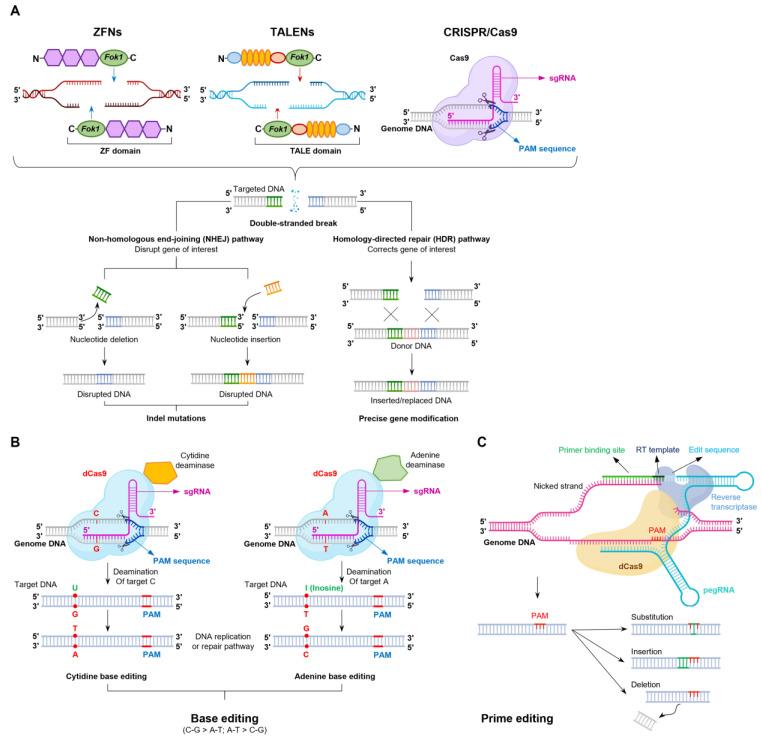
Traditional pig breeding has improved production traits but faces limitations in genetic diversity, disease resistance, and environmental adaptation. Gene editing technologies, such as CRISPR/Cas9, base editing, and prime editing, enable precise genetic modifications, overcoming these limitations and expanding applications to biomedical research. Here, we reviewed the advancements in gene editing technologies in pigs and explored pathways toward optimized swine genetics for a resilient and adaptive livestock industry. This review synthesizes recent research on gene editing tools applied to pigs, focusing on CRISPR/Cas9 and its derivatives. It examines their impact on critical swine production traits and their role as human disease models. Significant advancements have been made in targeting genes for disease resistance, such as those conferring immunity to porcine reproductive and respiratory syndrome viruses. Additionally, gene-edited pigs are increasingly used as models for human diseases, demonstrating the technology's broader applications. However, challenges such as off-target effects, ethical concerns, and varying regulatory frameworks remain. Gene editing holds substantial potential for sustainable and productive livestock production by enhancing key traits and supporting biomedical applications. Addressing technical and ethical challenges through integrated approaches will be essential to realize its full potential, ensuring a resilient, ethical, and productive livestock sector for future generations.
传统的猪育种提高了生产性能,但在遗传多样性、抗病性和环境适应性方面面临局限性。基因编辑技术,如CRISPR/Cas9、碱基编辑和引导编辑,能够实现精确的基因修饰,克服这些局限性,并将应用扩展到生物医学研究领域。在此,我们回顾了猪基因编辑技术的进展,并探索了实现优化猪遗传学以促进畜牧业适应力和适应性的途径。本综述综合了近期应用于猪的基因编辑工具的研究,重点关注CRISPR/Cas9及其衍生物。研究了它们对关键猪生产性能的影响以及它们作为人类疾病模型的作用。在针对抗病性的基因靶向方面取得了重大进展,例如那些赋予对猪繁殖与呼吸综合征病毒免疫力的基因。此外,基因编辑猪越来越多地被用作人类疾病模型,展示了该技术更广泛的应用。然而,脱靶效应、伦理问题和不同的监管框架等挑战依然存在。通过增强关键性状并支持生物医学应用,基因编辑在可持续和高效的畜牧生产方面具有巨大潜力。通过综合方法应对技术和伦理挑战对于充分发挥其潜力至关重要,以确保为子孙后代打造一个适应力强、符合伦理且高效的畜牧部门。
 Zotero 插件