
揭示微小RNA在食管癌中的作用:从发病机制到临床应用
Uncovering the role of microRNAs in esophageal cancer: from pathogenesis to clinical applications.
作者信息
He Zhenglin, Ji Yishuo, Yuan Yutong, Liang Tianfang, Liu Chenglin, Jiao Yiping, Chen Yimeng, Yang Yiming, Han Liang, Hu Yue, Cong Xianling
机构信息
China-Japan Union Hospital of Jilin University, Jilin University, Changchun, China.
The First Bethune Hospital of Jilin University, Jilin University, Changchun, China.
出版信息
Front Pharmacol. 2025 Jan 29;16:1532558. doi: 10.3389/fphar.2025.1532558. eCollection 2025.
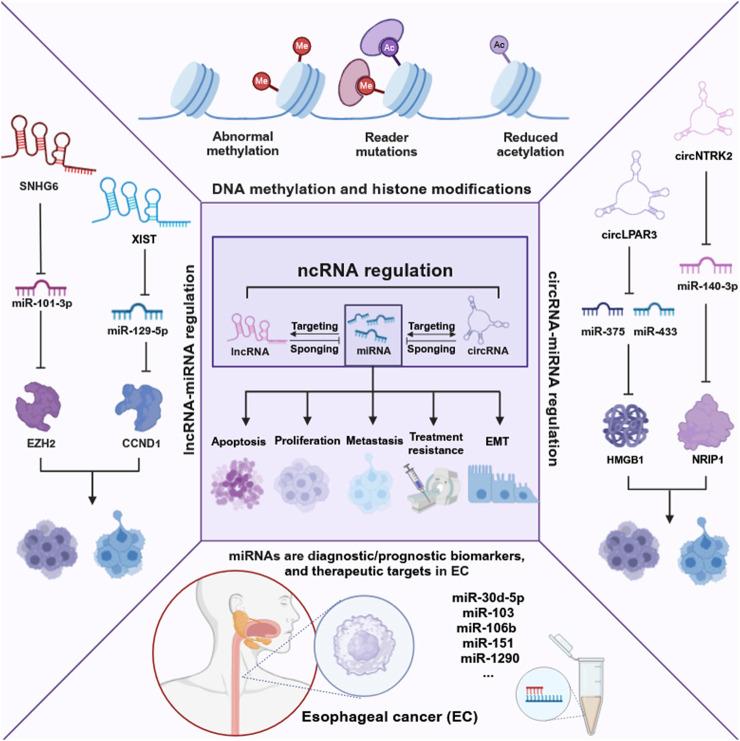
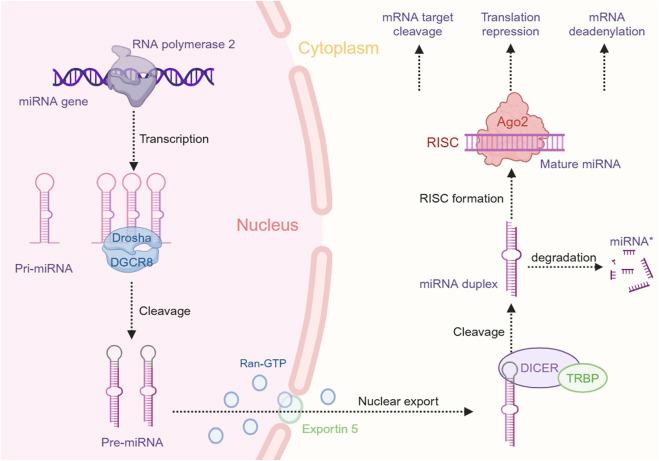
Esophageal cancer (EC) presents substantial therapeutic challenges due to its high mortality rate and the tendency for diagnosis at advanced stages. Acknowledging the constraints of the existing current treatment paradigm, there is a pressing need for the development of innovative, targeted therapeutic strategies to surpass the current stagnation in survival rate improvements. Recently, microRNAs (miRNAs) have attracted significant attention for their capacity to regulate gene expression at the post-transcriptional level, thereby influencing various cellular processes. In this review, we provide a comprehensive analysis of the role of miRNAs in EC, emphasizing their mechanisms in tumorigenesis, their potential as diagnostic and prognostic biomarkers, and their influence on resistance to therapy. We elucidate how miRNAs modulate oncogenic pathways and tumor suppressor genes, influencing EC cell behavior and treatment outcomes. By integrating insights from genetic sequencing and molecular biology, we identify key miRNAs that promote or inhibit EC progression and treatment resistance. This review highlights critical need for an enhanced understanding of miRNAs in EC, advocating for their integration into therapeutic strategies.
食管癌(EC)因其高死亡率以及晚期诊断倾向而面临重大治疗挑战。鉴于现有治疗模式的局限性,迫切需要开发创新的靶向治疗策略,以突破目前生存率提升停滞不前的局面。近年来,微小RNA(miRNA)因其在转录后水平调控基因表达的能力而备受关注,进而影响各种细胞过程。在本综述中,我们全面分析了miRNA在食管癌中的作用,着重阐述其在肿瘤发生中的机制、作为诊断和预后生物标志物的潜力以及对治疗耐药性的影响。我们阐明了miRNA如何调节致癌途径和肿瘤抑制基因,影响食管癌细胞行为和治疗结果。通过整合基因测序和分子生物学的见解,我们确定了促进或抑制食管癌进展和治疗耐药性的关键miRNA。本综述强调了深入了解食管癌中miRNA的迫切需求,主张将其纳入治疗策略。
 Zotero 插件