
影响暴露于艾滋病毒的婴儿营养状况的母亲因素:在内罗毕县马萨雷和基贝拉非正式定居点进行的12个月随访
Maternal Factors Influencing the Nutritional Status of HIV-Exposed Infants: A 12-Month Follow-Up in Mathare and Kibera Informal Settlements in Nairobi County.
作者信息
Kiilu Elizabeth Mueke, Karanja Simon, Kikuvi Gideon, Muthoki Linet
机构信息
Department of Public Health, University of Bradford, Bradford, UK.
Department of Public Health, Jomo Kenyatta University of Agriculture and Technology, Nairobi, Kenya.
出版信息
AIDS Behav. 2025 Jun;29(6):1796-1809. doi: 10.1007/s10461-025-04648-4. Epub 2025 Feb 14.
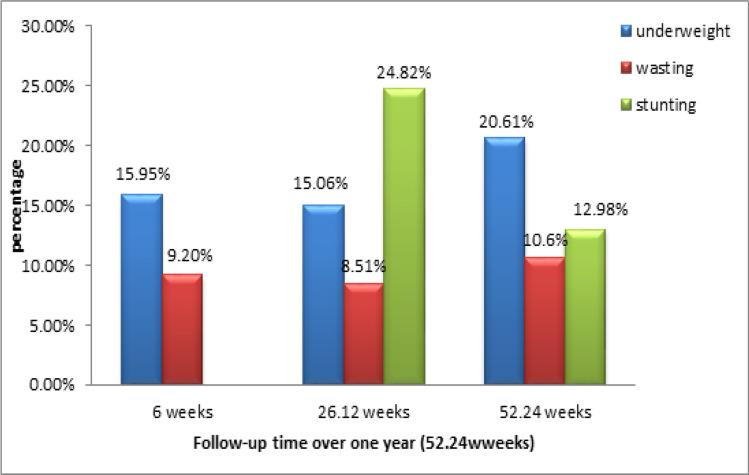
Optimal infant nutrition is crucial for good health and survival. HIV-exposed infants have a greater incidence of low birthweight than HIV-unexposed infants, predisposing them to malnutrition and a greater risk of HIV infection. A 12-month longitudinal study was conducted on 166 HIV-exposed infants, assessing nutritional status at 6 weeks, 6 months, and 12 months. Fisher's test and logistic regression analysed the data using WHO growth standards. Ethical approval was obtained (KEMRI/SERU/CPHR/002/3525). Results: Wasting: Younger maternal age (18-24 years) presented higher odds of infant wasting across all timepoints: 6 weeks aOR 4.31 (CI: 1.11, 1.83), 6 months aOR 4.49 (CI: 1.09, 27.34), and 12 months aOR 5.49 (CI: 1.41, 32.97). Stunting: At 6 months, infants of underweight mothers and those on second-line antiretroviral therapy (ART) regimens had higher odds of stunting aOR 4.76 (CI: 1.36, 16.65) and aOR 5.49 (CI: 1.64, 18.38), respectively. At 12 months, poor maternal ART adherence aOR 4.11 (CI: 1.14, 14.82) and mothers on second-line ART regimens aOR 3.68 (CI: 1.09, 12.49) had increased odds of infant stunting. Underweight: At 6 weeks, high maternal viral load aOR 6.33 (CI: 2.31, 17.36) was associated with higher odds underweight infants, whereas employed mothers had lower odds of underweight infants at 6 and 12 months aOR 0.10 (CI: 0.03, 0.32) and aOR 0.22 (CI: 0.09, 0.59) respectively. The results highlight maternal nutrition and ART adherence's influence on infant nutritional status and HIV vertical transmission risk. The study recommended integrating comprehensive nutritional care into HIV policies and enhancing ART counselling to reduce vertical transmission risk and poor infant growth.
最佳婴儿营养对良好健康和生存至关重要。与未接触艾滋病毒的婴儿相比,接触艾滋病毒的婴儿低出生体重发生率更高,这使他们更容易患营养不良和感染艾滋病毒的风险更高。对166名接触艾滋病毒的婴儿进行了一项为期12个月的纵向研究,在6周、6个月和12个月时评估营养状况。使用世界卫生组织生长标准,费舍尔检验和逻辑回归分析数据。获得了伦理批准(KEMRI/SERU/CPHR/002/3525)。结果:消瘦:较年轻的母亲年龄(18 - 24岁)在所有时间点婴儿消瘦的几率更高:6周时调整后比值比为4.31(置信区间:1.11,1.83),6个月时调整后比值比为4.49(置信区间:1.09,27.34),12个月时调整后比值比为5.49(置信区间:1.41,32.97)。发育迟缓:在6个月时,体重不足母亲的婴儿和接受二线抗逆转录病毒治疗(ART)方案的婴儿发育迟缓的几率更高,分别为调整后比值比4.76(置信区间:1.36,16.65)和调整后比值比5.49(置信区间:1.64,18.38)。在12个月时,母亲抗逆转录病毒治疗依从性差调整后比值比4.11(置信区间:1.14,14.82)以及接受二线抗逆转录病毒治疗方案的母亲调整后比值比3.68(置信区间:1.09,12.49)婴儿发育迟缓的几率增加。体重不足:在6周时,母亲高病毒载量调整后比值比6.33(置信区间:2.31,17.36)与婴儿体重不足几率较高相关,而就业母亲在6个月和12个月时婴儿体重不足的几率较低,分别为调整后比值比0.10(置信区间:0.03,0.32)和调整后比值比0.22(置信区间:0.09,0.59)。结果突出了母亲营养和抗逆转录病毒治疗依从性对婴儿营养状况和艾滋病毒垂直传播风险的影响。该研究建议将全面营养护理纳入艾滋病毒政策,并加强抗逆转录病毒治疗咨询,以降低垂直传播风险和婴儿生长不良。

 Zotero 插件