
为被迫移民社区提供响应式医疗保健的机制与态度:一项跨国实践的定性研究
Mechanisms and attitudes in responsive healthcare for forced migrant communities: a qualitative study of transnational practice.
作者信息
Robinson Amy Rebecca, Khan Ziaur Rahman A, Broadhurst Kofi Amy, Nellums Laura B, Renolds Gisela, Faiq Bayan, Smith Andrew
机构信息
University Hospitals of Morecambe Bay NHS Foundation Trust, Lancaster, UK
Global Link, Lancaster, UK.
出版信息
BMJ Open. 2025 Feb 17;15(2):e090211. doi: 10.1136/bmjopen-2024-090211.
OBJECTIVES
To understand the opportunities and practices that can support responsive healthcare for forced migrant communities.
DESIGN
A qualitative study of five transnational case examples of services actively working to improve access and experiences of care for forced migrant communities, which is one strand of the MORRA Study.
SETTING
Five services (Australia, Belgium, UK) providing a range of care (primary care, health advocacy, education and support, holistic health screening, care planning/coordination, transcultural mental healthcare). Delivered through state and not-for-profit structures in initial and contingency accommodation sites, health clinics and community spaces. Data collection took place between July and October 2022.
PARTICIPANTS
47 participants including forced migrants using or having used one of the five services, service leads, clinical and non-clinical workers (paid and volunteer), interpreters and service partners. Services supported recruitment of a crude representative sample of worker roles and service users/clients. Participants were required to speak one of nine languages for which we had translated study materials.
MAIN OUTCOME MEASURES
Experiences, practices, knowledges, skills and attributes of workers; experiences of forced migrants engaging in services.
RESULTS
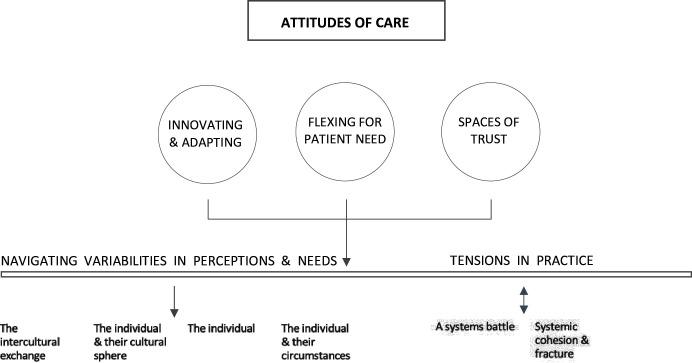
Services showed a willingness to innovate and work outside existing practice and organisational structures, including a 'microflexibility' in their interactions with patients, and through the creation of safe spaces that encouraged trust in providers. Other positive behaviours included engaging in intercultural exchange; facilitating the connection of people with their cultural sphere (eg, nationality, language) and a reflexive attitude to the individual and their broader circumstances. Social and political structures can diminish these efforts.
CONCLUSIONS
Environments that enable good health and support forced migrants to live lives of meaning are vital components of responsive care. This requires flexibility and reflexivity in practice, intercultural exchange, humility, and a commitment to communication. A broader range of caring practitioners can, and should, through intentional and interconnected communities of care, contribute to the healthcare of forced migrants. Opening up healthcare systems to include other state actors such as teachers and settlement workers and a range of non-state actors that should include community leaders and peers and private players is a key step in this process. Future work should focus on the health and health service implications of immigration practices; the inclusion of peers in a range of healthcare roles; alliance-building across unlikely collaborators and the embedding of intercultural exchange in practice.
目标
了解能够支持为被迫移民社区提供响应式医疗服务的机会和做法。
设计
对五个跨国案例进行定性研究,这些案例是积极致力于改善被迫移民社区医疗服务可及性和就医体验的服务项目,这是MORRA研究的一个部分。
背景
五个服务项目(澳大利亚、比利时、英国)提供一系列医疗服务(初级保健、健康宣传、教育与支持、全面健康筛查、护理计划/协调、跨文化心理保健)。通过州政府和非营利机构在初始和应急安置点、健康诊所及社区场所提供服务。数据收集于2022年7月至10月进行。
参与者
47名参与者,包括使用过或正在使用这五个服务项目之一的被迫移民、服务负责人、临床和非临床工作人员(带薪和志愿者)、口译员及服务合作伙伴。各服务项目协助招募了具有代表性的工作人员角色样本以及服务使用者/客户样本。参与者需能说九种语言中的一种,我们已为这九种语言翻译了研究材料。
主要结局指标
工作人员的经验、做法、知识、技能和特质;被迫移民接受服务的体验。
结果
各服务项目表现出创新意愿,并在现有实践和组织结构之外开展工作,包括在与患者互动中展现出“微观灵活性”,以及通过创建安全空间来鼓励患者信任提供者。其他积极行为包括进行跨文化交流;促进人们与自身文化领域(如国籍、语言)的联系,以及对个体及其更广泛境遇的反思态度。社会和政治结构可能会削弱这些努力。
结论
营造有利于健康并支持被迫移民过上有意义生活的环境是响应式医疗服务的重要组成部分。这需要在实践中具备灵活性和反思能力、进行跨文化交流、保持谦逊,并致力于沟通。更广泛的护理从业者能够且应该通过有意识且相互关联的护理社区,为被迫移民的医疗保健做出贡献。让医疗系统纳入其他国家行为体(如教师和安置工作人员)以及一系列非国家行为体(应包括社区领袖、同龄人及私人机构)是这一过程中的关键一步。未来的工作应聚焦于移民实践对健康和卫生服务的影响;让同龄人担任一系列医疗保健角色;在不太可能的合作伙伴之间建立联盟,以及将跨文化交流融入实践。
 Zotero 插件