
一种生物合成的烟酰胺单核苷酸类似物揭示了SARM1逐步激活导致细胞死亡和轴突退化的过程。
Stepwise activation of SARM1 for cell death and axon degeneration revealed by a biosynthetic NMN mimic.
作者信息
Huang Yinpin, Zhang Jun, Zhang Wenbin, Chen Jie, Chen Sijia, Wu Qincui, Zheng Sanduo, Wang Xiaodong
机构信息
Tsinghua Institute of Multidisciplinary Biomedical Research, Tsinghua University, Beijing 10094, China.
National Institute of Biological Sciences, Beijing 102206, China.
出版信息
Proc Natl Acad Sci U S A. 2025 Feb 25;122(8):e2424906122. doi: 10.1073/pnas.2424906122. Epub 2025 Feb 18.
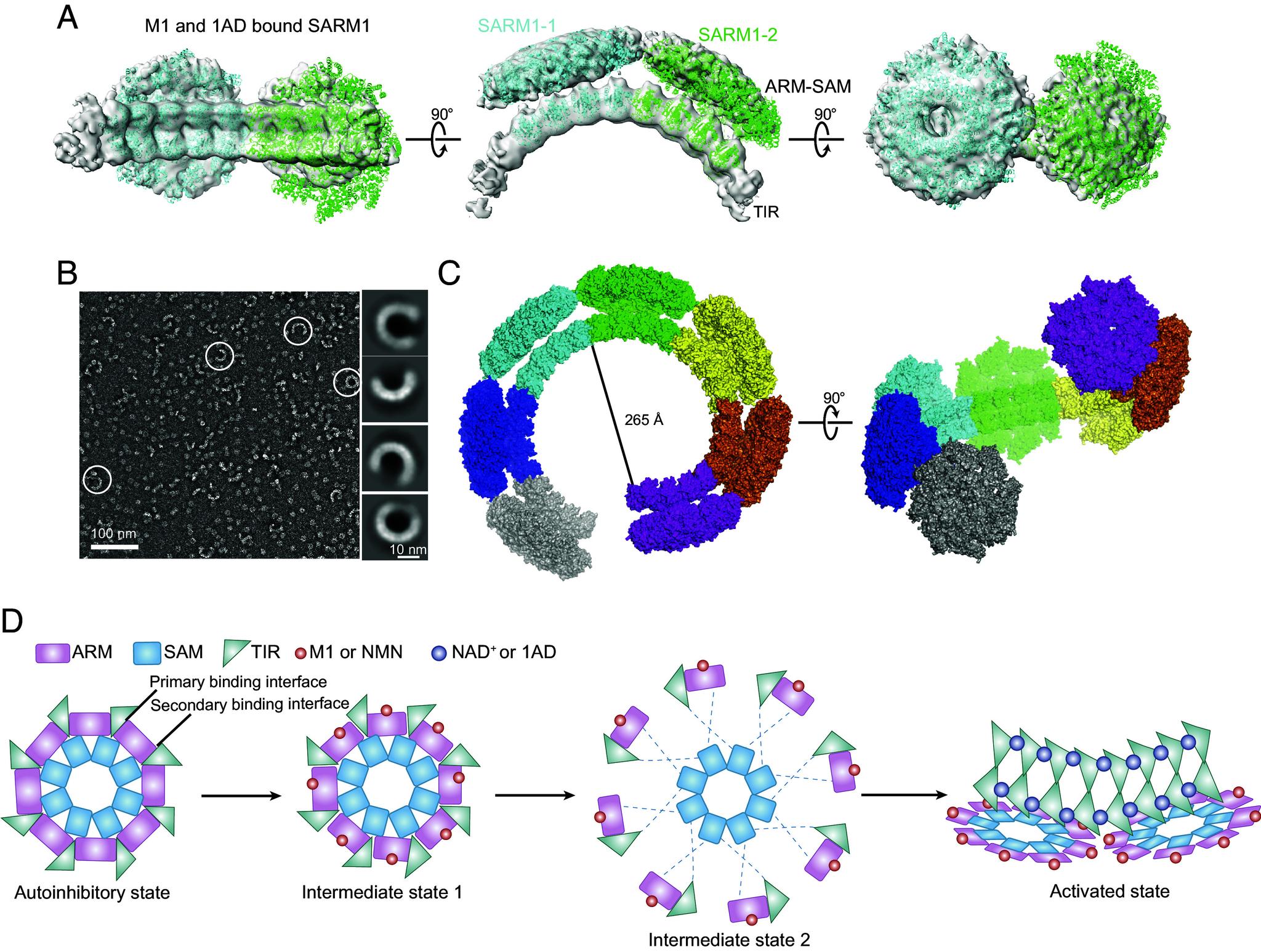
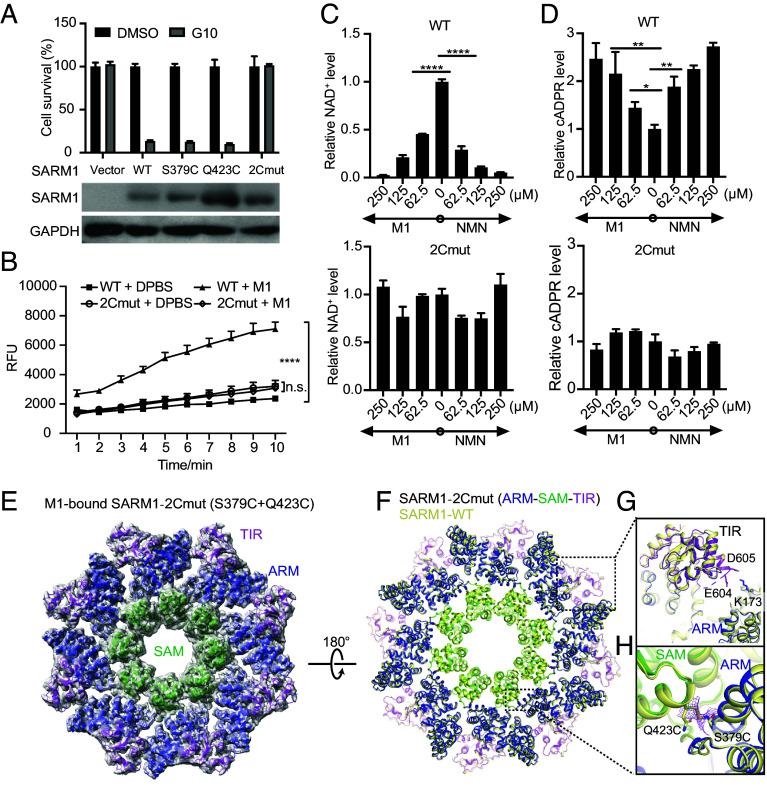
Axon degeneration, driven by the NAD hydrolyzing enzyme SARM1, is an early pathological hallmark of numerous neurodegenerative diseases. SARM1 exists in an inactive form and is activated following nerve injury. However, the precise molecular mechanism underlying SARM1 activation remains to be fully elucidated. In this study, we report the identification of a potent proactivator of SARM1, G10, which is converted into a direct activator (M1) by the enzyme nicotinamide phosphoribosyltransferase. Cryoelectron microscopy structures of SARM1 bound to M1, as well as to M1 and a nonhydrolyzable NAD analog (1AD), captured two intermediate activation states and the fully active state, revealing a stepwise mechanism of SARM1 activation. Further, introducing a disulfide bond to prevent conformational transitions between the two intermediate states mediated by M1 stabilized SARM1 in its inactive form and blocked M1-induced cell death. Together, these findings propose a sequential, stepwise activation model for SARM1 and offer a framework for developing potential SARM1 inhibitors for the treatment of neurodegenerative diseases.
由NAD水解酶SARM1驱动的轴突退化是众多神经退行性疾病的早期病理特征。SARM1以无活性形式存在,并在神经损伤后被激活。然而,SARM1激活背后的确切分子机制仍有待充分阐明。在本研究中,我们报告了一种强效的SARM1前激活剂G10的鉴定,它被烟酰胺磷酸核糖基转移酶转化为直接激活剂(M1)。与M1以及与M1和一种不可水解的NAD类似物(1AD)结合的SARM1的冷冻电镜结构捕获了两个中间激活状态和完全激活状态,揭示了SARM1激活的逐步机制。此外,引入二硫键以防止由M1介导的两个中间状态之间的构象转变,使SARM1稳定在其无活性形式并阻断M1诱导的细胞死亡。这些发现共同提出了一种SARM1的顺序、逐步激活模型,并为开发用于治疗神经退行性疾病的潜在SARM1抑制剂提供了一个框架。


 Zotero 插件