
扰乱干细胞发育:VMP1和TMEM41B在原始内胚层特化过程中调节FZD2/卷曲蛋白2的分泌。
Scrambling stem cell development: VMP1 and TMEM41B regulate FZD2/FRIZZLED2 secretion during primitive endoderm specification.
作者信息
Holzner Markus, Di Minin Giulio
机构信息
Institute of Molecular Health Sciences, Department of Biology, ETH Zurich, Zurich, Switzerland.
出版信息
Autophagy. 2025 Jun;21(6):1384-1386. doi: 10.1080/15548627.2025.2468483. Epub 2025 Feb 23.
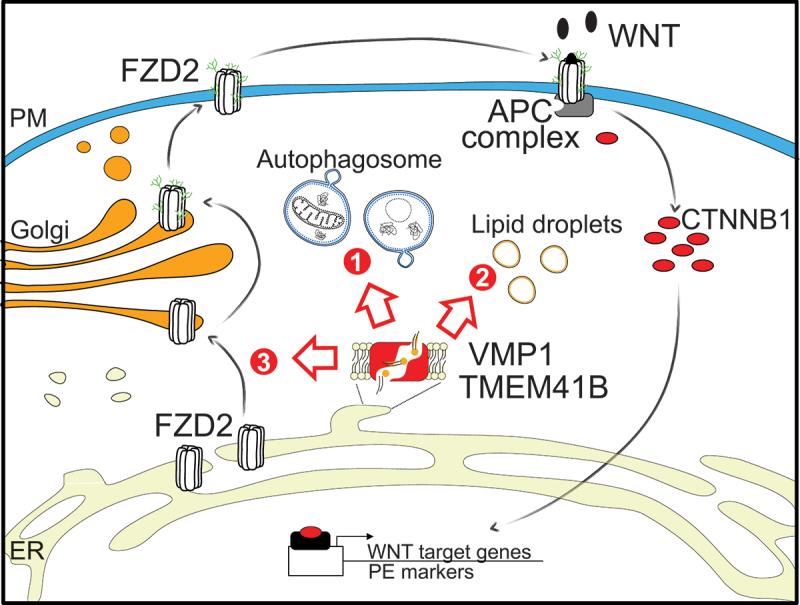
The endoplasmic reticulum (ER) is a central hub for lipid metabolism and protein secretion, crucial for maintaining cellular homeostasis and mediating environmental interactions. ER-resident proteins VMP1 and TMEM41B function as scramblases, regulating lipid membranes to support macroautophagy and lipid droplet metabolism. To explore their developmental roles, we generated and mutations in mouse embryonic stem cells (ESCs). While these mutations did not affect ESC self-renewal or pluripotency, they impaired differentiation into the primitive endoderm lineage. Our findings reveal that this defect stems from VMP1 and TMEM41B's critical role in the maturation and stability of FZD2/FRIZZLED2, essential for WNT signaling. Thus, this study highlights their extensive role in protein trafficking, linking lipid metabolism to cell signaling and deepening our understanding of their diverse contributions to cellular and developmental processes.
内质网(ER)是脂质代谢和蛋白质分泌的核心枢纽,对维持细胞内稳态和介导环境相互作用至关重要。内质网驻留蛋白VMP1和TMEM41B作为磷脂翻转酶发挥作用,调节脂质膜以支持巨自噬和脂滴代谢。为了探究它们在发育中的作用,我们在小鼠胚胎干细胞(ESC)中产生了VMP1和TMEM41B突变。虽然这些突变不影响ESC的自我更新或多能性,但它们损害了向原始内胚层谱系的分化。我们的研究结果表明,这一缺陷源于VMP1和TMEM41B在FZD2/卷曲蛋白2(WNT信号传导所必需)的成熟和稳定性中的关键作用。因此,本研究突出了它们在蛋白质运输中的广泛作用,将脂质代谢与细胞信号传导联系起来,并加深了我们对它们对细胞和发育过程的多种贡献的理解。
 Zotero 插件