
细胞外基质成分与合成自组装肽的力学性能比较
A Comparison of the Mechanical Properties of ECM Components and Synthetic Self-Assembling Peptides.
作者信息
Hartley Alex, Williams Philip Michael, Mata Alvaro
机构信息
School of Pharmacy, University of Nottingham, University Park Campus, Nottingham, NG7 2RD, UK.
Biodiscovery Institute, University of Nottingham, University Park Campus, Nottingham, NG7 2RD, UK.
出版信息
Adv Healthc Mater. 2025 Apr;14(11):e2402385. doi: 10.1002/adhm.202402385. Epub 2025 Feb 19.
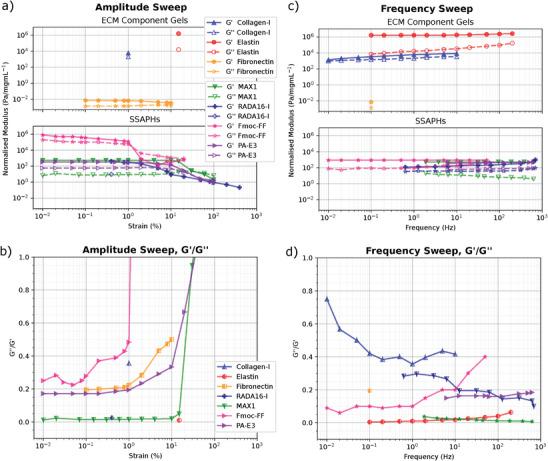
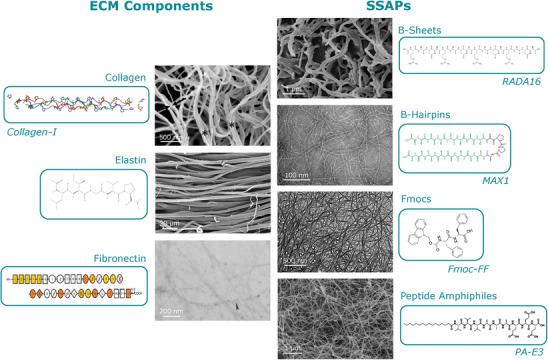
The field of tissue engineering is increasingly moving away from a one-size-fits-all approach of simple synthetic homogeneous gels, and embracing more tailored designs to optimize cell function and differentiation for the organ of interest. Extracellular matrix (ECM) proteins are still the optimal route for controlling cell function, while a field of great promise is that of synthetic self-assembling peptides (SSAPs), which are fully biocompatible, biodegradable, and offer both the hierarchical structure and dynamic properties displayed by protein networks found in natural tissue. However, the mechanical properties of neither group have been comprehensively reviewed. In this review, rheological data and the Young's modulus of the most prevalent proteins involved in the ECM (collagen I, elastin, and fibronectin) are collated for the first time, and compared against the most widely researched SSAPs: peptide amphiphiles (PAs), β-sheets, β-hairpin peptides, and Fmoc-based gels (with a focus on PA-E3, RADA16, MAX1, and FmocFF, respectively).
组织工程领域正日益摒弃简单合成均质凝胶的一刀切方法,转而采用更具针对性的设计,以优化目标器官的细胞功能和分化。细胞外基质(ECM)蛋白仍是控制细胞功能的最佳途径,而合成自组装肽(SSAPs)领域前景广阔,它们具有完全的生物相容性、可生物降解性,并且具备天然组织中蛋白质网络所展现的层级结构和动态特性。然而,这两类材料的力学性能均未得到全面综述。在本综述中,首次整理了参与ECM的最常见蛋白质(I型胶原蛋白、弹性蛋白和纤连蛋白)的流变学数据和杨氏模量,并与研究最广泛的SSAPs进行比较:肽两亲分子(PAs)、β折叠、β发夹肽和基于芴甲氧羰基的凝胶(分别重点关注PA-E3、RADA16、MAX1和FmocFF)。

 Zotero 插件