
一项基于中医治疗糖尿病视网膜病变系统评价的证据图谱研究。
An evidence mapping study based on systematic reviews of traditional Chinese medicine (TCM) for diabetic retinopathy.
作者信息
Ling Juan, Xie ZhuoLin, Luo XiangXia, Hu Mei, Glujovsky Demián, Zhuang JiaYuan, Wang Yan, Zhou Jun, HongYong Deng
机构信息
Clinical College of Chinese Medicine, Gansu University of Chinese Medicine, Lanzhou, Gansu Province, 730030, China.
Gansu Provincial Hospital, Lanzhou, 730030, China.
出版信息
Syst Rev. 2025 Feb 20;14(1):45. doi: 10.1186/s13643-025-02755-w.
BACKGROUND
Diabetic retinopathy (DR) is a leading cause of vision impairment and blindness among individuals with diabetes. Traditional Chinese medicine (TCM) has been explored as an alternative treatment for DR, but the quality of evidence remains uncertain. A comprehensive evidence mapping study is necessary to synthesize existing SRs, identify gaps in the literature, and highlight areas requiring further research.
OBJECTIVE
This study aims to evaluate the reporting and methodological quality of SRs on TCM for DR and to assess the effectiveness of TCM interventions using an evidence-mapping approach.
METHODS
A comprehensive search of major biomedical databases to identify relevant SRs published up to November 2023. The reporting quality of the included SRs was assessed using the Preferred Reporting Items for Systematic Reviews and Meta-Analyses (PRISMA) guidelines, while the methodological quality was evaluated using the Assessment of Multiple Systematic Reviews 2 (AMSTAR 2) tool.
RESULTS
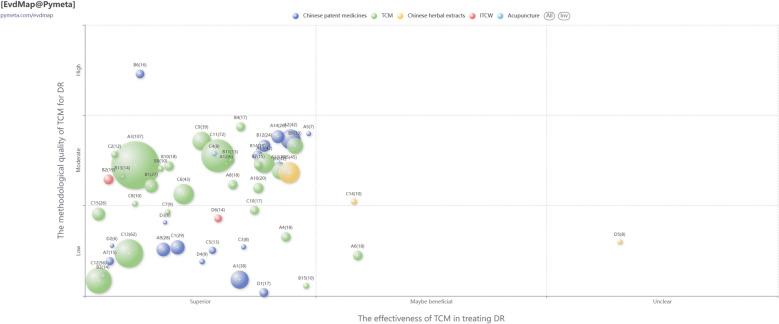
A total of 51 SRs involving 131,084 participants were included in the analysis. Evidence mapping indicated that TCM is relatively effective in treating DR. However, the methodological quality and reporting standards of these SRs were generally suboptimal. According to the AMSTAR 2 assessment, only one SR (2%) was rated as high quality, 29 SRs (56.9%) were of moderate quality, 20 SRs (39.2%) were of low quality, and one SR (2%) was of critically low quality. While all studies adequately reported the PICO components, risk of bias assessment, and statistical methods, none provided information on funding sources. Furthermore, only one study (2%) included a list of excluded studies with reasons, and eight SRs (15.7%) documented pre-specified protocols. Common reporting deficiencies included incomplete protocol and registration details, unclear review rationales, and insufficient presentation of relevant outcome data.
CONCLUSION
This evidence mapping study highlights the potential benefits of TCM for treating DR while identifying significant gaps in the existing literature. Although TCM interventions show potential benefits for treating DR, the overall quality of SRs is suboptimal. Future research should focus on addressing these gaps, particularly in areas such as funding disclosure and methodological rigor, to enhance the reliability of evidence on TCM interventions for DR.
背景
糖尿病视网膜病变(DR)是糖尿病患者视力损害和失明的主要原因。中医已被探索作为DR的替代治疗方法,但证据质量仍不确定。有必要进行一项全面的证据图谱研究,以综合现有系统评价(SRs)、识别文献中的空白,并突出需要进一步研究的领域。
目的
本研究旨在评估关于中医治疗DR的SRs的报告质量和方法学质量,并使用证据图谱方法评估中医干预措施的有效性。
方法
全面检索主要生物医学数据库,以识别截至2023年11月发表的相关SRs。使用系统评价和Meta分析的首选报告项目(PRISMA)指南评估纳入的SRs的报告质量,同时使用多重系统评价评估2(AMSTAR 2)工具评估方法学质量。
结果
分析共纳入51项SRs,涉及131,084名参与者。证据图谱表明,中医在治疗DR方面相对有效。然而,这些SRs的方法学质量和报告标准总体上并不理想。根据AMSTAR 2评估,只有1项SR(2%)被评为高质量,29项SR(56.9%)为中等质量,20项SR(39.2%)为低质量,1项SR(2%)为极低质量。虽然所有研究都充分报告了PICO成分、偏倚风险评估和统计方法,但均未提供资金来源信息。此外,只有1项研究(2%)列出了排除研究及其原因,8项SR(15.7%)记录了预先指定的方案。常见的报告缺陷包括方案和注册细节不完整、综述理由不明确以及相关结局数据呈现不足。
结论
这项证据图谱研究突出了中医治疗DR的潜在益处,同时识别了现有文献中的重大空白。虽然中医干预措施显示出治疗DR的潜在益处,但SRs的总体质量并不理想。未来的研究应专注于弥补这些空白,特别是在资金披露和方法学严谨性等领域,以提高中医治疗DR证据的可靠性。


 Zotero 插件