
中药辅助治疗重症肺炎的疗效与安全性:随机对照试验、系统评价和荟萃分析的证据图谱
Efficacy and safety of traditional Chinese medicine adjuvant therapy for severe pneumonia: evidence mapping of the randomized controlled trials, systematic reviews, and meta-analyses.
作者信息
Xie Kai, Guan Shengnan, Jing Hui, Ji Wenshuai, Kong Xinxin, Du Shen, Jia Mingyan, Wang Haifeng
机构信息
Department of Respiratory Medicine, The First Affiliated Hospital of Henan University of Traditional Chinese Medicine, Zhengzhou, China.
Academy of Chinese Medical Sciences, Henan University of Chinese Medicine, Zhengzhou, China.
出版信息
Front Pharmacol. 2023 Sep 29;14:1227436. doi: 10.3389/fphar.2023.1227436. eCollection 2023.
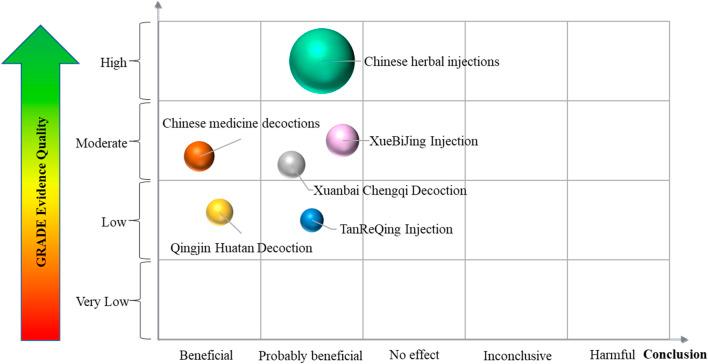
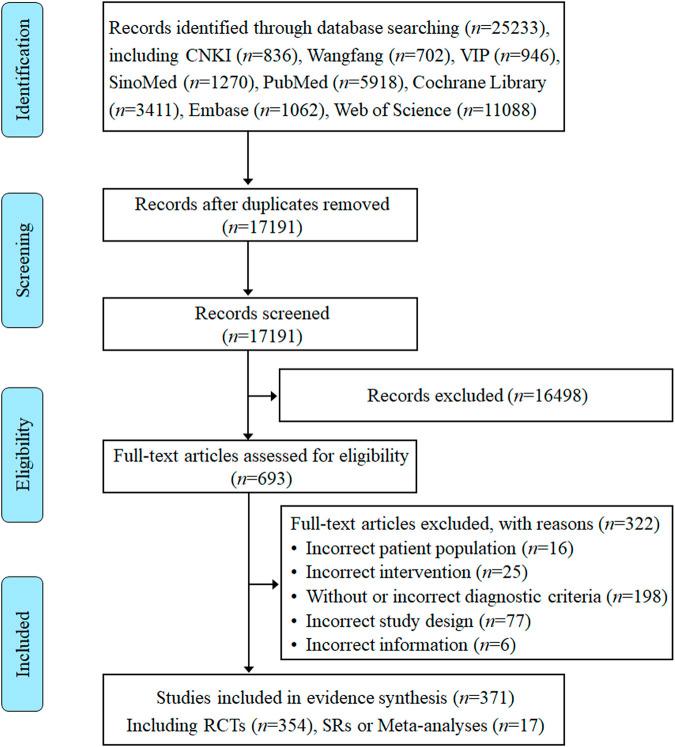
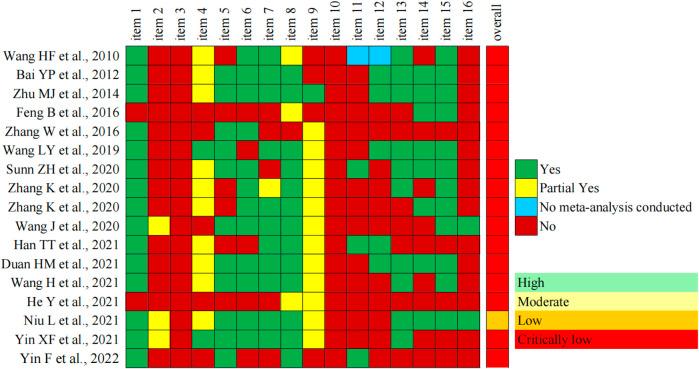
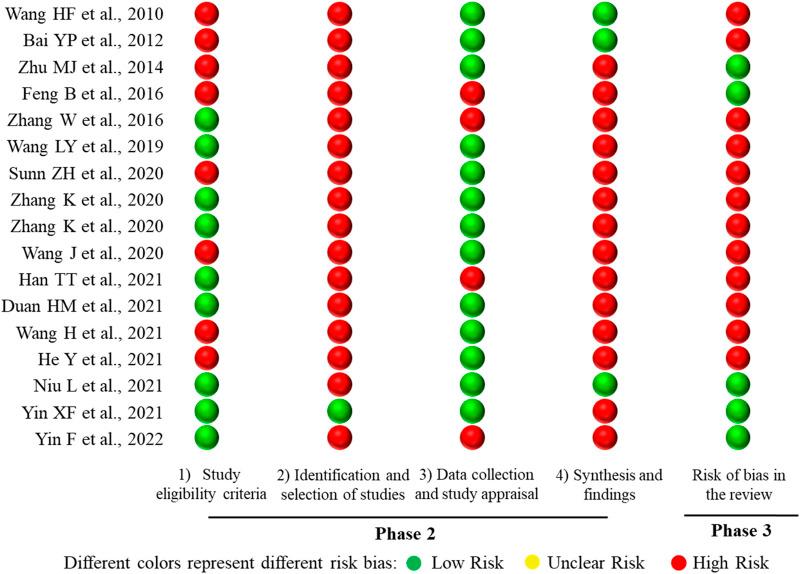
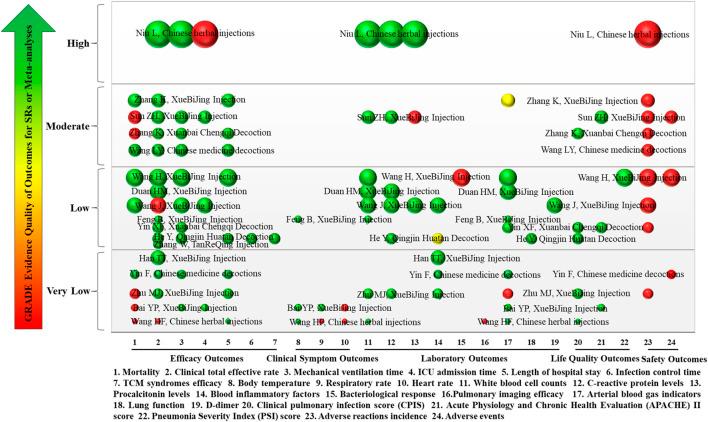
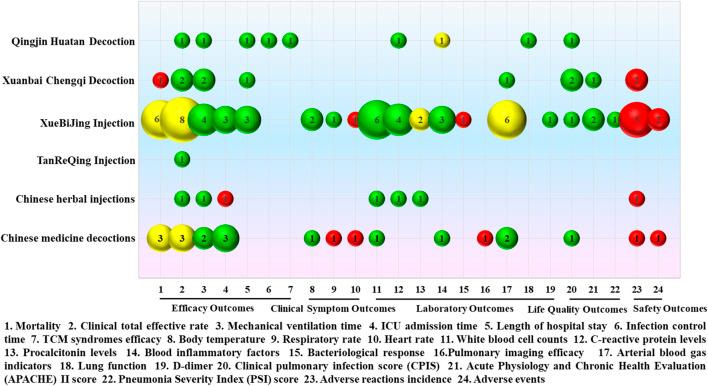
Severe pneumonia is a critical respiratory disease with high mortality. There is insufficient evidence on the efficacy and safety of traditional Chinese medicine (TCM) adjuvant therapy for severe pneumonia. This study aims to identify, describe, assess, and summarize the currently available high-quality design evidence on TCM adjuvant therapy for severe pneumonia to identify evidence gaps using the evidence mapping approach. Systematic searches were performed on English and Chinese online databases (PubMed, EMBASE, Cochrane Library, Web of Science, CNKI, WanFang Data, CQVIP, and SinoMed) to identify papers from inception until August 2023 for inclusion into the review. Randomized controlled trials (RCTs), systematic reviews (SRs), and meta-analyses concerning TCM adjuvant therapy for severe pneumonia or its complications in adults were included. The risk of bias in RCTs was evaluated by using the ROB tool. The Assessment of Multiple Systematic Reviews 2 (AMSTAR-2), the Risk of Bias in Systematic Review (ROBIS) tool, and the Grading of Recommendations Assessment, Development and Evaluation (GRADE) system were used to assess the methodological quality, risk of bias, and evidence quality of SRs or meta-analyses, respectively. Then, a bubble plot was designed to visually display information in four dimensions. A total of 354 RCTs and 17 SRs or meta-analyses met the inclusion criteria. The published RCTs had several flaws, such as unreasonable design, limited sample size, insufficient attention to non-drug therapy studies and syndrome differentiation, improper selection or use of outcome indicators, and failure to provide high-quality evidence. Sixteen SRs or meta-analyses of methodological quality scored "Critically Low" confidence. Twelve SRs or meta-analyses were rated as "High Risk." Most outcomes were rated as "Low" evidence quality. We found that TCM combined with conventional treatment could improve the clinical total effective rate and the TCM syndromes efficacy. The combined approach could also shorten mechanical ventilation time, infection control time, and length of hospital and ICU stay; significantly reduce temperature, respiratory rate, heart rate, white blood cell counts, levels of C-reactive protein, procalcitonin, blood inflammatory factors, bacteriological response, and D-dimer; decrease CPIS, APACHE II score, and PSI score; improve pulmonary imaging features, arterial blood gas indicators (including arterial oxygen pressure, arterial oxygen saturation, and oxygen index), and lung function (including forced vital capacity and forced expiratory volume in the first second) for severe pneumonia compared with conventional treatment only ( < 0.05). There was no significant difference in adverse reactions and incidence of adverse events ( > 0.05). In addition, compared with conventional treatment only, most SRs or meta-analyses concluded that TCM combined with conventional treatment was "Beneficial" or "Probably beneficial." TCM combined with conventional treatment had advantages in efficacy, clinical signs, laboratory results, and life quality outcomes of severe pneumonia, with no difference in safety outcomes compared with conventional treatment only. QingJin Huatan decoction is the most promising target, and Xuanbai Chengqi decoction has a "Probably beneficial" conclusion. XueBiJing injection and TanReQing injection are two commonly used Chinese herbal injections for treating severe pneumonia, and both are "Probably beneficial." However, there was a need for multicenter RCTs with large sample sizes and high methodological quality in the future. In addition, the methodological design and quality of SRs or meta-analyses should be improved to form high-quality, evidence-based medical evidence and provide evidence for the effectiveness and safety of TCM adjuvant therapy for severe pneumonia.
重症肺炎是一种死亡率很高的严重呼吸系统疾病。关于中药辅助治疗重症肺炎的疗效和安全性,证据尚不充分。本研究旨在识别、描述、评估和总结目前可获得的关于中药辅助治疗重症肺炎的高质量设计证据,采用证据图谱法识别证据空白。我们对英文和中文在线数据库(PubMed、EMBASE、Cochrane图书馆、Web of Science、中国知网、万方数据、维普资讯和中国生物医学文献数据库)进行了系统检索,以识别从建库至2023年8月的论文纳入综述。纳入了关于成人重症肺炎或其并发症的中药辅助治疗的随机对照试验(RCT)、系统评价(SR)和Meta分析。采用ROB工具评估RCT中的偏倚风险。分别使用多重系统评价评估2(AMSTAR-2)、系统评价中的偏倚风险(ROBIS)工具和推荐分级评估、制定与评价(GRADE)系统评估SR或Meta分析的方法学质量、偏倚风险和证据质量。然后,设计了一个气泡图以直观地展示四个维度的信息。共有354项RCT以及17项SR或Meta分析符合纳入标准。已发表的RCT存在一些缺陷,如设计不合理、样本量有限、对非药物治疗研究和辨证论治关注不足、结局指标选择或使用不当,以及未能提供高质量证据。16项方法学质量的SR或Meta分析得分为“极低”置信度。12项SR或Meta分析被评为“高风险”。大多数结局的证据质量被评为“低”。我们发现,中药联合常规治疗可提高临床总有效率和中医证候疗效。联合治疗还可缩短机械通气时间、感染控制时间以及住院和入住重症监护病房的时间;显著降低体温、呼吸频率、心率、白细胞计数、C反应蛋白、降钙素原、血液炎症因子、细菌学反应和D-二聚体水平;降低临床肺部感染评分(CPIS)、急性生理与慢性健康状况评分系统II(APACHE II)评分和肺炎严重指数(PSI)评分;与单纯常规治疗相比,改善重症肺炎的肺部影像学特征、动脉血气指标(包括动脉血氧分压、动脉血氧饱和度和氧合指数)以及肺功能(包括用力肺活量和第1秒用力呼气量)(P<0.05)。不良反应和不良事件发生率无显著差异(P>0.05)。此外,与单纯常规治疗相比,大多数SR或Meta分析得出结论,中药联合常规治疗是“有益的”或“可能有益的”。中药联合常规治疗在重症肺炎的疗效、临床体征、实验室检查结果和生活质量结局方面具有优势,与单纯常规治疗相比,安全性结局无差异。清气化痰汤是最有前景的靶点,宣白承气汤有“可能有益”的结论。血必净注射液和痰热清注射液是治疗重症肺炎常用的两种中药注射剂,两者均“可能有益”。然而,未来需要开展大样本量、高方法学质量的多中心RCT。此外,应提高SR或Meta分析的方法学设计和质量,以形成高质量的循证医学证据,为中药辅助治疗重症肺炎的有效性和安全性提供证据。



 Zotero 插件