
用于人乳头瘤病毒检测的自行采集阴道样本:持久共识宫颈癌筛查与管理指南委员会的建议
Self-Collected Vaginal Specimens for HPV Testing: Recommendations From the Enduring Consensus Cervical Cancer Screening and Management Guidelines Committee.
作者信息
Wentzensen Nicolas, Massad L Stewart, Clarke Megan A, Garcia Francisco, Smith Robert, Murphy Jeanne, Guido Richard, Reyes Ana, Phillips Sarah, Berman Nancy, Quinlan Jeffrey, Lind Eileen, Perkins Rebecca B
机构信息
Division of Cancer Epidemiology & Genetics, National Cancer Institute, Rockville, MD.
Division of Gynecologic Oncology, Washington University School of Medicine, St. Louis, MO.
出版信息
J Low Genit Tract Dis. 2025 Apr 1;29(2):144-152. doi: 10.1097/LGT.0000000000000885. Epub 2025 Feb 21.
OBJECTIVE
The Enduring Consensus Cervical Cancer Screening and Management Guidelines Committee developed recommendations for the use of self-collected vaginal specimens for human papillomavirus (HPV) testing in health care settings.
METHODS
A comprehensive literature search was performed, external systematic reviews were evaluated, and HPV genotype agreement between self-collected vaginal and clinician-collected cervical specimens was summarized. Recommendations considered available data, public comments, and expert consensus. Recommendations were ratified through a vote by the Consensus Stakeholder Group.
RESULTS
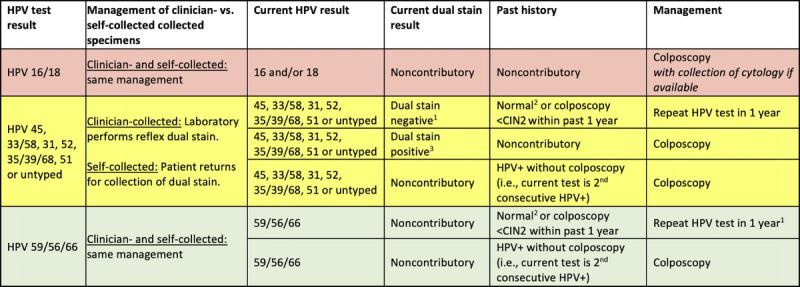
Clinician-collected cervical specimens are preferred and self-collected vaginal specimens are acceptable for primary HPV screening of asymptomatic average-risk individuals. Repeat testing in 3 years is recommended following HPV-negative screens using self-collected vaginal specimens. Colposcopy with collection of cytology and biopsies is recommended following positive tests for HPV types 16 and 18. Clinician-collected cytology or dual stain for triage testing is recommended following positive tests for HPV 45, 33/58, 31, 52, 35/39/68, or 51 or for pooled HPV other types but negative for HPV 16 or 18. Repeat HPV testing in 1 year is recommended following a positive test for HPV types 56/59/66 and no other carcinogenic types. Minimal data exist on use of self-collected vaginal specimens for surveillance following abnormal screening test results, colposcopy or treatment, and therefore, clinician-collected cervical specimens are preferred.
CONCLUSIONS
Human papillomavirus testing of self-collected vaginal specimens expands cervical cancer screening options and has potential to increase access for currently underscreened individuals. Laboratory and clinical workflows will need to be modified to ensure adequate specimen processing and follow-up.
目的
持久共识宫颈癌筛查与管理指南委员会制定了关于在医疗机构中使用自我采集的阴道标本进行人乳头瘤病毒(HPV)检测的建议。
方法
进行了全面的文献检索,评估了外部系统评价,并总结了自我采集的阴道标本与临床医生采集的宫颈标本之间的HPV基因型一致性。建议考虑了现有数据、公众意见和专家共识。建议经共识利益相关者小组投票批准。
结果
对于无症状的平均风险个体进行初次HPV筛查,临床医生采集的宫颈标本为首选,自我采集的阴道标本也可接受。使用自我采集的阴道标本进行HPV阴性筛查后,建议3年后重复检测。HPV 16和18型检测呈阳性后,建议进行阴道镜检查并采集细胞学和活检样本。HPV 45、33/58、31、52、35/39/68或51型检测呈阳性,或混合HPV其他类型检测呈阳性但HPV 16或18型检测呈阴性时,建议采用临床医生采集的细胞学或双重染色进行分流检测。HPV 56/59/66型检测呈阳性且无其他致癌类型时,建议1年后重复进行HPV检测。关于在异常筛查结果、阴道镜检查或治疗后使用自我采集的阴道标本进行监测的数据极少,因此,临床医生采集的宫颈标本为首选。
结论
自我采集阴道标本进行HPV检测扩展了宫颈癌筛查选项,有可能增加目前筛查不足人群的筛查机会。需要修改实验室和临床工作流程,以确保标本得到充分处理和后续跟进。

 Zotero 插件