
人乳头瘤病毒(HPV)检测在尿液和阴道自我样本与临床医生收集的宫颈样本比较在转介行阴道镜检查的女性中的准确性。
Accuracy of Human Papillomavirus (HPV) Testing on Urine and Vaginal Self-Samples Compared to Clinician-Collected Cervical Sample in Women Referred to Colposcopy.
机构信息
Department of Medicine and Surgery, University of Milano-Bicocca, 20900 Monza, Italy.
IRCCS San Gerardo dei Tintori, 20900 Monza, Italy.
出版信息
Viruses. 2023 Sep 7;15(9):1889. doi: 10.3390/v15091889.
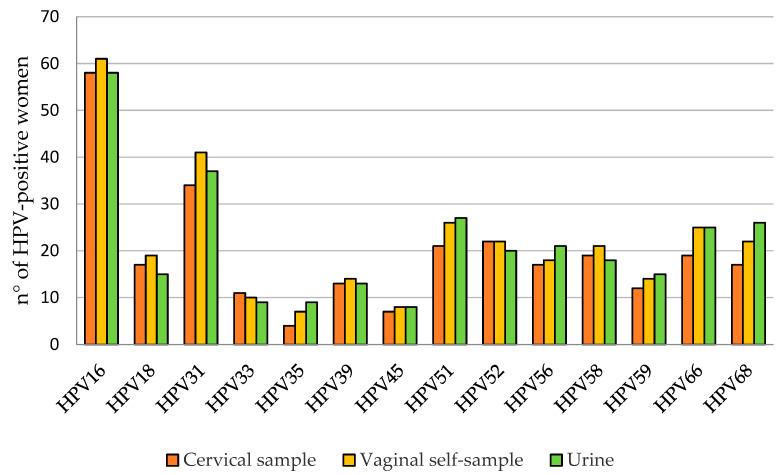
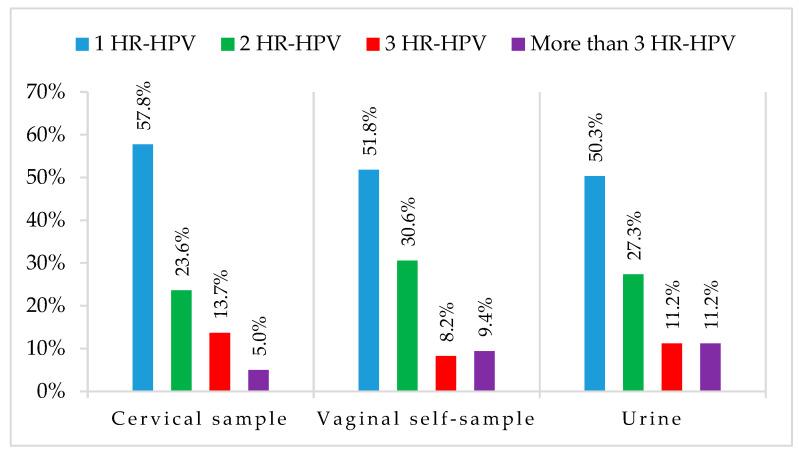
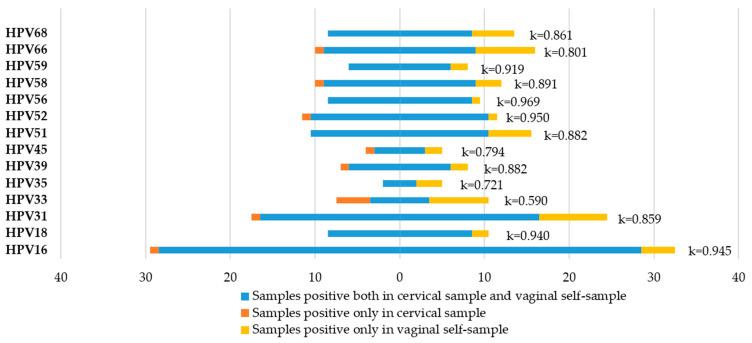
In the context of cervical cancer prevention, where human papillomavirus (HPV) infection is pivotal, HPV testing is replacing Pap Smear in primary screening. This transition offers an opportunity for integrating self-sampling to enhance coverage. We evaluated the accuracy of HPV testing using self-collected urine and vaginal samples, comparing them to physician-collected cervical swabs. From a cohort of 245 women with abnormal cytology, we collected self-sampled vaginal, urine, and clinician-administered cervical specimens. Employing Anyplex™II HPV28 assay, outcomes revealed HPV positivity rates of 75.1% (cervical), 78.4% (vaginal), and 77.1% (urine). Significant, hr-HPV detection concordance was observed between self-taken cervical samples and clinical counterparts (k = 0.898 for vaginal; k = 0.715 for urine). This study extends beyond accuracy, highlighting self-collected sample efficacy in detecting high-grade cervical lesions. The insight underscores self-sampling's role in bolstering participation and aligns with WHO's goal to eliminate cervical cancer by 2030.
在宫颈癌预防中,人乳头瘤病毒(HPV)感染至关重要,HPV 检测正在取代巴氏涂片法成为初级筛查手段。这一转变为整合自我采样以提高覆盖率提供了机会。我们评估了使用自我采集的尿液和阴道样本进行 HPV 检测的准确性,并将其与医生采集的宫颈拭子进行了比较。在一个细胞学异常的 245 名女性队列中,我们采集了自我采集的阴道、尿液和临床医生管理的宫颈样本。采用 Anyplex™II HPV28 检测,结果显示 HPV 阳性率分别为宫颈 75.1%、阴道 78.4%和尿液 77.1%。自我采集的宫颈样本与临床样本之间存在显著的 HR-HPV 检测一致性(阴道 k = 0.898;尿液 k = 0.715)。本研究不仅关注准确性,还强调了自我采集样本在检测高级别宫颈病变方面的效果。这一发现突出了自我采样在提高参与度方面的作用,符合世界卫生组织到 2030 年消除宫颈癌的目标。



 Zotero 插件