
在4000名中国成年人中,通过两种基于亲和性的平台对2168种血浆蛋白进行的比较研究。
Comparative studies of 2168 plasma proteins measured by two affinity-based platforms in 4000 Chinese adults.
作者信息
Wang Baihan, Pozarickij Alfred, Mazidi Mohsen, Wright Neil, Yao Pang, Said Saredo, Iona Andri, Kartsonaki Christiana, Fry Hannah, Lin Kuang, Chen Yiping, Du Huaidong, Avery Daniel, Schmidt-Valle Dan, Yu Canqing, Sun Dianjianyi, Lv Jun, Hill Michael, Li Liming, Bennett Derrick A, Collins Rory, Walters Robin G, Clarke Robert, Millwood Iona Y, Chen Zhengming
机构信息
Clinical Trial Service Unit, Nuffield Department of Population Health, University of Oxford, Oxford, UK.
Department of Epidemiology & Biostatistics, School of Public Health, Peking University, Beijing, China.
出版信息
Nat Commun. 2025 Feb 21;16(1):1869. doi: 10.1038/s41467-025-56935-2.
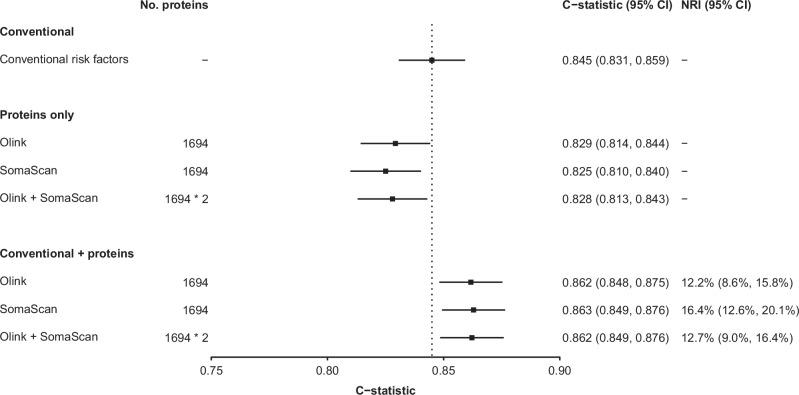
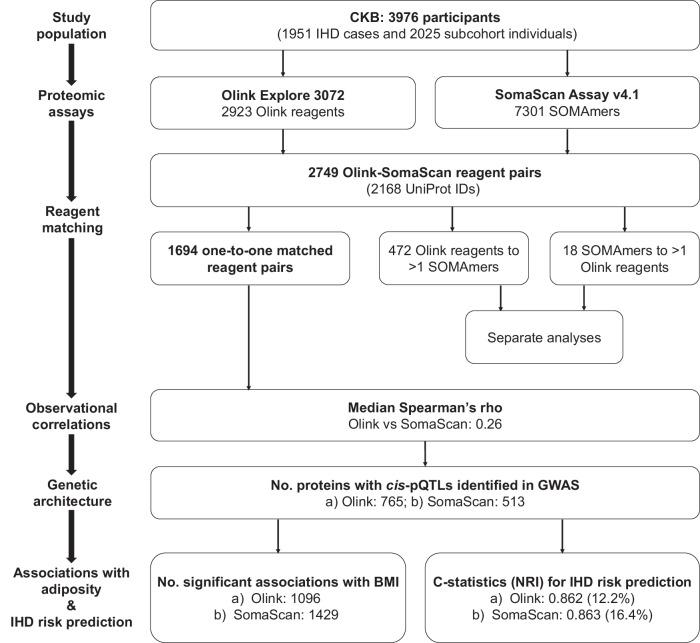
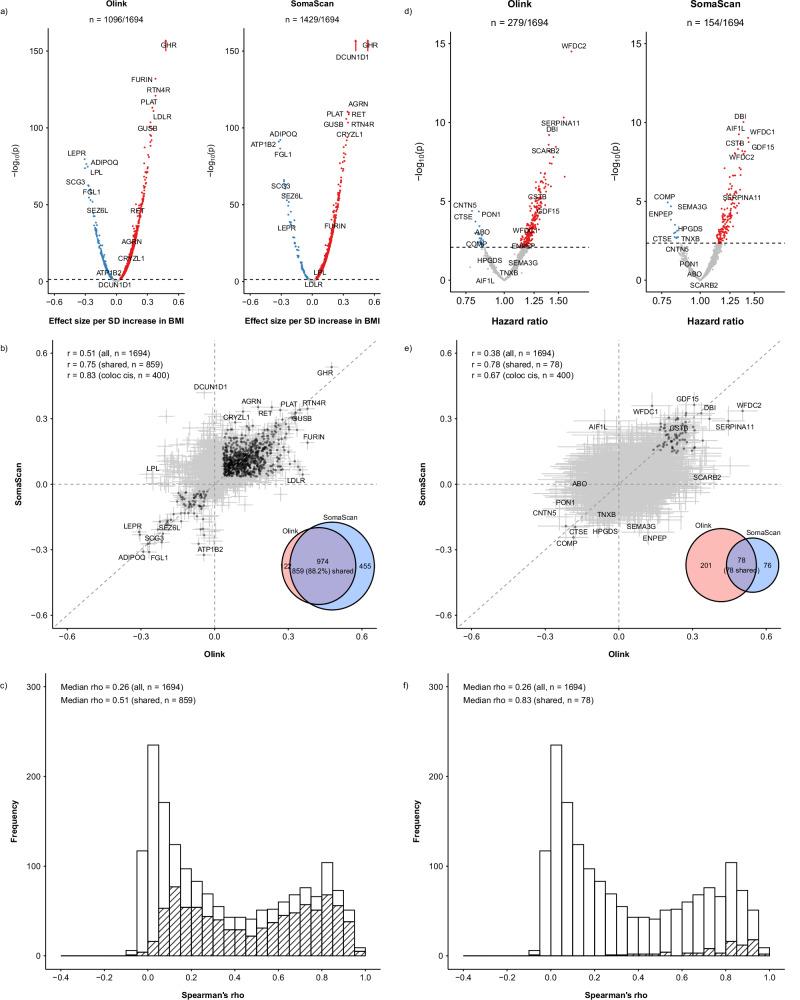
Proteomics offers unique insights into human biology and drug development, but few studies have directly compared the utility of different proteomics platforms. We measured plasma levels of 2168 proteins in 3976 Chinese adults using both Olink Explore and SomaScan platforms. The correlation of protein levels between platforms was modest (median rho = 0.29), with protein abundance and data quality parameters being key factors influencing correlation. For 1694 proteins with one-to-one matched reagents, 765 Olink and 513 SomaScan proteins had cis-pQTLs, including 400 with colocalising cis-pQTLs. Moreover, 1096 Olink and 1429 SomaScan proteins were associated with BMI, while 279 and 154 proteins were associated with risk of ischaemic heart disease, respectively. Addition of Olink and SomaScan proteins to conventional risk factors for ischaemic heart disease improved C-statistics from 0.845 to 0.862 (NRI: 12.2%) and 0.863 (NRI: 16.4%), respectively. These results demonstrate the utility of these platforms and could inform the design and interpretation of future studies.
蛋白质组学为人类生物学和药物开发提供了独特的见解,但很少有研究直接比较不同蛋白质组学平台的效用。我们使用Olink Explore和SomaScan平台测量了3976名中国成年人血浆中2168种蛋白质的水平。平台间蛋白质水平的相关性一般(中位数rho = 0.29),蛋白质丰度和数据质量参数是影响相关性的关键因素。对于1694种具有一对一匹配试剂的蛋白质,765种Olink蛋白质和513种SomaScan蛋白质具有顺式pQTL,其中400种具有共定位的顺式pQTL。此外,1096种Olink蛋白质和1429种SomaScan蛋白质与体重指数相关,而分别有279种和154种蛋白质与缺血性心脏病风险相关。将Olink和SomaScan蛋白质添加到缺血性心脏病的传统风险因素中,C统计量分别从0.845提高到0.862(净重新分类改善率:12.2%)和0.863(净重新分类改善率:16.4%)。这些结果证明了这些平台的效用,并可为未来研究的设计和解释提供参考。

 Zotero 插件