
通过针对性补充营养,在代谢性减肥手术后五年提高营养健康水平和患者满意度。
Enhancing nutritional health and patient satisfaction five years after metabolic bariatric surgery with targeted supplementation.
作者信息
Gorini Stefania, Camajani Elisabetta, Franchi Arianna, Cava Edda, Gentileschi Paolo, Bellia Alfonso, Karav Sercan, Sbraccia Paolo, Caprio Massimiliano, Lombardo Mauro
机构信息
Department for the Promotion of Human Science and Quality of Life, San Raffaele Open University, Rome, Italy.
Laboratory of Cardiovascular Endocrinology, IRCCS San Raffaele Pisana, Rome, Italy.
出版信息
J Transl Med. 2025 Feb 21;23(1):216. doi: 10.1186/s12967-025-06224-9.
BACKGROUND
This study analyzes the long-term outcomes of metabolic bariatric surgery (MBS), focusing on weight loss, nutritional deficiencies, and patient satisfaction. We evaluate different surgical techniques to identify their impact on these outcomes.
METHODS
A five-year retrospective analysis was conducted on 249 patients who underwent MBS at a specialized center. Baseline characteristics included an average age of 38.5 years, weight of 118.5 kg, and BMI of 43.2 kg/m². Weight loss outcomes were assessed using mean excess weight loss (%EWL) at 60 months. Surgical techniques included laparoscopic sleeve gastrectomy (LSG), one anastomosis gastric bypass (OAGB), and Roux-en-Y gastric bypass (RYGB). Nutritional deficiencies and patient-reported quality of life were also evaluated.
RESULTS
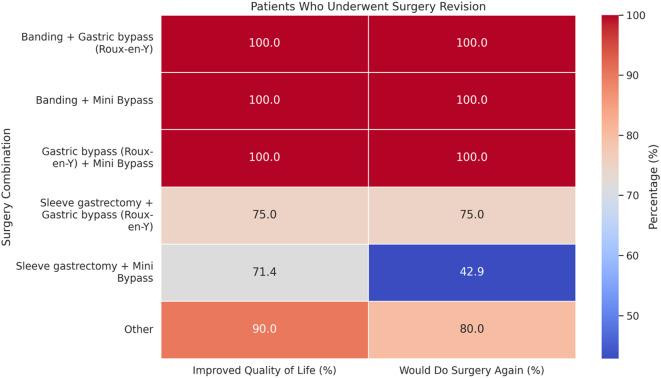
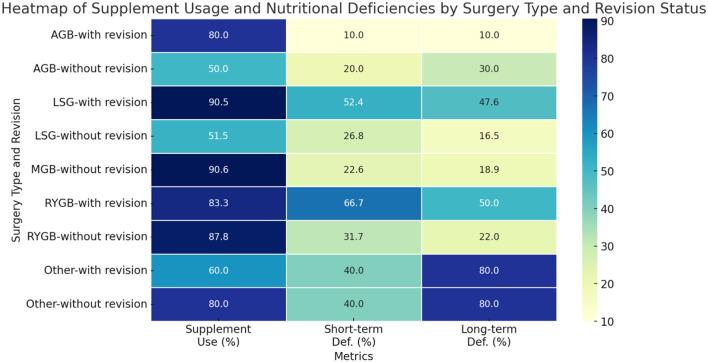
The mean %EWL at 60 months was 92.1% ± 25.8% (p = 0.013). While LSG and OAGB showed similar weight loss patterns, RYGB resulted in further weight reduction from the third year onwards. Patients revised from LSG to RYGB had significantly greater weight loss (102.1%) compared to those revised to mini-gastric bypass (MGB) (84.6%, p < 0.05). Nutritional deficiencies were prevalent, with 41.2% of revised LSG patients experiencing iron deficiency and 14.3% developing new vitamin D deficiencies (p < 0.05). Most patients (85%) reported improvements in quality of life, and 85% expressed a willingness to undergo surgery again (p = 0.0028).
CONCLUSIONS
MBS resulted in substantial and sustained weight loss, particularly in RYGB patients. Surgical revisions, especially from LSG to RYGB, were associated with greater weight loss but also increased nutritional risks. Persistent iron and vitamin D deficiencies highlight the necessity of individualized supplementation and long-term monitoring. Type-targeted supplementation represents an innovative approach to optimizing long-term nutritional support in bariatric patients. Future studies with larger cohorts and validated tools are needed to confirm these findings and strengthen clinical guidelines.
TRIAL REGISTRATION
This study is registered at ClinicalTrials.gov (NCT06664580).
背景
本研究分析了代谢性减重手术(MBS)的长期疗效,重点关注体重减轻、营养缺乏和患者满意度。我们评估了不同的手术技术,以确定它们对这些疗效的影响。
方法
对在一家专业中心接受MBS的249例患者进行了为期五年的回顾性分析。基线特征包括平均年龄38.5岁、体重118.5千克和体重指数43.2千克/平方米。使用60个月时的平均超重减轻百分比(%EWL)评估体重减轻疗效。手术技术包括腹腔镜袖状胃切除术(LSG)、单吻合口胃旁路术(OAGB)和Roux-en-Y胃旁路术(RYGB)。还评估了营养缺乏情况和患者报告的生活质量。
结果
60个月时的平均%EWL为92.1%±25.8%(p = 0.013)。虽然LSG和OAGB显示出相似的体重减轻模式,但RYGB从第三年起导致进一步的体重减轻。从LSG改为RYGB的患者比改为迷你胃旁路术(MGB)的患者体重减轻显著更多(102.1%对84.6%,p < 0.05)。营养缺乏很普遍,41.2%的接受LSG手术的患者出现缺铁,14.3%出现新的维生素D缺乏(p < 0.05)。大多数患者(85%)报告生活质量有所改善,85%表示愿意再次接受手术(p = 0.0028)。
结论
MBS导致了显著且持续的体重减轻,尤其是RYGB患者。手术修正,特别是从LSG改为RYGB,与更大程度的体重减轻相关,但也增加了营养风险。持续的铁和维生素D缺乏凸显了个体化补充和长期监测的必要性。针对类型的补充是优化肥胖症患者长期营养支持的一种创新方法。需要进行更大样本量和使用经过验证工具的未来研究来证实这些发现并加强临床指南。
试验注册
本研究已在ClinicalTrials.gov注册(NCT06664580)。


 Zotero 插件