
机械化学触发的铁-生物质复合材料受限配位,用于在近中性pH条件下通过加速电子提取高效还原Cr(VI)
Mechanochemical-Triggered Confined Coordination of Iron-Biomass Composites for Efficient Cr(VI) Reduction Under Circumneutral pH Via Accelerated Electron Extraction.
作者信息
Wang Yue, Li Hongyu, Liu Hao, Hou Chengsi, Zhou Zhengwei, Peng Shuai, Chen Zuofeng, Lei Zhendong, Wu Deli
机构信息
State Key Laboratory of Pollution Control and Resources Reuse, College of Environmental Science & Engineering, Tongji University, Shanghai, 200092, P. R. China.
School of Chemical Science and Engineering, Tongji University, Shanghai, 200092, P. R. China.
出版信息
Adv Sci (Weinh). 2025 Apr;12(15):e2417368. doi: 10.1002/advs.202417368. Epub 2025 Feb 24.
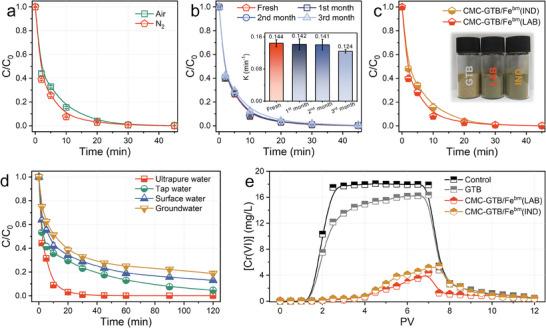
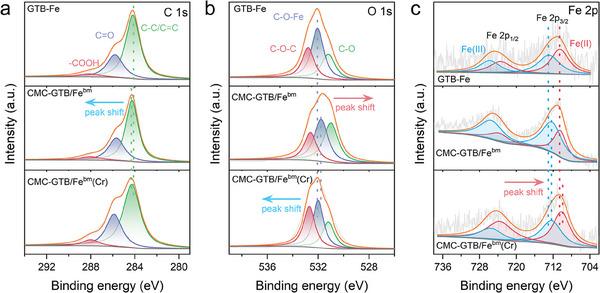
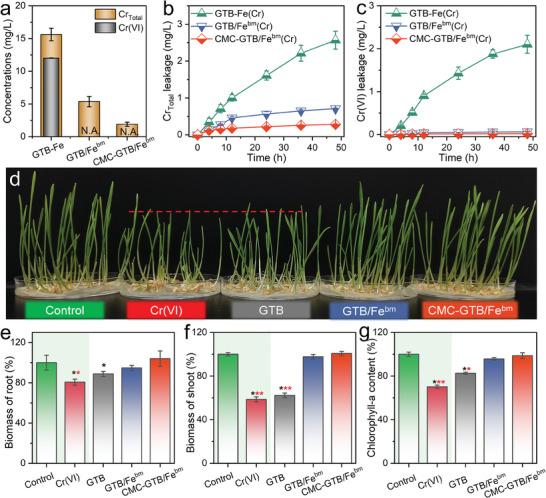
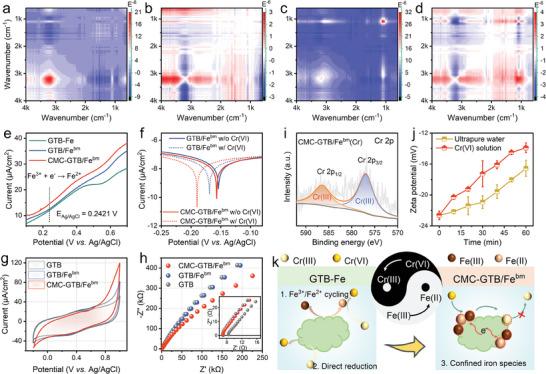
Green and eco-friendly iron-based materials for efficient Cr(VI) removal have attracted considerable interest, but challenges related to narrow working pH ranges and iron utilization efficiency still remain. Herein, inspired by the hot-spot effect-triggered confined coordination strategy, a biomass-confined iron-based reductant (CMC-GTB/Fe) is designed for Cr(VI) reduction and detoxification. Electron enrichment and confinement on biomass carriers are achieved through electron transfer mediated by coordination interactions between anchored iron species and biomass. Thus, the CMC-GTB/Fe achieved 99% Cr(VI) reduction at circumneutral pH (5-9), with a maximum removal capacity of 180 mg g. Under iron dosing close to the stoichiometric ratio (Fe/Cr = 3/1), the Cr(VI) removal kinetics and efficiency of CMC-GTB/Fe are 53.2-870.5 and 5.5-48.8 times higher than those of micro- or nano-zero-valent iron (ZVI), respectively. Mechanistic analyses revealed that confined electron transfer is facilitated by coordination interactions between biomass and anchored iron species, which enhanced Cr(VI) reduction. Moreover, biomass-tethered reduced Cr(III) is stabilized by electrostatic adsorption and biomass-Cr(III) coordination, which ultimately detoxifies the phytotoxicity of Cr(VI). The conversion of this strategy to kilogram-scale production and the simulated Cr(VI) removal in real water matrices are confirmed. This study provides a basis for the controlled design and industrial application of environmentally friendly iron-based reductants.
用于高效去除 Cr(VI) 的绿色环保铁基材料引起了广泛关注,但仍存在工作 pH 范围窄和铁利用效率等相关挑战。在此,受热点效应触发的受限配位策略启发,设计了一种生物质受限的铁基还原剂(CMC-GTB/Fe)用于 Cr(VI) 的还原和解毒。通过锚定铁物种与生物质之间的配位相互作用介导的电子转移,实现了生物质载体上的电子富集和限制。因此,CMC-GTB/Fe 在环境中性 pH(5-9)下实现了 99% 的 Cr(VI) 还原,最大去除容量为 180 mg g。在铁投加量接近化学计量比(Fe/Cr = 3/1)时,CMC-GTB/Fe 的 Cr(VI) 去除动力学和效率分别比微零价铁或纳米零价铁(ZVI)高 53.2-870.5 倍和 5.5-48.8 倍。机理分析表明,生物质与锚定铁物种之间的配位相互作用促进了受限电子转移,增强了 Cr(VI) 的还原。此外,生物质束缚的还原态 Cr(III) 通过静电吸附和生物质-Cr(III) 配位得以稳定,最终消除了 Cr(VI) 的植物毒性。证实了该策略向千克级生产的转化以及在实际水基质中模拟 Cr(VI) 的去除。本研究为环境友好型铁基还原剂的可控设计和工业应用提供了依据。



 Zotero 插件