
神经系统疾病中的ISR调节剂
ISR Modulators in Neurological Diseases.
作者信息
Kalinin Alexander Pavlovich, Zubkova Ekaterina Sergeevna, Menshikov Mikhail Yuryevich, Parfyonova Yelena Victorovna
机构信息
National Medical Research Centre of Cardiology Named after Academician E.I. Chazov, Ministry of Health of the Russian Federation, Moscow 121552, Russia.
Department of Biochemistry and Regenerative Biomedicine, Faculty of Fundamental Medicine, Lomonosov Moscow State University, Moscow 119991, Russia.
出版信息
Curr Neuropharmacol. 2025;23(10):1184-1214. doi: 10.2174/011570159X361653250213114821.
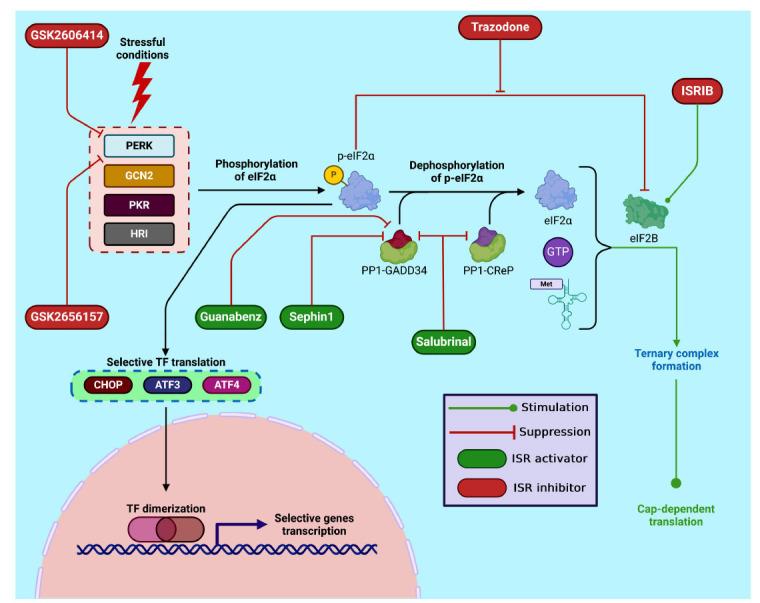
The dysfunction of different cells lies in the pathogenesis of neurological diseases and is usually associated with cellular stress. Various stressors trigger the integrated stress response (ISR) signaling, whose highly conserved mechanism is primarily aimed at protecting a stress-exposed cell to cope as safely as possible with such stressful conditions. On the contrary, if a cell is unable to cope with excessive stress, the ISR can induce apoptosis. The ISR mechanism, whose main stage is the inhibition of translation machinery in favor of the synthesis of specific proteins, including the transcription factors ATF3, ATF4, CEBPA, and CEBPB, which function only as dimers and determine the uniqueness of the ISR response in each individual case, thus ensures different outcomes of the ISR. Inhibition of global protein synthesis is achieved through phosphorylation of eIF2α by PERK, HRI, PKR, or GCN2. To date, a number of compounds have been developed that modulate the ISR, including activators and inhibitors of the abovementioned ISR kinases as well as modulators of p-eIF2α dephosphorylation. They target different ISR stages, allowing a broad ISR modulation strategy. At the same time, there are no drugs that are both exceptionally safe and effective for the treatment of several neurological diseases, so there is an urgent need for new approaches to the treatment of these disorders. In this review, we represent ISR signaling as an important participant in the pathogenesis of neurological diseases. We also describe how various ISR modulators may become a part of future therapies for these diseases.
不同细胞的功能障碍存在于神经疾病的发病机制中,并且通常与细胞应激相关。各种应激源触发整合应激反应(ISR)信号通路,其高度保守的机制主要旨在保护处于应激状态的细胞,使其尽可能安全地应对此类应激条件。相反,如果细胞无法应对过度应激,ISR会诱导细胞凋亡。ISR机制的主要阶段是抑制翻译机制,以利于合成特定蛋白质,包括转录因子ATF3、ATF4、CEBPA和CEBPB,这些转录因子仅作为二聚体发挥作用,并决定了每种情况下ISR反应的独特性,从而确保了ISR的不同结果。通过PERK、HRI、PKR或GCN2使eIF2α磷酸化来实现整体蛋白质合成的抑制。迄今为止,已经开发出了多种调节ISR的化合物,包括上述ISR激酶的激活剂和抑制剂以及p-eIF2α去磷酸化的调节剂。它们针对不同的ISR阶段,从而形成了广泛的ISR调节策略。同时,目前还没有对几种神经疾病治疗既异常安全又有效的药物,因此迫切需要治疗这些疾病的新方法。在本综述中,我们将ISR信号通路描述为神经疾病发病机制中的一个重要参与者。我们还描述了各种ISR调节剂如何可能成为这些疾病未来治疗的一部分。


 Zotero 插件