
健康与疾病状态下肠道上皮内T淋巴细胞的配体
Ligands for Intestinal Intraepithelial T Lymphocytes in Health and Disease.
作者信息
Hada Akanksha, Xiao Zhengguo
机构信息
Department of Animal and Avian Sciences, University of Maryland, College Park, MD 20742, USA.
出版信息
Pathogens. 2025 Jan 23;14(2):109. doi: 10.3390/pathogens14020109.
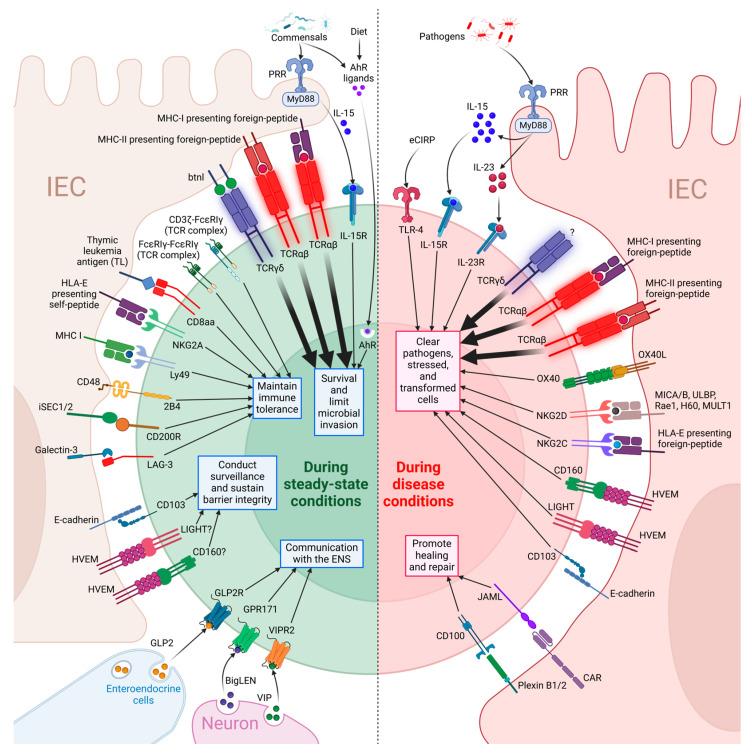
The intestinal tract is constantly exposed to a diverse mixture of luminal antigens, such as those derived from commensals, dietary substances, and potential pathogens. It also serves as a primary route of entry for pathogens. At the forefront of this intestinal defense is a single layer of epithelial cells that forms a critical barrier between the gastrointestinal (GI) lumen and the underlying host tissue. The intestinal intraepithelial T lymphocytes (T-IELs), one of the most abundant lymphocyte populations in the body, play a crucial role in actively surveilling and maintaining the integrity of this barrier by tolerating non-harmful factors such as commensal microbiota and dietary components, promoting epithelial turnover and renewal while also defending against pathogens. This immune balance is maintained through interactions between ligands in the GI microenvironment and receptors on T-IELs. This review provides a detailed examination of the ligands present in the intestinal epithelia and the corresponding receptors expressed on T-IELs, including T cell receptors (TCRs) and non-TCRs, as well as how these ligand-receptor interactions influence T-IEL functions under both steady-state and pathological conditions. By understanding these engagements, we aim to shed light on the mechanisms that govern T-IEL activities within the GI microenvironment. This knowledge may help in developing strategies to target GI ligands and modulate T-IEL receptor expression, offering precise approaches for treating intestinal disorders.
肠道不断暴露于多种腔内抗原混合物中,例如源自共生菌、饮食物质和潜在病原体的抗原。它也是病原体进入的主要途径。肠道防御的前沿是一层上皮细胞,它在胃肠道(GI)管腔与下方的宿主组织之间形成了关键屏障。肠道上皮内T淋巴细胞(T-IELs)是体内最丰富的淋巴细胞群体之一,通过耐受共生微生物群和饮食成分等无害因素,促进上皮细胞更新和再生,同时抵御病原体,在积极监测和维持这一屏障的完整性方面发挥着关键作用。这种免疫平衡通过GI微环境中的配体与T-IELs上的受体之间的相互作用得以维持。本综述详细研究了肠道上皮中存在的配体以及T-IELs上表达的相应受体,包括T细胞受体(TCRs)和非TCRs,以及这些配体-受体相互作用在稳态和病理条件下如何影响T-IEL功能。通过了解这些相互作用,我们旨在阐明在GI微环境中控制T-IEL活动的机制。这些知识可能有助于制定针对GI配体和调节T-IEL受体表达的策略,为治疗肠道疾病提供精确方法。
 Zotero 插件