
院外心脏骤停幸存者的肾功能与临床结局
Renal function and clinical outcomes in survivors of out-of-hospital cardiac arrest.
作者信息
Lee Hao-Wei, Kuo Ming-Jen, Hsu Pai-Feng, Lee I-Hsin, Yang Chih-Yu, Hsu Teh-Fu, How Chorng-Kuang, Lin Yenn-Jiang, Huang Chin-Chou
机构信息
Division of Cardiology, Department of Medicine, Taipei Veterans General Hospital, Taipei, Taiwan.
General Cardiology, Cardiovascular Center, Cathay General Hospital, Taipei, Taiwan.
出版信息
Resusc Plus. 2025 Jan 28;22:100881. doi: 10.1016/j.resplu.2025.100881. eCollection 2025 Mar.
BACKGROUND
Comprehensive studies about renal-function changes in the context of out-of-hospital cardiac arrest (OHCA) have been lacking. Therefore, we investigated the impact of renal function on clinical outcomes among patients with OHCA.
METHOD
This retrospective cohort study enrolled consecutive patients with OHCA between June 2017 and December 2021. Acute kidney injury (AKI) was defined based on the "Kidney Disease: Improving Global Outcomes (KDIGO)" guidelines. AKI recovery was defined as a decrease in serum creatinine below the level determined in the definition of AKI. Clinical outcomes included neurological outcomes and all-cause mortality.
RESULT
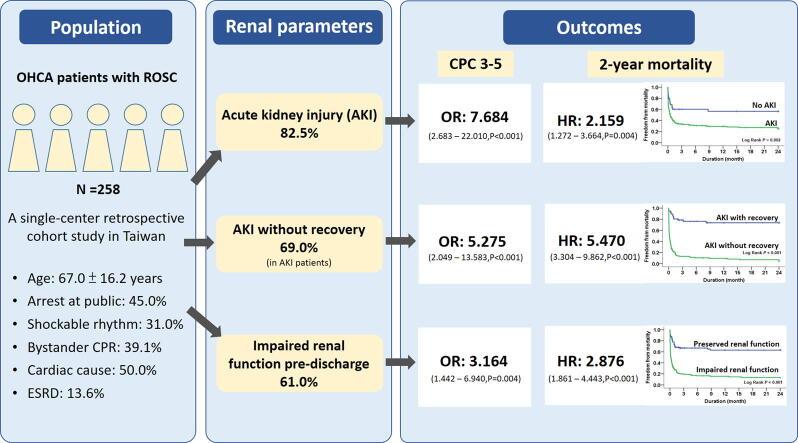
A total of 258 patients were enrolled, including 35 patients with underlying end-stage renal disease (ESRD). Among patients without ESRD, 82.5% developed AKI, of which 31.0% achieved AKI recovery, while 61.0% were discharged with impaired renal function. Multivariable analysis using regression models revealed that unfavorable neurological outcomes at discharge and higher mortality at 2 years were associated with AKI (odds ratio [OR] 7.684, 95% confidence interval (CI) 2.683-22.010, 0.001; hazard ratio [HR] 2.159, 95% CI 1.272-3.664, 0.004), AKI without recovery (OR 5.275, 95% CI 2.049-13.583, 0.001; HR 5.470, 95% CI 3.304-9.862, 0.001), and impaired pre-discharge renal function (OR 3.164, 95% CI 1.442-6.940, 0.004; HR 2.876, 95% CI 1.861-4.443, 0.001). Compared to those without ESRD, patients with underlying ESRD had similar neurological outcomes and mortality.
CONCLUSION
AKI, AKI without recovery, and impaired pre-discharge renal function were significantly correlated with worse clinical outcomes in OHCA among patients without ESRD, while underlying ESRD did not lead to worse clinical outcomes.
背景
关于院外心脏骤停(OHCA)情况下肾功能变化的综合研究一直缺乏。因此,我们调查了肾功能对OHCA患者临床结局的影响。
方法
这项回顾性队列研究纳入了2017年6月至2021年12月期间连续的OHCA患者。急性肾损伤(AKI)根据“改善全球肾脏病预后(KDIGO)”指南进行定义。AKI恢复定义为血清肌酐降至AKI定义中确定的水平以下。临床结局包括神经学结局和全因死亡率。
结果
共纳入258例患者,其中35例患有潜在终末期肾病(ESRD)。在没有ESRD的患者中,82.5%发生了AKI,其中31.0%实现了AKI恢复,而61.0%出院时肾功能受损。使用回归模型的多变量分析显示,出院时不良神经学结局和2年时较高死亡率与AKI(优势比[OR]7.684,95%置信区间[CI]2.683 - 22.010,P = 0.001;风险比[HR]2.159,95%CI 1.272 - 3.664,P = 0.004)、未恢复的AKI(OR 5.275,95%CI 2.049 - 13.583,P = 0.001;HR 5.470,95%CI 3.304 - 9.862,P = 0.001)以及出院前肾功能受损(OR 3.164,95%CI 1.442 - 6.940,P = 0.004;HR 2.876,95%CI 1.861 - 4.443,P = 0.001)相关。与没有ESRD的患者相比,患有潜在ESRD的患者神经学结局和死亡率相似。
结论
在没有ESRD的OHCA患者中,AKI、未恢复的AKI和出院前肾功能受损与更差的临床结局显著相关,而潜在的ESRD不会导致更差的临床结局。
 Zotero 插件