
免疫治疗的食管癌患者治疗前中性粒细胞与淋巴细胞比值和血小板与淋巴细胞比值的预后价值:一项系统评价和荟萃分析
The prognostic value of pretreatment neutrophil-lymphocyte ratio and platelet-lymphocyte ratio in patients with esophageal cancer undergoing immunotherapy: a systematic review and meta-analysis.
作者信息
Deng Min, Qing Yun, Qiu Dan, Sheng Ya, Zhou Juan, Sun Lan
机构信息
Department of Oncology, Bishan Hospital of Chongqing Medical University, Chongqing, China.
出版信息
Front Oncol. 2025 Feb 14;15:1536920. doi: 10.3389/fonc.2025.1536920. eCollection 2025.
BACKGROUND
Esophageal cancer (EC) is associated with a high morbidity and mortality rate. Immunotherapy has demonstrated effective antitumor activity in patients with EC, making it imperative to investigate easily accessible prognostic factors. Consequently, we conducted a meta-analysis to explore the prognostic significance of neutrophil-to-lymphocyte ratio (NLR) and platelet-to-lymphocyte ratio (PLR) in EC patients treated with immunotherapy.
METHODS
The literature search was conducted across three databases: PubMed, Embase, and Web of Science. The primary deadline for literature retrieval was July 2024. Hazard ratio (HR) with a 95% confidence interval (CI) was utilized to assess the association between NLR or PLR and overall survival (OS) as well as progression-free survival (PFS). Statistical analysis was performed using Review Manager version 5.4 and STATA version 15.0.
RESULTS
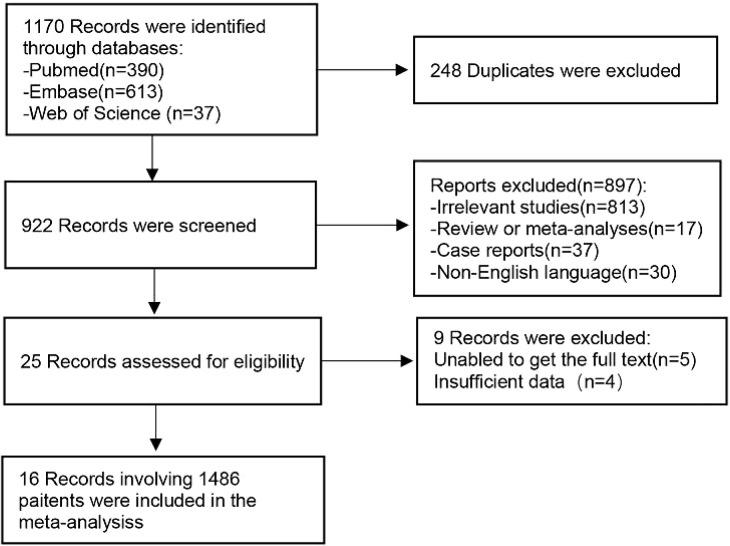
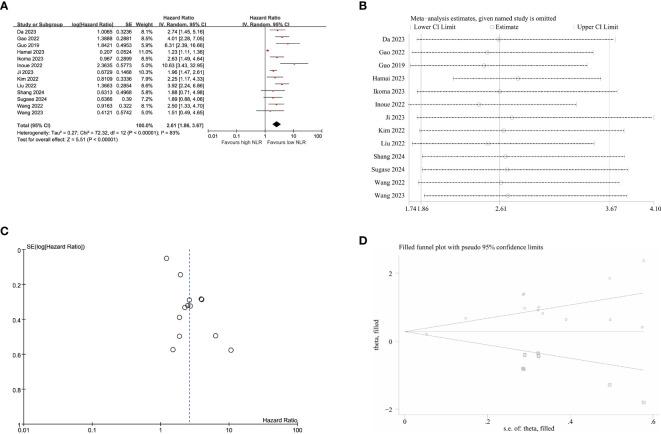
The meta-analysis included a total of 16 studies involving 1,481 patients. The results indicated a significant correlation between high pretreatment NLR and poor PFS (HR=1.76, 95%CI:1.38-2.25, p<0.001) as well as poor OS (HR=2.61,95%CI:1.86-3.67, p<0.001). Subgroup analyses based on tumor stage revealed that the association between elevated NLR and poor PFS was only observed in advanced EC patients. Regarding PLR, an increased PLR was found to be indicative of inferior PFS (HR=1.44, 95%CI: 1.20-1.72, p<0.001) and OS (HR=1.72,95%CI:1.08-2.74, p=0.020). However, the sensitivity analyses suggested that the observed increase in PLR lack robustness in terms of its impact on inferior OS.
CONCLUSION
Elevated NLR and PLR are associated with inferior PFS and OS in EC patients receiving immunotherapy. These findings suggest that NLR and PLR levels hold promise as prognostic biomarkers in clinical practice, offering valuable guidance for personalized immunotherapy strategies.
SYSTEMATIC REVIEW REGISTRATION
PROSPERO https://www.crd.york.ac.uk/prospero/, identifier CRD42024596737.
背景
食管癌(EC)的发病率和死亡率都很高。免疫疗法已在食管癌患者中显示出有效的抗肿瘤活性,因此有必要研究易于获取的预后因素。因此,我们进行了一项荟萃分析,以探讨中性粒细胞与淋巴细胞比值(NLR)和血小板与淋巴细胞比值(PLR)在接受免疫治疗的食管癌患者中的预后意义。
方法
在三个数据库中进行文献检索:PubMed、Embase和Web of Science。文献检索的截止日期为2024年7月。采用风险比(HR)及95%置信区间(CI)评估NLR或PLR与总生存期(OS)以及无进展生存期(PFS)之间的关联。使用Review Manager 5.4版和STATA 15.0版进行统计分析。
结果
该荟萃分析共纳入16项研究,涉及1481例患者。结果表明,治疗前高NLR与较差的PFS(HR=1.76,95%CI:1.38-2.25,p<0.001)以及较差的OS(HR=2.61,95%CI:1.86-3.67,p<0.001)显著相关。基于肿瘤分期的亚组分析显示,仅在晚期食管癌患者中观察到NLR升高与较差的PFS之间存在关联。关于PLR,发现PLR升高表明PFS(HR=1.44,95%CI:1.20-1.72,p<0.001)和OS(HR=1.72,95%CI:1.08-2.74,p=0.020)较差。然而,敏感性分析表明,观察到的PLR升高对较差OS的影响缺乏稳健性。
结论
在接受免疫治疗的食管癌患者中,NLR和PLR升高与较差的PFS和OS相关。这些发现表明,NLR和PLR水平有望成为临床实践中的预后生物标志物,为个性化免疫治疗策略提供有价值的指导。
系统评价注册
PROSPERO https://www.crd.york.ac.uk/prospero/,标识符CRD42024596737。



 Zotero 插件