
用于构建药物测试模型的3D生物打印——发展策略与监管问题
3D bioprinting for the construction of drug testing models-development strategies and regulatory concerns.
作者信息
Mallya Divya, Gadre Mrunmayi Ashish, Varadharajan S, Vasanthan Kirthanashri S
机构信息
Manipal Centre for Biotherapeutics Research, Manipal Academy of Higher Education, Manipal, Karnataka, India.
Manipal Institute of Technology, Manipal Academy of Higher Education, Manipal, Karnataka, India.
出版信息
Front Bioeng Biotechnol. 2025 Feb 14;13:1457872. doi: 10.3389/fbioe.2025.1457872. eCollection 2025.
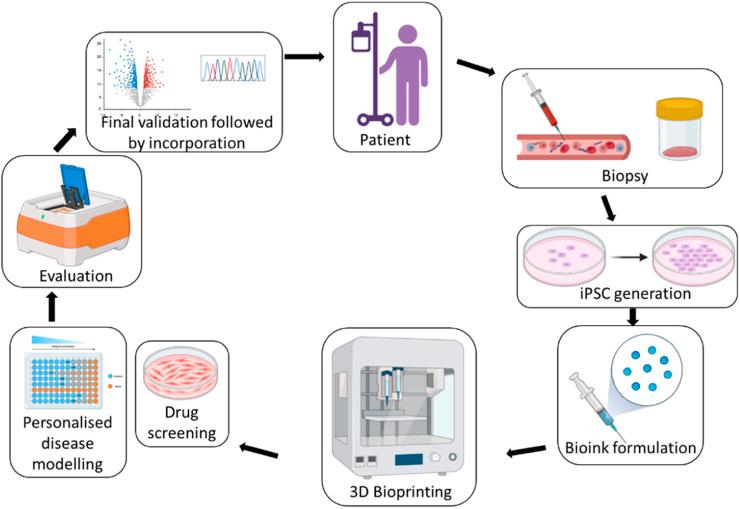
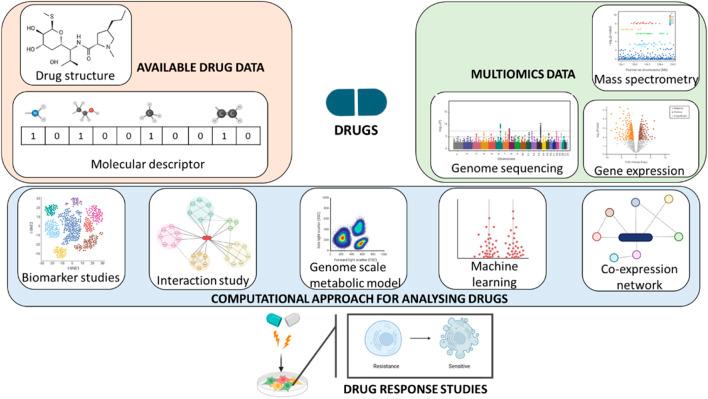
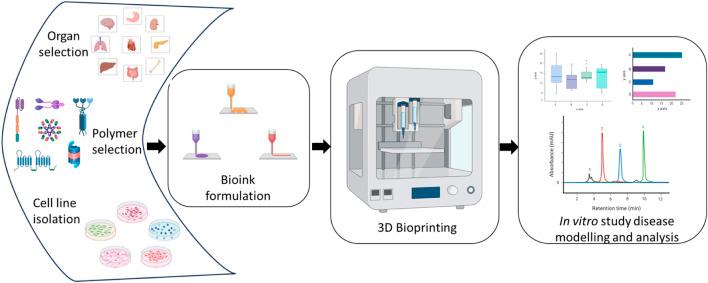
A drug to be successfully launched in the market requires a significant amount of capital, resources and time, where the unsuccessful results in the last stages lead to catastrophic failure for discovering drugs. This is the very reason which calls for the invention of innovative models that can closely mimic the human model for producing reliable results. Throughout the innovation line, there has been improvement in the rationale designing but yet there is requirement for correlations. During the evolving of the drug testing models, the 3D models produced by different methods have been proven to produce better results than the traditional 2D models. However, the fabrications of live tissues are still bottleneck in realizing their complete potential. There is an urgent need for the development of single, standard and simplified 3D tissue models that can be reliable for investigating the biological and pathological aspects of drug discovery, which is yet to be achieved. The existing pre-clinical models have considerable drawbacks despite being the gold standard in pre-clinical research. The major drawback being the interspecies differences and low reliability on the generated results. This gap could be overcome by the fabrication of bioengineered human disease models for drug screening. The advancement in the fabrication of 3D models will provide a valuable tool in screening drugs at different stages as they are one step closer to bio-mimic human tissues. In this review, we have discussed on the evolution of preclinical studies, and different models, including mini tissues, spheroids, organoids, bioengineered three dimensional models and organs on chips. Furthermore, we provide details of different disease models fabricated across various organs and their applications. In addition to this, the review also focuses on the limitations and the current prospects of the role of three dimensionally bioprinted models in drug screening and development.
一种药物要成功推向市场需要大量资金、资源和时间,而在最后阶段的失败会导致药物研发的灾难性后果。这正是需要发明创新模型的原因,这些模型能够紧密模拟人体模型以产生可靠结果。在整个创新过程中,理论设计已有改进,但仍需要相关性。在药物测试模型的发展过程中,通过不同方法产生的3D模型已被证明比传统的2D模型能产生更好的结果。然而,活组织的制造仍然是实现其全部潜力的瓶颈。迫切需要开发单一、标准且简化的3D组织模型,这种模型在研究药物发现的生物学和病理学方面能够可靠,但尚未实现。现有的临床前模型尽管是临床前研究的金标准,但仍有相当大的缺点。主要缺点是种间差异以及对所产生结果的低可靠性。通过制造用于药物筛选的生物工程化人类疾病模型可以克服这一差距。3D模型制造的进步将为在不同阶段筛选药物提供有价值的工具,因为它们更接近生物模拟人体组织。在这篇综述中,我们讨论了临床前研究的演变以及不同的模型,包括微型组织、球体、类器官、生物工程三维模型和芯片上的器官。此外,我们提供了跨各种器官制造的不同疾病模型及其应用的详细信息。除此之外,本综述还关注三维生物打印模型在药物筛选和开发中的作用的局限性和当前前景。
 Zotero 插件