
大型B细胞淋巴瘤中CAR T细胞制造失败的风险因素及患者预后:来自英国国家CAR T专家组的报告
Risk factors for CAR T-cell manufacturing failure and patient outcomes in large B-cell lymphoma: a report from the UK National CAR T Panel.
作者信息
Dulobdas Vaishali, Kirkwood Amy A, Serpenti Fabio, Gautama Brijesh, Panopoulou Aikaterini, Mathew Amrith, Gabriel Sumantha, Malladi Ram, Pealing Jessica, Bonney Denise, Nicholson Emma, Besley Caroline, Ghorashian Sara, Kuhnl Andrea, Davies Elizabeth, Chappell Jackie, Black Anne, Menne Tobias, O'Reilly Maeve A, Sanderson Robin, Chaganti Sridhar
机构信息
Centre for Clinical Haematology, University Hospitals Birmingham NHS Foundation Trust, Birmingham, UK.
Cancer Research UK & UCL Cancer Trials Centre, UCL Cancer Institute, University College London, London, UK.
出版信息
Blood Cancer J. 2025 Mar 4;15(1):30. doi: 10.1038/s41408-025-01225-9.
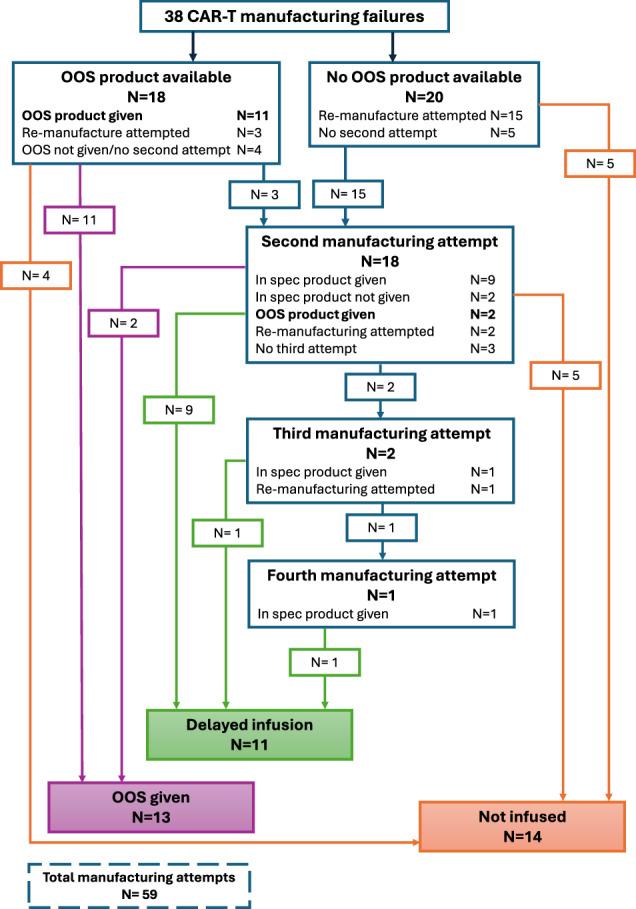
CAR T-cell manufacturing failure (MF) is a situation where the manufacturing process fails to yield a product or results in one which is out-of-specification (OOS). We conducted a multicentre retrospective review of factors contributing to MF and patient outcomes. Of 981 large B-cell lymphoma (LBCL) patients approved for CAR T-cell therapy, 38 (3.87%) had MF. Eleven patients received delayed infusion with a product in-specification (delayed-infused) following 21 remanufacturing attempts. OOS product was infused in 13 (OOS-infused), and 14 were not infused. For comparison, we included 38 LBCL controls without MF; 29 received infusion (controls-infused). Prior bendamustine was the only baseline variable associated with MF risk, largely due to therapy within 6 months; 23.7% MF vs 0% controls (P = 0.0029). Overall survival (OS) and progression-free survival (PFS) were not significantly different for infused patients, with 1-year OS (PFS) of 52.8% (46.2%), 46.8% (24.2%) and 68.4% (41.4%) for OOS-infused, delayed-infused and controls-infused respectively (PFS HR OOS-infused vs controls-infused 1.41, P = 0.40; delayed-infused vs controls-infused 1.64, P = 0.25; and OOS-infused vs delayed-infused 0.86, P = 0.76). CRS, ICANS and cytopenias were not significantly different between cohorts. Outcomes for OOS-infused LBCL patients following MF are encouraging. Remanufacturing led to infusion of a product in-specification in around 50% and may be an option for patients where a suitable OOS product is not available.
嵌合抗原受体(CAR)T细胞制造失败(MF)是指制造过程未能产生产品或产生不符合规格(OOS)的产品的情况。我们对导致制造失败的因素和患者预后进行了多中心回顾性研究。在981例获批接受CAR T细胞治疗的大B细胞淋巴瘤(LBCL)患者中,38例(3.87%)出现制造失败。11例患者在21次再制造尝试后接受了符合规格产品的延迟输注(延迟输注组)。13例患者接受了不符合规格产品的输注(不符合规格产品输注组),14例未接受输注。作为对照,我们纳入了38例无制造失败的LBCL患者;29例接受了输注(对照输注组)。既往使用苯达莫司汀是与制造失败风险相关的唯一基线变量,主要原因是在6个月内接受治疗;制造失败率为23.7%,而对照组为0%(P = 0.0029)。对于接受输注的患者,总生存期(OS)和无进展生存期(PFS)无显著差异,不符合规格产品输注组、延迟输注组和对照输注组的1年OS(PFS)分别为52.8%(46.2%)、46.8%(24.2%)和68.4%(41.4%)(不符合规格产品输注组与对照输注组的PFS风险比为1.41,P = 0.40;延迟输注组与对照输注组为1.64,P = 0.25;不符合规格产品输注组与延迟输注组为0.86,P = 0.76)。细胞因子释放综合征(CRS)、免疫效应细胞相关神经毒性综合征(ICANS)和血细胞减少在各队列之间无显著差异。制造失败后不符合规格产品输注的LBCL患者的预后令人鼓舞。再制造导致约50%的患者接受了符合规格的产品输注,对于没有合适的不符合规格产品的患者而言,再制造可能是一种选择。



 Zotero 插件