
靶向肿瘤微环境的纳米抗体及其作为纳米药物的制剂。
Nanobodies targeting the tumor microenvironment and their formulation as nanomedicines.
作者信息
Maksymova Liudmyla, Pilger Yannick A, Nuhn Lutz, Van Ginderachter Jo A
机构信息
Lab of Cellular and Molecular Immunology, Brussels Center for Immunology (BCIM), Vrije Universiteit Brussel, Pleinlaan 2, Brussels, B-1050, Belgium.
Myeloid Cell Immunology Lab, VIB Center for Inflammation Research, Brussels, Belgium.
出版信息
Mol Cancer. 2025 Mar 4;24(1):65. doi: 10.1186/s12943-025-02270-5.
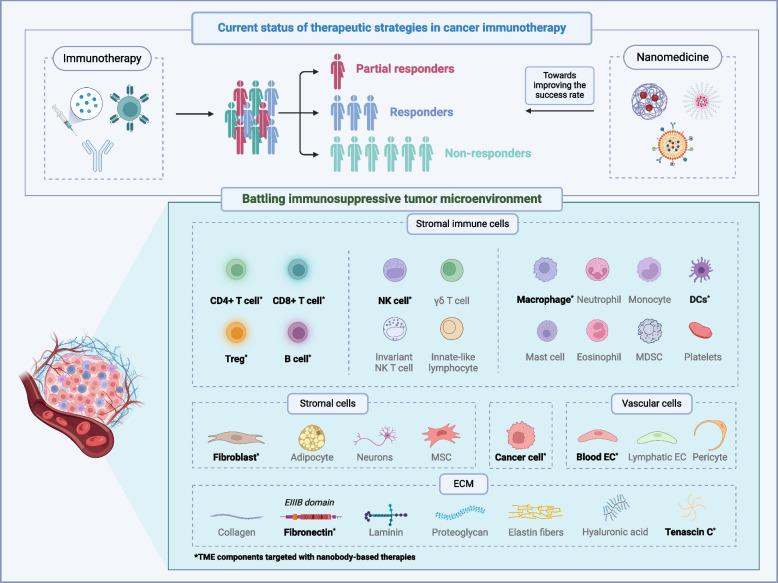
Among the emerging strategies for cancer theranostics, nanomedicines offer significant promise in advancing both patients' diagnosis and treatment. In combination with nanobodies, nanomedicines can potentially enhance the precision and efficiency of drug or imaging agent delivery, addressing key limitations of current approaches, such as off-target toxicities. The development of nanomedicines will be further accelerated by the creation of smart nanoparticles, and their integration with immunotherapy. Obviously, the success of nano-immunotherapy will depend on a comprehensive understanding of the tumor microenvironment, including the complex interplay of mechanisms that drive cancer-mediated immunosuppression and immune escape. Hence, effective therapeutic targeting of the tumor microenvironment requires modulation of immune cell function, overcoming resistance mechanisms associated with stromal components or the extracellular matrix, and/or direct elimination of cancer cells. Identifying key molecules involved in cancer progression and drug resistance is, therefore, essential for developing effective therapies and diagnostic tools that can predict patient responses to treatment and monitor therapeutic outcomes. Current nanomedicines are being designed with careful consideration of factors such as the choice of carrier (e.g., biocompatibility, controlled cargo release) and targeting moiety. The unique properties of nanobodies make them an effective engineering tool to target biological molecules with high affinity and specificity. In this review, we focus on the latest applications of nanobodies for targeting various components of the tumor microenvironment for diagnostic and therapeutic purposes. We also explore the main types of nanoparticles used as a carrier for cancer immunotherapies, as well as the strategies for formulating nanoparticle-nanobody conjugates. Finally, we highlight how nanobody-nanoparticle formulations can enhance current nanomedicines.
在癌症诊疗新兴策略中,纳米药物在推进患者诊断和治疗方面具有巨大潜力。与纳米抗体相结合,纳米药物有可能提高药物或成像剂递送的精准度和效率,解决当前方法的关键局限性,如脱靶毒性。智能纳米颗粒的创制及其与免疫疗法的整合将进一步加速纳米药物的发展。显然,纳米免疫疗法的成功将取决于对肿瘤微环境的全面理解,包括驱动癌症介导的免疫抑制和免疫逃逸的复杂机制相互作用。因此,对肿瘤微环境进行有效的治疗靶向需要调节免疫细胞功能,克服与基质成分或细胞外基质相关的耐药机制,和/或直接消除癌细胞。因此,识别参与癌症进展和耐药性的关键分子对于开发能够预测患者对治疗的反应并监测治疗效果的有效疗法和诊断工具至关重要。当前的纳米药物在设计时会仔细考虑载体选择(如生物相容性、可控载药释放)和靶向部分等因素。纳米抗体的独特性质使其成为一种以高亲和力和特异性靶向生物分子的有效工程工具。在本综述中,我们重点关注纳米抗体用于靶向肿瘤微环境的各种成分以实现诊断和治疗目的的最新应用。我们还探讨了用作癌症免疫疗法载体的主要纳米颗粒类型,以及制备纳米颗粒 - 纳米抗体缀合物的策略。最后,我们强调纳米抗体 - 纳米颗粒制剂如何增强当前的纳米药物。



 Zotero 插件