
配备白蛋白以延长血浆半衰期的抗癌人免疫球蛋白A的工程改造。
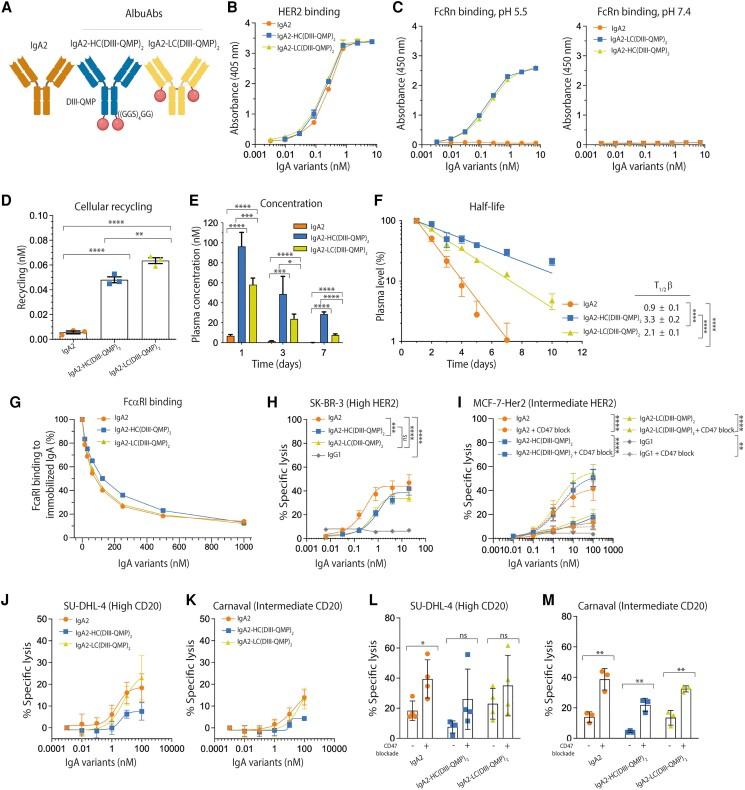
Engineering of anticancer human immunoglobulin A equipped with albumin for enhanced plasma half-life.
作者信息
Mester Simone, Chan Chilam, Lustig Marta, Foss Stian, Jansen J H Marco, Leangen Herigstad Marie, Evers Mitchell, Nilsen Jeannette, Reiding Karli R, A Damen J Mirjam, Burger Renate, Grevys Algirdas, Dalhus Bjørn, Valerius Thomas, Sandlie Inger, Leusen Jeanette H W, Andersen Jan Terje
机构信息
Department of Immunology, Oslo University Hospital Rikshospitalet and University of Oslo, Norway, PO Box 4950, N-0424 Oslo, Norway.
Precision Immunotherapy Alliance (PRIMA), Department of Pharmacology, Institute of Clinical Medicine, University of Oslo, PO Box 1171, N-0318 Oslo, Norway.
出版信息
PNAS Nexus. 2025 Feb 11;4(2):pgaf042. doi: 10.1093/pnasnexus/pgaf042. eCollection 2025 Feb.
Most therapeutic antibodies are based on immunoglobulin G (IgG) due to their potent effector functions and long plasma half-life. However, also monomeric IgA has emerged as an attractive candidate for cancer treatment as, upon specific binding to tumor cells, it can activate myeloid cells, like polymorphonuclear leukocytes and macrophages, to kill the tumor cells by engaging the Fc α receptor I (FcαRI). Despite this favorable property, human IgA has a short plasma half-life in both mice and humans, which is clearly limiting preclinical studies in a translational perspective. Here, we report on albumin-equipped designs of human IgA antibodies that are long acting due to tailored binding to the human form of neonatal Fc receptor (FcRn), which is a natural plasma half-life regulator of albumin. Importantly, this was achieved without compromising the ability of IgA to engage and activate FcαRI-expressing effector cells for tumor cell killing in vitro and in vivo in a new mouse model transgenic for the human forms of FcRn and FcαRI. We further show that the potency of the engineered long-acting human IgA against tumor cells with intermediate target antigen expression levels could be enhanced by myeloid checkpoint inhibitors targeting the signal regulatory protein α-CD47 axis.
大多数治疗性抗体基于免疫球蛋白G(IgG),这是由于其强大的效应功能和较长的血浆半衰期。然而,单体IgA也已成为癌症治疗的有吸引力的候选者,因为在与肿瘤细胞特异性结合后,它可以激活髓样细胞,如多形核白细胞和巨噬细胞,通过与Fcα受体I(FcαRI)结合来杀死肿瘤细胞。尽管具有这种有利特性,但人IgA在小鼠和人类中血浆半衰期都很短,从转化的角度来看,这显然限制了临床前研究。在此,我们报道了配备白蛋白的人IgA抗体设计,由于其与人类形式的新生儿Fc受体(FcRn)的定制结合而具有长效作用,FcRn是白蛋白的天然血浆半衰期调节剂。重要的是,在一种针对人类形式的FcRn和FcαRI的新型转基因小鼠模型中,在体外和体内实现了这一点,同时又不损害IgA结合和激活表达FcαRI的效应细胞以杀死肿瘤细胞的能力。我们进一步表明,通过靶向信号调节蛋白α-CD47轴的髓样检查点抑制剂,可以增强工程化长效人IgA对具有中等靶抗原表达水平的肿瘤细胞的效力。


 Zotero 插件