
吗啡诱导的痛觉过敏影响小细胞外囊泡微小RNA的组成和功能。
Morphine-induced hyperalgesia impacts small extracellular vesicle microRNA composition and function.
作者信息
Reddy Deepa, Lin Zhucheng, Ramanathan Sujay, Luo Xuan, Pande Richa, Tian Yuzhen, Side Christine M, Barker Jacqueline M, Sacan Ahmet, Blendy Julie A, Ajit Seena K
机构信息
Department of Pharmacology & Physiology, Drexel University College of Medicine, Philadelphia, Pennsylvania.
Microbiology and Immunology Graduate Program, Drexel University College of Medicine, Philadelphia, Pennsylvania.
出版信息
J Pharmacol Exp Ther. 2025 Apr;392(4):103398. doi: 10.1016/j.jpet.2025.103398. Epub 2025 Feb 6.
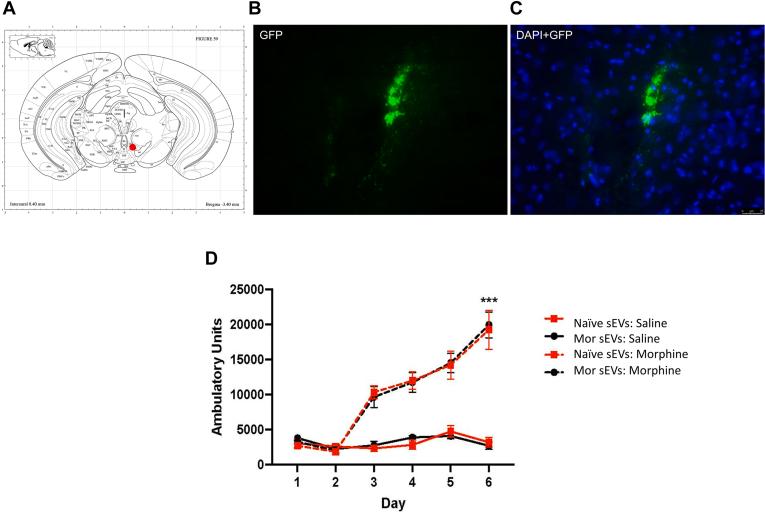
Morphine and other synthetic opioids are widely prescribed to treat pain. Prolonged morphine exposure can paradoxically enhance pain sensitivity in humans and nociceptive behavior in rodents. To better understand the molecular mechanisms underlying opioid-induced hyperalgesia, we investigated changes in microRNA (miRNA) composition of small extracellular vesicles (sEVs) from the serum of mice after a morphine treatment paradigm that induces hyperalgesia. We observed significant differential expression of 18 miRNAs in sEVs from morphine-treated mice of both sexes compared with controls. Several of these miRNAs were bioinformatically predicted to regulate cyclic AMP response element binding protein (CREB), a well characterized transcription factor implicated in pain and drug addiction. We confirmed the binding and repression of Creb mRNA by miR-155 and miR-10a. We tested if serum-derived sEVs from morphine-treated mice could elicit nociceptive behavior in naïve recipient mice. Intrathecal injection of 1 μg sEVs did not significantly impact basal mechanical and thermal thresholds in naïve recipient mice. However, prophylactic 1 μg sEV administration in recipient mice resulted in faster resolution of complete Freund's adjuvant-induced mechanical and thermal inflammatory hypersensitivity. Other behaviors assayed following administration of these sEVs were not impacted, including sEV-conditioned place preference and locomotor sensitization. These results indicate that morphine regulation of serum sEV composition can contribute to analgesia and suggest a potential for sEVs to be a nonopioid therapeutic intervention strategy to treat pain. SIGNIFICANCE STATEMENT: A mouse model of opioid-induced hyperalgesia was used to show that chronic morphine treatment causes differential microRNA packaging into small extracellular vesicles (sEVs) present in the serum of mice. Two of these sEV microRNAs can downregulate CREB expression, and administration of these sEVs attenuates pain hypersensitivity in recipient mice. These studies position sEVs as a potential pain therapeutic and highlight changes underlying opioid-induced hyperalgesia, shedding light on a phenomenon with unclear pathophysiology.
吗啡和其他合成阿片类药物被广泛用于治疗疼痛。然而,长期接触吗啡会出人意料地增强人类的疼痛敏感性以及啮齿动物的伤害性反应行为。为了更好地理解阿片类药物诱导痛觉过敏的分子机制,我们在一种能诱导痛觉过敏的吗啡治疗模式下,研究了小鼠血清中小细胞外囊泡(sEVs)的微小RNA(miRNA)组成变化。我们观察到,与对照组相比,接受吗啡治疗的雌雄小鼠的sEVs中有18种miRNA存在显著差异表达。通过生物信息学预测,其中几种miRNA可调节环磷酸腺苷反应元件结合蛋白(CREB),这是一种在疼痛和药物成瘾方面具有明确特征的转录因子。我们证实了miR - 155和miR - 10a对Creb mRNA的结合和抑制作用。我们测试了来自吗啡处理小鼠的血清衍生sEVs是否能在未接触过的受体小鼠中引发伤害性反应行为。向未接触过的受体小鼠鞘内注射1μg sEVs对基础机械和热阈值没有显著影响。然而,在受体小鼠中预防性给予1μg sEVs可使完全弗氏佐剂诱导的机械性和热性炎症超敏反应更快消退。给予这些sEVs后检测的其他行为未受影响,包括sEV条件性位置偏爱和运动致敏。这些结果表明,吗啡对血清sEV组成的调节有助于镇痛,并提示sEVs有可能成为一种治疗疼痛的非阿片类治疗干预策略。意义声明:利用阿片类药物诱导痛觉过敏的小鼠模型表明,慢性吗啡治疗会导致不同的微小RNA被包装到小鼠血清中的小细胞外囊泡(sEVs)中。其中两种sEV微小RNA可下调CREB表达,给予这些sEVs可减轻受体小鼠的疼痛超敏反应。这些研究将sEVs定位为一种潜在的疼痛治疗方法,并突出了阿片类药物诱导痛觉过敏的潜在变化,为一种病理生理学尚不清楚的现象提供了线索。


 Zotero 插件