
自主神经系统交感神经成分在第三磨牙拔除前后对疼痛的作用——一项观察性队列研究。
The role of the sympathetic component of the autonomic nervous system on pain before and after third molar extraction- an observational cohort study.
作者信息
Deschaumes Christophe, Devoize Laurent, Sudrat Yannick, Pereira Bruno, Dallel Radhouane, Dualé Christian
机构信息
Université Clermont-Auvergne, CHU Clermont-Ferrand, Neuro-Dol, Inserm, Clermont-Ferrand, F-63000, France.
Direction de la Recherche Clinique et des Innovations, CHU Clermont-Ferrand, Clermont-Ferrand, F-63000, France.
出版信息
BMC Anesthesiol. 2025 Mar 8;25(1):117. doi: 10.1186/s12871-025-02949-8.
BACKGROUND
Assessing heart rate variability (HRV) before a standardized surgery would help to explore further the relationship between the autonomic nervous system and pain.
METHODS
A single-center prospective cohort of 117 patients (55% female) scheduled for third molar extraction underwent a preoperative resting measurement of arterial pressure followed by an HRV recording, then potentiated by a Valsalva maneuver and a deep breathing challenge. Finally, pain sensitivity was assessed by hand immersion in hot water. All surgeries were conducted under local anesthesia, with or without sedation. The primary outcome was a composite pain/analgesia score (CPAS) incorporating both pain intensity and analgesic drug intake; it was adjusted to the type of anesthesia by within-subgroup ranking.
RESULTS
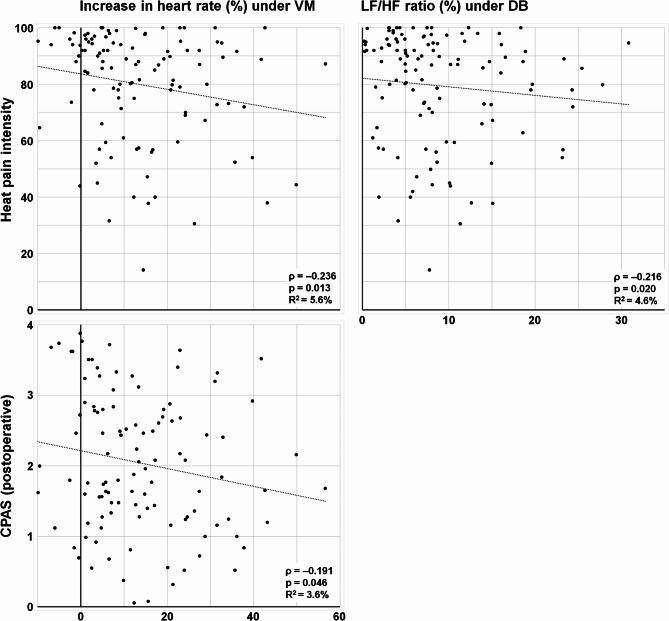
The increase in heart rate in the Valsalva maneuver, and the low- to high-frequency ratio (LF/HF) in the deep breathing, were inversely correlated to preoperative heat pain, which was correlated itself to the CPAS (ρ = 0.195; p = 0.035). The only other parameter influencing CPAS was the increase in heart rate in the Valsalva maneuver, with an inverse correlation (ρ = - 0.191; p = 0.046). While age tended to impair HRV, particularly in its parasympathetic component, and while men displayed a stronger parasympathetic response than women, neither age nor sex interacted with these effects. Neither preoperative arterial pressure nor the occurrence of parental hypertension influenced the pain outcomes.
DISCUSSION
Although the identified relationships were not particularly strong, they are consistent with an influence of the sympathetic component of the autonomic nervous system. However, they do not support the interest of HRV assessment to predict postoperative pain in current practice.
TRIAL REGISTRATION
Not applicable.
背景
在标准化手术前评估心率变异性(HRV)有助于进一步探索自主神经系统与疼痛之间的关系。
方法
一项单中心前瞻性队列研究,纳入了117例计划拔除第三磨牙的患者(55%为女性),术前静息状态下测量动脉压,随后记录HRV,接着通过瓦尔萨尔瓦动作和深呼吸激发试验增强测量。最后,通过将手浸入热水中来评估疼痛敏感性。所有手术均在局部麻醉下进行,可使用或不使用镇静剂。主要结局是综合疼痛/镇痛评分(CPAS),该评分综合了疼痛强度和镇痛药摄入量;通过亚组内排名对麻醉类型进行了调整。
结果
瓦尔萨尔瓦动作时心率的增加以及深呼吸时低频与高频比值(LF/HF)与术前热痛呈负相关,而术前热痛本身与CPAS相关(ρ = 0.195;p = 0.035)。影响CPAS的唯一其他参数是瓦尔萨尔瓦动作时心率的增加,呈负相关(ρ = -0.191;p = 0.046)。虽然年龄往往会损害HRV,尤其是其副交感神经成分,并且男性的副交感神经反应比女性更强,但年龄和性别均未与这些效应相互作用。术前动脉压和父母高血压的发生均未影响疼痛结局。
讨论
尽管所确定的关系不是特别强,但它们与自主神经系统交感神经成分的影响一致。然而,它们不支持在当前实践中通过HRV评估来预测术后疼痛的意义。
试验注册
不适用。


 Zotero 插件