
2011年至2013年日本偏远岛屿半隔离人群中甲型H3N2流感病毒传播局部模式的系统发育研究
Phylogenetic Study of Local Patterns Influenza A(H3N2) Virus Transmission in a Semi-Isolated Population in a Remote Island in Japan Between 2011 and 2013.
作者信息
Han Su Myat, Shiino Teiichiro, Masuda Shingo, Furuse Yuki, Yasaka Takahiro, Kanda Satoshi, Komori Kazuhiri, Saito Nobuo, Kubo Yoshiano, Smith Chris, Endo Akira, Robert Alexis, Baguelin Marc, Ariyoshi Koya
机构信息
School of Tropical Medicine and Global Health, Nagasaki University, Nagasaki, Japan.
Department of Infectious Disease Epidemiology, Faculty of Epidemiology and Population Health, London School of Hygiene and Tropical Medicine, London, UK.
出版信息
Influenza Other Respir Viruses. 2025 Mar;19(3):e70089. doi: 10.1111/irv.70089.
BACKGROUND
Influenza A outbreak risk is impacted by the potential for importation and local transmission. Reconstructing transmission history with phylogenetic analysis of genetic sequences can help assess outbreak risk but relies on regular collection of genetic sequences. Few influenza genetic sequences are collected in Japan, which makes phylogenetic analysis challenging, especially in rural, remote settings. We generated influenza A genetic sequences from nasopharyngeal swabs (NPS) samples collected using rapid influenza diagnostic tests and used them to analyze the transmission dynamics of influenza in a remote island in Japan.
METHODS
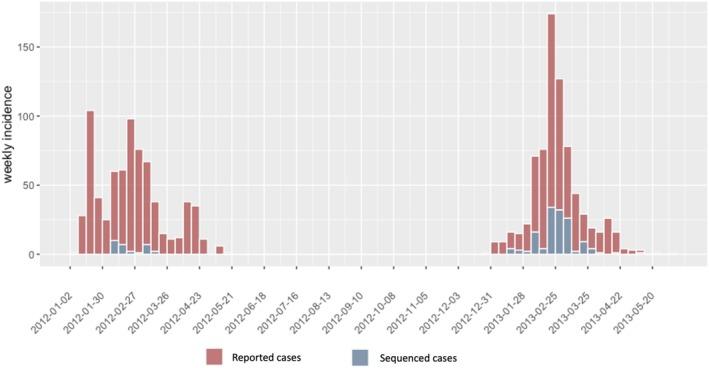
We generated 229 whole genome sequences of influenza A/H3N2 collected during 2011/12 and 2012/13 influenza seasons in Kamigoto Island, Japan, of which 178 sequences passed the quality check. We built time-resolved phylogenetic trees from hemagglutinin sequences to classify the circulating clades by comparing the Kamigoto sequences to global sequences. Spatiotemporal transmission patterns were then analyzed for the largest local clusters.
RESULTS
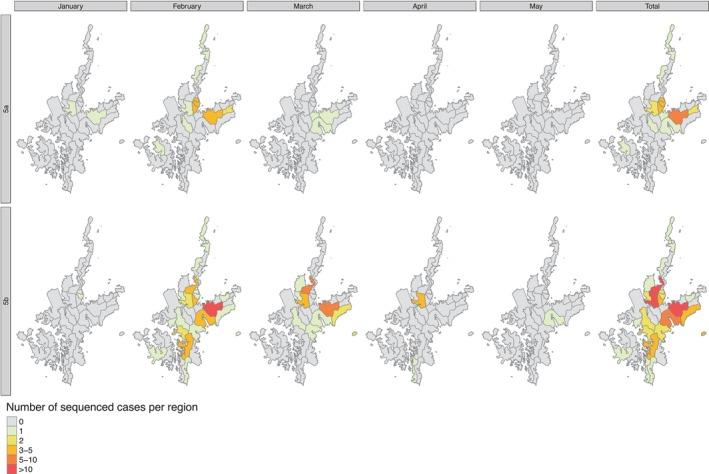
Using a time-resolved phylogenetic tree, we showed that the sequences clustered in six independent transmission groups (1 in 2011/12, 5 in 2012/13). Sequences were closely related to strains from mainland Japan. All 2011/12 strains were identified as clade 3C.2 (n = 29), while 2012/13 strains fell into two clades: clade 3C.2 (n = 129) and 3C.3a (n = 20). Clusters reported in 2012/13 circulated simultaneously in the same regions. The spatiotemporal analysis of the largest cluster revealed that while the first sequences were reported in the busiest district of Kamigoto, the later sequences were scattered across the island.
CONCLUSION
Kamigoto Island was exposed to repeated importations of Influenza A(H3N2), mostly from mainland Japan, sometimes leading to local transmission and ultimately outbreaks. As independent groups of sequences overlapped in time and space, cases may be wrongly allocated to the same transmission group in the absence of genomic surveillance, thereby underestimating the risk of importations. Our analysis highlights how NPS could be used to better understand influenza transmission patterns in little-studied settings and improve influenza surveillance in Japan.
背景
甲型流感的爆发风险受到输入和本地传播可能性的影响。通过对基因序列进行系统发育分析来重建传播历史有助于评估爆发风险,但这依赖于基因序列的定期收集。在日本,很少收集流感基因序列,这使得系统发育分析具有挑战性,尤其是在农村和偏远地区。我们从使用快速流感诊断测试收集的鼻咽拭子(NPS)样本中生成了甲型流感基因序列,并利用它们分析了日本一个偏远岛屿上流感的传播动态。
方法
我们生成了2011/12年和2012/13年流感季节在日本上五岛收集的229条甲型H3N2全基因组序列,其中178条序列通过了质量检查。我们从血凝素序列构建了时间分辨系统发育树,通过将上五岛的序列与全球序列进行比较来对流行的进化枝进行分类。然后对最大的本地集群的时空传播模式进行了分析。
结果
使用时间分辨系统发育树,我们表明这些序列聚集在六个独立的传播组中(2011/12年1个,2012/13年5个)。序列与来自日本本土的毒株密切相关。所有2011/12年的毒株都被鉴定为3C.2进化枝(n = 29),而2012/13年的毒株分为两个进化枝:3C.2进化枝(n = 129)和3C.3a进化枝(n = 20)。2012/13年报告的集群在同一地区同时传播。对最大集群的时空分析表明,虽然第一批序列是在上五岛最繁忙的地区报告的,但后来的序列分散在整个岛屿。
结论
上五岛多次受到甲型H3N2流感的输入,主要来自日本本土,有时导致本地传播并最终引发疫情。由于独立的序列组在时间和空间上重叠,在没有基因组监测的情况下,病例可能会被错误地分配到同一个传播组,从而低估输入风险。我们的分析强调了NPS如何可用于更好地了解研究较少地区的流感传播模式,并改善日本的流感监测。


 Zotero 插件