
2010-2019 年非洲 25 国季节性流感流行时间:回顾性分析。
Timing of seasonal influenza epidemics for 25 countries in Africa during 2010-19: a retrospective analysis.
机构信息
Influenza Division, National Center for Immunization and Respiratory Diseases, Centers for Disease Control and Prevention, Atlanta, GA, USA; Faculty of Epidemiology and Population Health, London School of Hygiene & Tropical Medicine, London, UK; Immunization Systems Branch, Global Immunization Division, Center for Global Health, Centers for Disease Control and Prevention, Atlanta, GA, USA.
National Center for Emerging and Zoonotic Infectious Diseases, Centers for Disease Control and Prevention, Atlanta, GA, USA.
出版信息
Lancet Glob Health. 2023 May;11(5):e729-e739. doi: 10.1016/S2214-109X(23)00109-2.
BACKGROUND
Using country-specific surveillance data to describe influenza epidemic activity could inform decisions on the timing of influenza vaccination. We analysed surveillance data from African countries to characterise the timing of seasonal influenza epidemics to inform national vaccination strategies.
METHODS
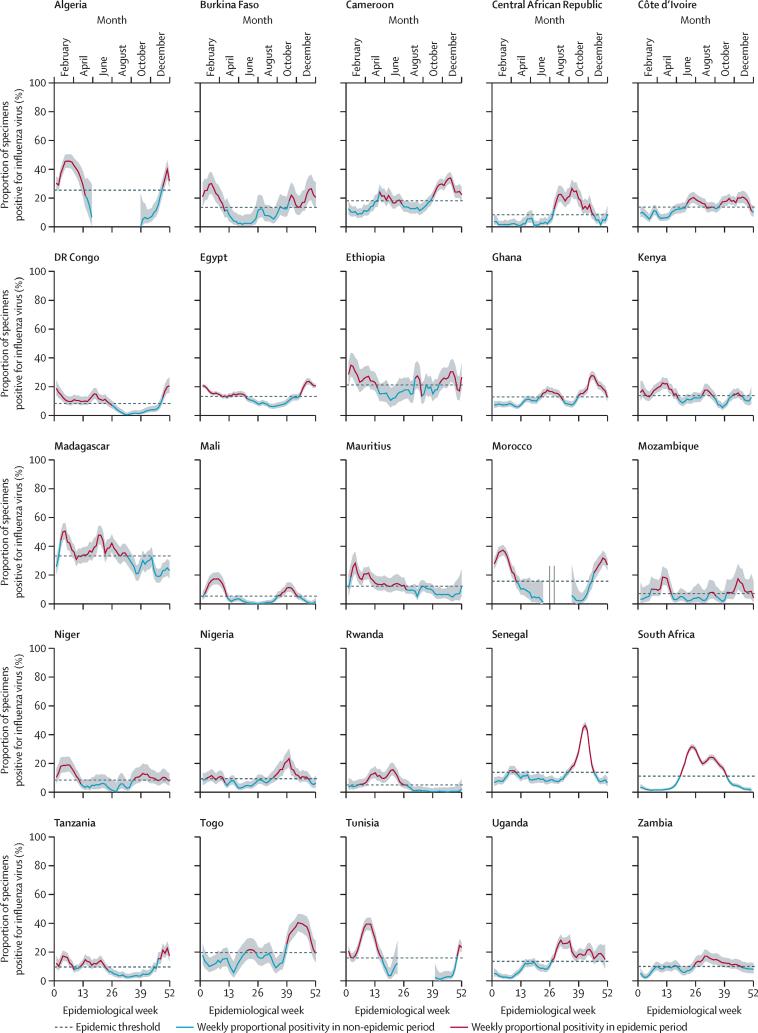
We used publicly available sentinel data from African countries reporting to the WHO Global Influenza Surveillance and Response FluNet platform that had 3-10 years of data collected during 2010-19. We calculated a 3-week moving proportion of samples positive for influenza virus and assessed epidemic timing using an aggregate average method. The start and end of each epidemic were defined as the first week when the proportion of positive samples exceeded or went below the annual mean, respectively, for at least 3 consecutive weeks. We categorised countries into five epidemic patterns: northern hemisphere-dominant, with epidemics occurring in October-March; southern hemisphere-dominant, with epidemics occurring in April-September; primarily northern hemisphere with some epidemic activity in southern hemisphere months; primarily southern hemisphere with some epidemic activity in northern hemisphere months; and year-round influenza transmission without a discernible northern hemisphere or southern hemisphere predominance (no clear pattern).
FINDINGS
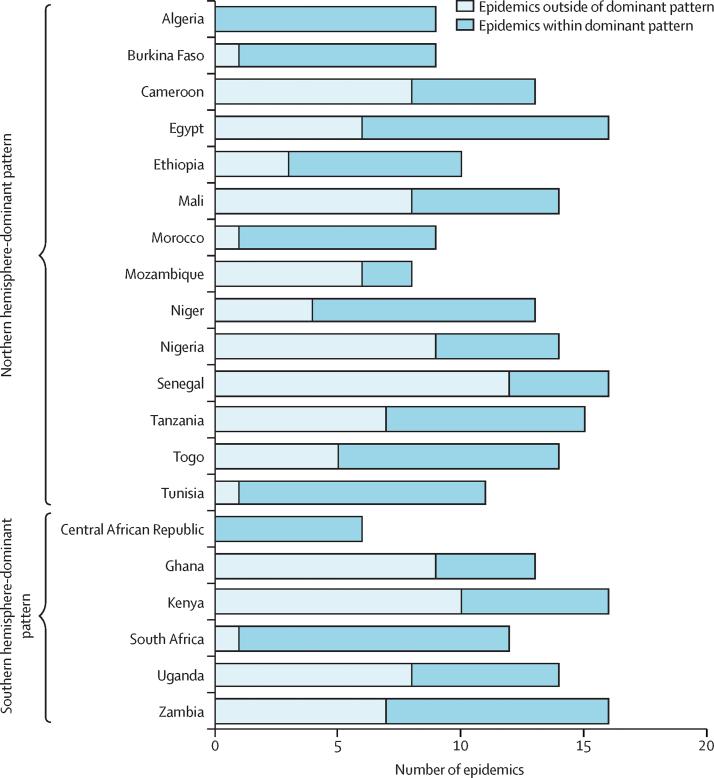
Of the 34 countries reporting data to FluNet, 25 had at least 3 years of data, representing 46% of the countries in Africa and 89% of Africa's population. Study countries reported RT-PCR respiratory virus results for a total of 503 609 specimens (median 12 971 [IQR 9607-20 960] per country-year), of which 74 001 (15%; median 2078 [IQR 1087-3008] per country-year) were positive for influenza viruses. 248 epidemics occurred across 236 country-years of data (median 10 [range 7-10] per country). Six (24%) countries had a northern hemisphere pattern (Algeria, Burkina Faso, Egypt, Morocco, Niger, and Tunisia). Eight (32%) had a primarily northern hemisphere pattern with some southern hemisphere epidemics (Cameroon, Ethiopia, Mali, Mozambique, Nigeria, Senegal, Tanzania, and Togo). Three (12%) had a primarily southern hemisphere pattern with some northern hemisphere epidemics (Ghana, Kenya, and Uganda). Three (12%) had a southern hemisphere pattern (Central African Republic, South Africa, and Zambia). Five (20%) had no clear pattern (Côte d'Ivoire, DR Congo, Madagascar, Mauritius, and Rwanda).
INTERPRETATION
Most countries had identifiable influenza epidemic periods that could be used to inform authorities of non-seasonal and seasonal influenza activity, guide vaccine timing, and promote timely interventions.
FUNDING
None.
TRANSLATIONS
For the Berber, Luganda, Xhosa, Chewa, Yoruba, Igbo, Hausa and Afan Oromo translations of the abstract see Supplementary Materials section.
背景
利用特定国家的监测数据来描述流感流行活动,可以为流感疫苗接种的时机提供信息。我们分析了来自非洲国家的监测数据,以描述季节性流感流行的时间,为国家疫苗接种策略提供信息。
方法
我们使用了世界卫生组织全球流感监测和应对 FluNet 平台报告的来自非洲国家的公开哨兵数据,这些数据在 2010-19 年期间收集了 3-10 年的数据。我们计算了 3 周移动比例,即流感病毒阳性样本的比例,并使用综合平均法评估流行时间。每个流行期的开始和结束分别定义为阳性样本比例首次超过或低于年度平均值的第一周,连续至少 3 周。我们将国家分为五种流行模式:北半球占主导地位,流行期在 10 月至 3 月;南半球占主导地位,流行期在 4 月至 9 月;主要是北半球,南半球有一些流行期;主要是南半球,北半球有一些流行期;以及无明显北半球或南半球优势的全年流感传播(无明显模式)。
结果
在向 FluNet 报告数据的 34 个国家中,有 25 个国家至少有 3 年的数据,占非洲国家的 46%,占非洲人口的 89%。研究国家报告了总共 503609 份 RT-PCR 呼吸道病毒检测结果(每个国家/年中位数为 12971 [IQR 9607-20960]),其中 74001 份(15%;中位数 2078 [IQR 1087-3008])为流感病毒阳性。在 236 个国家/年的数据中,发生了 248 次流行(中位数为每个国家/年 10 次[范围为 7-10])。有 6 个(24%)国家存在北半球模式(阿尔及利亚、布基纳法索、埃及、摩洛哥、尼日尔和突尼斯)。8 个(32%)国家主要是北半球模式,南半球有一些流行期(喀麦隆、埃塞俄比亚、马里、莫桑比克、尼日利亚、塞内加尔、坦桑尼亚和多哥)。3 个(12%)国家主要是南半球模式,北半球有一些流行期(加纳、肯尼亚和乌干达)。3 个(12%)国家存在南半球模式(中非共和国、南非和赞比亚)。5 个(20%)国家无明显模式(科特迪瓦、刚果民主共和国、马达加斯加、毛里求斯和卢旺达)。
解释
大多数国家都有可识别的流感流行期,可以为当局提供非季节性和季节性流感活动的信息,指导疫苗接种时机,并促进及时干预。
资金
无。

 Zotero 插件