
2011-2017 年期间非洲流感监测能力的提升。
Influenza surveillance capacity improvements in Africa during 2011-2017.
机构信息
Influenza Division, National Center for Immunization and Respiratory Diseases, Centers for Disease Control and Prevention, Atlanta, GA, USA.
London School of Hygiene and Tropical Medicine, London, UK.
出版信息
Influenza Other Respir Viruses. 2021 Jul;15(4):495-505. doi: 10.1111/irv.12818. Epub 2020 Nov 4.
BACKGROUND
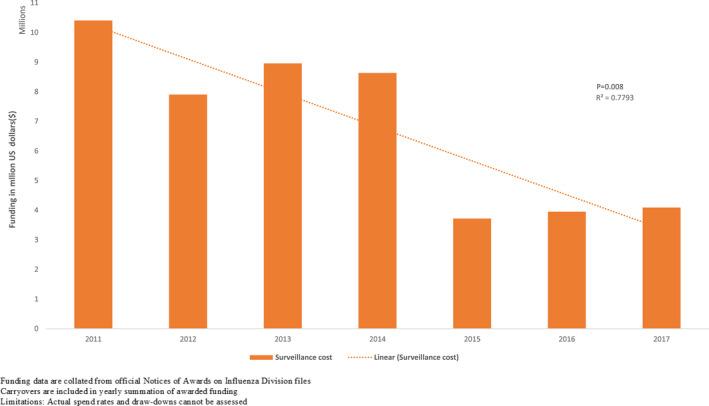
Influenza surveillance helps time prevention and control interventions especially where complex seasonal patterns exist. We assessed influenza surveillance sustainability in Africa where influenza activity varies and external funds for surveillance have decreased.
METHODS
We surveyed African Network for Influenza Surveillance and Epidemiology (ANISE) countries about 2011-2017 surveillance system characteristics. Data were summarized with descriptive statistics and analyzed with univariate and multivariable analyses to quantify sustained or expanded influenza surveillance capacity in Africa.
RESULTS
Eighteen (75%) of 24 ANISE members participated in the survey; their cumulative population of 710 751 471 represent 56% of Africa's total population. All 18 countries scored a mean 95% on WHO laboratory quality assurance panels. The number of samples collected from severe acute respiratory infection case-patients remained consistent between 2011 and 2017 (13 823 vs 13 674 respectively) but decreased by 12% for influenza-like illness case-patients (16 210 vs 14 477). Nine (50%) gained capacity to lineage-type influenza B. The number of countries reporting each week to WHO FluNet increased from 15 (83%) in 2011 to 17 (94%) in 2017.
CONCLUSIONS
Despite declines in external surveillance funding, ANISE countries gained additional laboratory testing capacity and continued influenza testing and reporting to WHO. These gains represent important achievements toward sustainable surveillance and epidemic/pandemic preparedness.
背景
流感监测有助于及时采取预防和控制措施,尤其是在存在复杂季节性模式的地方。我们评估了非洲的流感监测可持续性,因为那里的流感活动存在差异,而且监测的外部资金减少了。
方法
我们调查了非洲流感监测和流行病学网络(ANISE)国家 2011-2017 年监测系统的特征。使用描述性统计数据对数据进行总结,并进行单变量和多变量分析,以量化非洲流感监测能力的持续或扩大。
结果
24 个 ANISE 成员国中有 18 个(75%)参加了调查;它们的累计人口为 710751471 人,占非洲总人口的 56%。所有 18 个国家在世界卫生组织(WHO)实验室质量保证小组中得分均为 95%。从严重急性呼吸道感染病例患者中采集的样本数量在 2011 年至 2017 年期间保持一致(分别为 13823 和 13674),但流感样病例患者的样本数量减少了 12%(分别为 16210 和 14477)。9 个(50%)国家获得了乙型流感谱系型的检测能力。向世界卫生组织 FluNet 报告的国家数量从 2011 年的 15 个(83%)增加到 2017 年的 17 个(94%)。
结论
尽管外部监测资金有所减少,但 ANISE 国家获得了额外的实验室检测能力,并继续向世界卫生组织报告流感检测情况。这些进展是朝着可持续监测和流行病/大流行准备工作取得的重要成就。

 Zotero 插件