
纤维素分解酶处理与芬顿氧化法用于分析轮胎橡胶颗粒中微塑料的比较
Comparison of cellulolytic enzyme treatment and Fenton oxidation for analysis of microplastics in tire rubber particles.
作者信息
Lee Soyoung, Yamamoto Kanako, Tobino Tomohiro, Nakajima Fumiyuki
机构信息
Environmental Science Center, The University of Tokyo, Bunkyo-ku, Tokyo, Japan.
Department of Urban Engineering, Graduate School of Engineering, The University of Tokyo, Bunkyo-ku, Tokyo, Japan.
出版信息
Water Environ Res. 2025 Mar;97(3):e70053. doi: 10.1002/wer.70053.
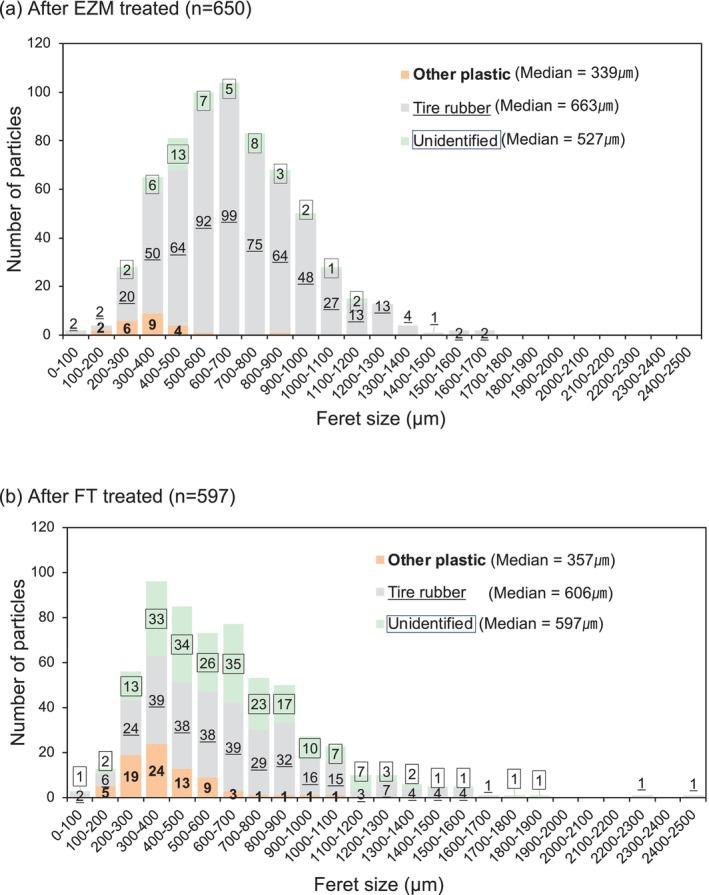
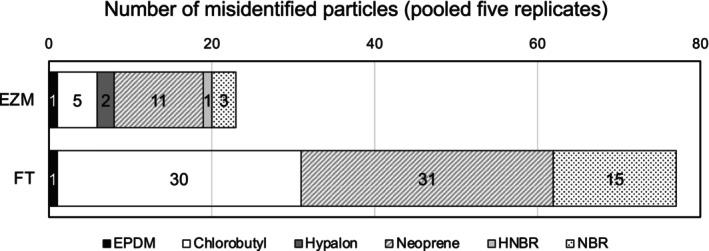
Uncertainties in the quantification of microplastics in various products arise from the applied pretreatment processes. Road dust, a significant source of microplastics, requires precise quantification methods to ensure accuracy. In this study, we examined the impact of pretreatment processes on the accuracy of microplastic quantification in road dust, specifically focusing on tire rubber particles. We compared the effects of cellulolytic enzyme (EZM) and Fenton (FT) treatments by analyzing the changes in particle number, size, shape, and identification accuracy for each treatment. Both treatments increased the number of tire rubber particles, reduced their size, and made them more spherical. Notably, the FT treatment resulted in smaller particle parameters (Feret, MinFeret, Major, Minor, and Area) compared to the EZM treatment. Identification accuracy also varied, with 89% of tire rubber particles identified after EZM treatment, compared to 51% after FT treatment. Furthermore, microplastic volume was overestimated by 4.5% following EZM treatment and underestimated by 21% after FT treatment. These findings demonstrate that pretreatment procedures significantly influence the accuracy of microplastic quantification. Our study underscores the need for further research to determine whether current microplastic estimates are accurate, as the estimated volume can change due to organic removal processes. PRACTITIONER POINTS: Pretreatment to eliminate organic materials is necessary for improving the efficiency of microplastic analysis. Tire rubber particles (TRPs) are a significant plastic material found in urban surfaces. Pretreatment can reduce the size of TRPs and lead to material misidentification of materials. Compared to the Fenton oxidation treatment, cellulolytic enzyme treatment results in less particle fragmentation and volume modification.
各种产品中微塑料定量的不确定性源于所应用的预处理过程。道路灰尘是微塑料的一个重要来源,需要精确的定量方法来确保准确性。在本研究中,我们研究了预处理过程对道路灰尘中微塑料定量准确性的影响,特别关注轮胎橡胶颗粒。我们通过分析每种处理的颗粒数量、尺寸、形状和识别准确性的变化,比较了纤维素酶(EZM)处理和芬顿(FT)处理的效果。两种处理都增加了轮胎橡胶颗粒的数量,减小了它们的尺寸,并使它们更接近球形。值得注意的是,与EZM处理相比,FT处理导致颗粒参数(费雷特直径、最小费雷特直径、长轴、短轴和面积)更小。识别准确性也有所不同,EZM处理后89%的轮胎橡胶颗粒被识别,而FT处理后为51%。此外,EZM处理后微塑料体积被高估了4.5%,FT处理后被低估了21%。这些发现表明预处理程序对微塑料定量的准确性有显著影响。我们的研究强调需要进一步研究以确定当前微塑料估计是否准确,因为估计体积可能因有机去除过程而改变。从业者要点:消除有机材料的预处理对于提高微塑料分析效率是必要的。轮胎橡胶颗粒(TRPs)是城市表面发现的一种重要塑料材料。预处理可以减小TRPs的尺寸并导致材料误识别。与芬顿氧化处理相比,纤维素酶处理导致的颗粒破碎和体积改变较少。

 Zotero 插件