
脑转移瘤的分子基础
Molecular Underpinnings of Brain Metastases.
作者信息
Jacome Maria A, Wu Qiong, Chen Jianan, Mohamed Zaynab Sidi, Mokhtari Sepideh, Piña Yolanda, Etame Arnold B
机构信息
Department of Immunology, H. Lee Moffitt Cancer Center & Research Institute, Tampa, FL 33612, USA.
Department of Neuro-Oncology, H. Lee Moffitt Cancer Center & Research Institute, Tampa, FL 33612, USA.
出版信息
Int J Mol Sci. 2025 Mar 5;26(5):2307. doi: 10.3390/ijms26052307.
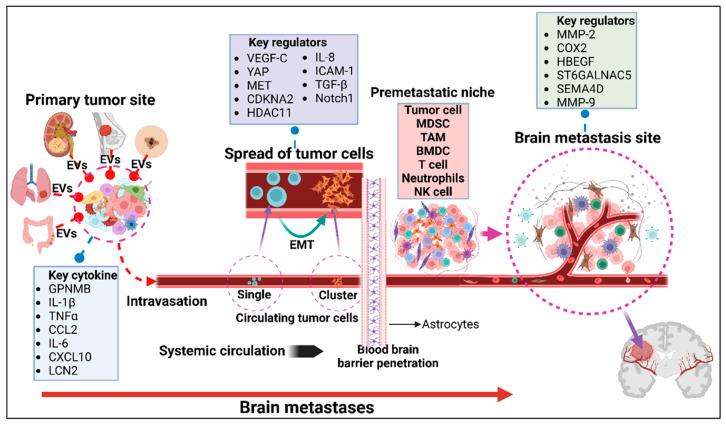
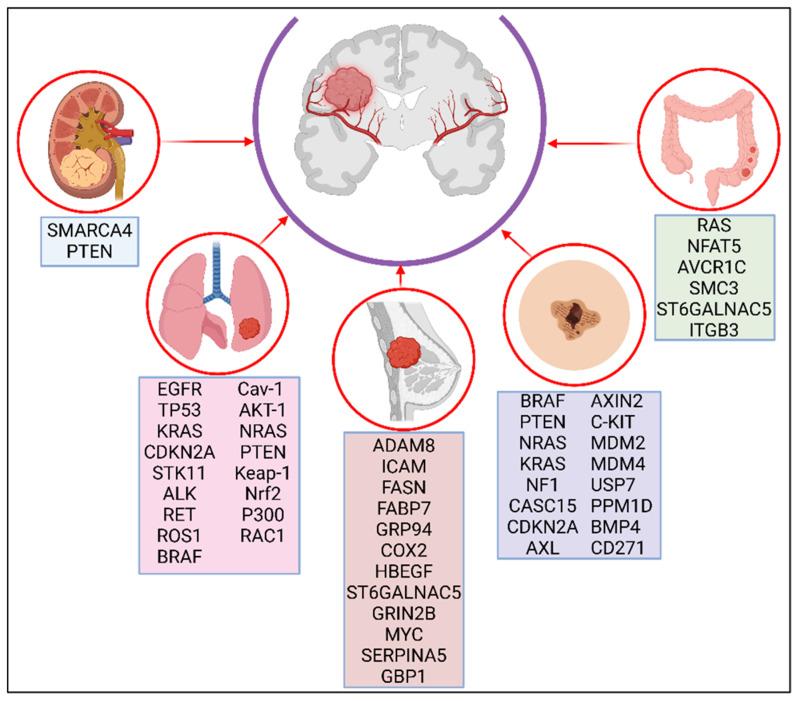
Brain metastases are the most commonly diagnosed type of central nervous system tumor, yet the mechanisms of their occurrence are still widely unknown. Lung cancer, breast cancer, and melanoma are the most common etiologies, but renal and colorectal cancers have also been described as metastasizing to the brain. Regardless of their origin, there are common mechanisms for progression to all types of brain metastases, such as the creation of a suitable tumor microenvironment in the brain, priming of tumor cells, adaptations to survive spreading in lymphatic and blood vessels, and development of mechanisms to penetrate the blood-brain barrier. However, there are complex genetic and molecular interactions that are specific to every type of primary tumor, making the understanding of the metastatic progression of tumors to the brain a challenging field of study. In this review, we aim to summarize current knowledge on the pathophysiology of brain metastases, from specific genetic characteristics of commonly metastatic tumors to the molecular and cellular mechanisms involved in progression to the central nervous system. We also briefly discuss current challenges in targeted therapies for brain metastases and how there is still a gap in knowledge that needs to be overcome to improve patient outcomes.
脑转移瘤是中枢神经系统肿瘤中最常被诊断出的类型,但其发生机制仍广为人知。肺癌、乳腺癌和黑色素瘤是最常见的病因,但肾癌和结直肠癌也被描述为会转移至脑部。无论其起源如何,各类脑转移瘤的进展都存在共同机制,例如在脑内创建适宜的肿瘤微环境、使肿瘤细胞致敏、适应在淋巴管和血管中扩散生存以及形成穿透血脑屏障的机制。然而,每种原发性肿瘤都存在复杂的基因和分子相互作用,这使得理解肿瘤向脑转移的进展成为一个具有挑战性的研究领域。在本综述中,我们旨在总结关于脑转移瘤病理生理学的现有知识,从常见转移瘤的特定基因特征到进展至中枢神经系统所涉及的分子和细胞机制。我们还简要讨论了脑转移瘤靶向治疗当前面临的挑战,以及在改善患者预后方面仍需填补的知识空白。
 Zotero 插件