
血清混合谱系激酶结构域样蛋白在急性原发性幕上脑出血中的预后意义评估:一项多中心前瞻性队列研究
Evaluation of Prognostic Implication of Serum Mixed Lineage Kinase Domain-Like Protein in Acute Primary Supratentorial Intracerebral Hemorrhage: A Multicenter Prospective Cohort Study.
作者信息
Ma Yijun, Wang Jun, Tang Chao, Liu Jin, Wu Xiaoyu, Dong Xiaoqiao, Du Quan, Li Wei, Lv Xuan, Zhu Suijun
机构信息
Department of Neurosurgery, First People's Hospital of Linping District, Hangzhou, China.
Department of Neurosurgery, Linping Campus, the Second Affiliated Hospital of Zhejiang University School of Medicine, Hangzhou, China.
出版信息
Brain Behav. 2025 Mar;15(3):e70424. doi: 10.1002/brb3.70424.
OBJECTIVE
Mixed lineage kinase domain-like protein (MLKL) is a key component of necroptosis. Here, serum MLKL levels were measured with the intent to assess its prognostic significance in acute intracerebral hemorrhage (ICH).
METHODS
A collective of 161 patients with acute primary supratentorial ICH and 73 controls were enlisted in this multicenter prospective cohort study. Serum MLKL levels were measured at admission in all patients, at study entry in all controls, and on post-ICH days 1, 3, 5, 7, 10, and 15 in 73 of all patients. Multivariate analyses were adopted to assess relationships between serum MLKL levels, severity, early neurological deterioration (END), poststroke 6-month modified Rankin Scale (mRS) scores, and poor prognosis (mRS scores of 3-6).
RESULTS
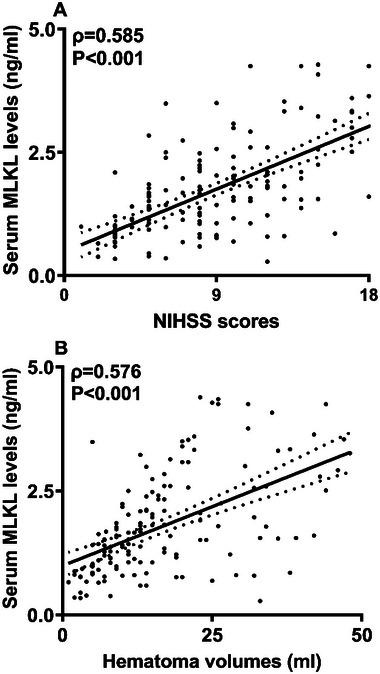
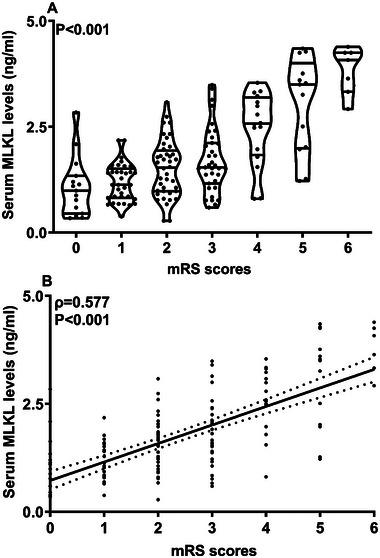
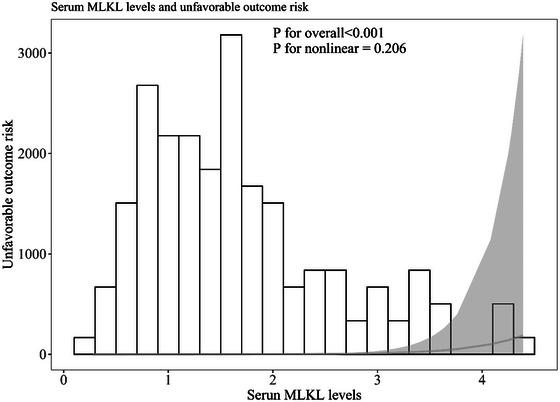
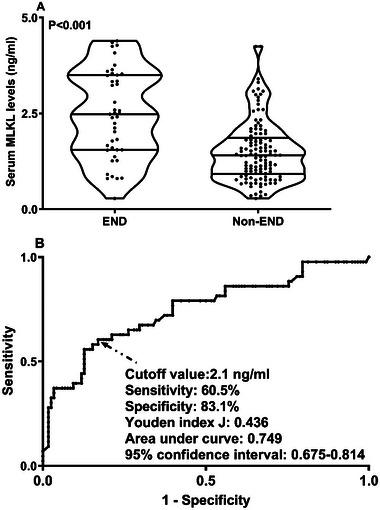
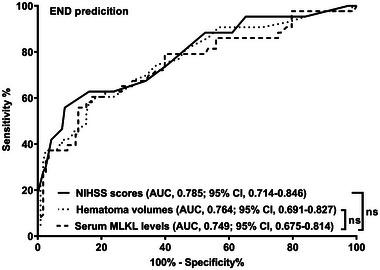
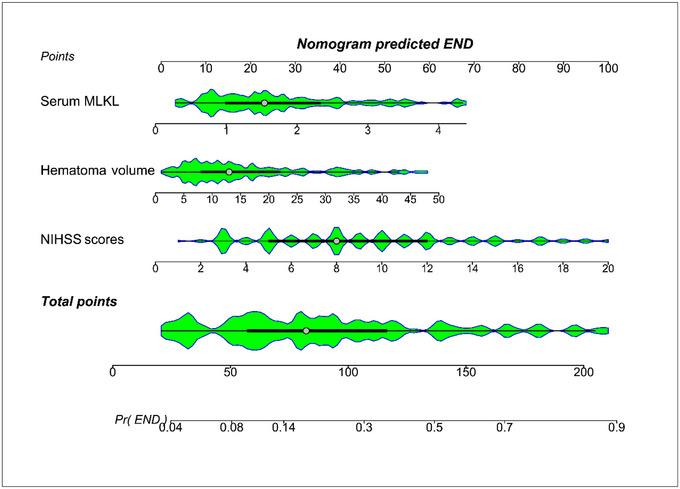
Patients, relative to controls, had significantly promoted serum MLKL levels from admission until Day 15, with the peaking value at Day 3 (p < 0.001). Admission serum MLKL levels were independently correlated with National Institutes of Health Stroke Scale (NIHSS) scores (beta, 0.133; 95% confidence interval (CI), 0.088-0.178; p = 0.011), hematoma volume (beta, 0.051; 95%CI, 0.037-0.064; p = 0.001), and 6-month mRS scores (beta, 0.707; 95%CI, 0.487-0.927; p = 0.023), as well as independently predicted END (odds ratio, 1.902; 95%CI, 1.229-2.945; p = 0.014) and poor prognosis (odds ratio, 2.286; 95%CI, 1.324-3.946; p = 0.038). Admission serum MLKL levels were linearly connected to risks of poor prognosis (p > 0.05) and END (p > 0.05), had no interactions with age, gender, hypertension, and so forth (all p > 0.05), and possessed similar areas under the receiver operating characteristic curve to NIHSS scores and hematoma volume (all p > 0.05). The models integrating serum MLKL levels, NIHSS scores, and hematoma volume were graphically represented by nomogram and predicted END and poor prognosis with a good consistency under the calibration curve.
CONCLUSIONS
Serum MLKL levels are markedly increased shortly following ICH, and may accurately mirror disease severity, and efficaciously anticipate END and six-month bad prognosis of patients, strengthening serum MLKL as a prognostic biomarker of good prospect in ICH.
目的
混合谱系激酶结构域样蛋白(MLKL)是坏死性凋亡的关键组成部分。在此,测量血清MLKL水平旨在评估其在急性脑出血(ICH)中的预后意义。
方法
本多中心前瞻性队列研究纳入了161例急性原发性幕上ICH患者和73例对照。所有患者在入院时、所有对照在研究入组时测量血清MLKL水平,73例患者在ICH后第1、3、5、7、10和15天测量血清MLKL水平。采用多变量分析评估血清MLKL水平、严重程度、早期神经功能恶化(END)、卒中后6个月改良Rankin量表(mRS)评分和不良预后(mRS评分为3 - 6)之间的关系。
结果
与对照组相比,患者从入院到第15天血清MLKL水平显著升高,在第3天达到峰值(p < 0.001)。入院时血清MLKL水平与美国国立卫生研究院卒中量表(NIHSS)评分(β,0.133;95%置信区间(CI),0.088 - 0.178;p = 0.011)、血肿体积(β,0.051;95%CI,0.037 - 0.064;p = 0.001)和6个月mRS评分(β,0.707;95%CI,0.487 - 0.927;p = 0.023)独立相关,并且独立预测END(比值比,1.902;95%CI,1.229 - 2.945;p = 0.014)和不良预后(比值比,2.286;95%CI,1.324 - 3.946;p = 0.038)。入院时血清MLKL水平与不良预后风险(p > 0.05)和END风险(p > 0.05)呈线性相关,与年龄、性别、高血压等无相互作用(所有p > 0.05),并且与NIHSS评分和血肿体积在受试者工作特征曲线下的面积相似(所有p > 0.05)。整合血清MLKL水平、NIHSS评分和血肿体积的模型通过列线图进行图形表示,并在校准曲线下对END和不良预后进行了良好一致性的预测。
结论
ICH后血清MLKL水平迅速显著升高,可能准确反映疾病严重程度,并有效预测患者的END和6个月不良预后,强化了血清MLKL作为ICH中有良好前景的预后生物标志物的地位。








 Zotero 插件