
认知障碍老年人的社会参与模式及其与后续认知功能的关联:一项潜在类别分析
Social participation patterns and associations with subsequent cognitive function in older adults with cognitive impairment: a latent class analysis.
作者信息
Li Xin, Feng Haishan, Chen Qingling
机构信息
Zhongshan Hospital, Xiamen University, Xiamen, China.
出版信息
Front Med (Lausanne). 2025 Feb 27;12:1493359. doi: 10.3389/fmed.2025.1493359. eCollection 2025.
BACKGROUND
Social participation (SP) has been associated with cognitive benefits among older adults; however, little is known about SP patterns and their relationships with cognitive function in cognitively impaired populations. This study aimed to identify SP patterns among cognitively impaired older individuals and evaluate their associations with subsequent cognitive function, specifically mental intactness and episodic memory.
METHODS
Data were drawn from the China Health and Retirement Longitudinal Study (CHARLS), including 5,673 individuals aged 60 years and older with cognitive impairment from 2015 to 2018. Latent class analysis (LCA) was used to identify SP patterns, and hierarchical linear regression analyses were conducted to examine associations between these patterns and cognitive function.
RESULTS
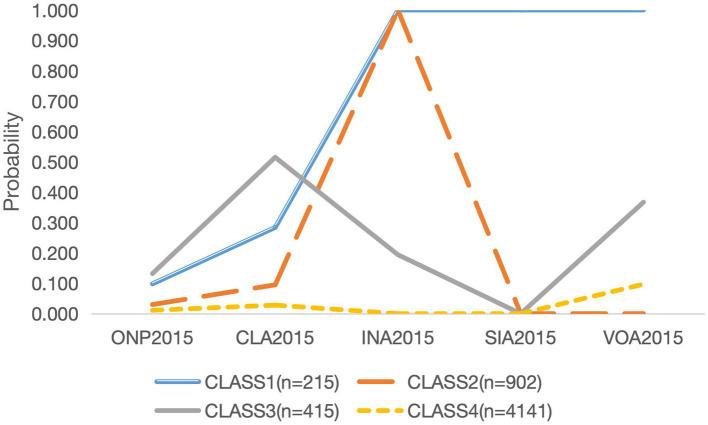
Four distinct SP patterns were identified: "Offline Social Participation Group" (Class 1), "Intellectual Social Participation Only Group" (Class 2), "Club and Volunteer Activities Group" (Class 3), and "Minimal Social Participation Group" (Class 4). The Class 4 comprised the majority (73%) and exhibited the poorest cognitive outcomes. Compared to the Class 4, Class 2 showed significant improvements in mental intactness ( < 0.001) and episodic memory ( = 0.022), while Class 3 demonstrated significant improvements in mental intactness ( = 0.032) but not episodic memory. Class 1 showed significant improvements in episodic memory ( = 0.023).
CONCLUSION
This study highlights the cognitive benefits of social participation, particularly intellectual activities, for older adults with cognitive impairment. Targeted interventions promoting SP, especially intellectual activities, are essential to mitigate cognitive decline and improve cognitive resilience in vulnerable populations.
背景
社会参与(SP)与老年人的认知益处相关;然而,对于认知障碍人群的社会参与模式及其与认知功能的关系知之甚少。本研究旨在识别认知障碍老年人的社会参与模式,并评估它们与后续认知功能的关联,特别是心理完整性和情景记忆。
方法
数据来自中国健康与养老追踪调查(CHARLS),包括2015年至2018年5673名年龄在60岁及以上的认知障碍个体。采用潜在类别分析(LCA)来识别社会参与模式,并进行分层线性回归分析以检验这些模式与认知功能之间的关联。
结果
识别出四种不同的社会参与模式:“线下社会参与组”(第1类)、“仅智力社会参与组”(第2类)、“俱乐部和志愿者活动组”(第3类)和“极少社会参与组”(第4类)。第4类占大多数(73%),且认知结果最差。与第4类相比,第2类在心理完整性(<0.001)和情景记忆(=0.022)方面有显著改善,而第3类在心理完整性(=0.032)方面有显著改善,但情景记忆方面没有。第1类在情景记忆方面有显著改善(=0.023)。
结论
本研究强调了社会参与,特别是智力活动,对认知障碍老年人的认知益处。促进社会参与,尤其是智力活动的针对性干预措施,对于减轻认知衰退和提高弱势群体的认知恢复力至关重要。
 Zotero 插件