
德国的区域新冠疫情防控措施及其对主观幸福感的影响:基于大规模人口调查数据观察随时间变化的趋势
Regional COVID-19 measures and effects on subjective well-being in Germany: observing trends over time with data from a large population survey.
作者信息
Finne Emily, Nowak Anna Christina, Razum Oliver
机构信息
School of Public Health, Department of Epidemiology and International Public Health, Bielefeld University, Bielefeld, Germany.
出版信息
Front Public Health. 2025 Feb 27;13:1523691. doi: 10.3389/fpubh.2025.1523691. eCollection 2025.
BACKGROUND
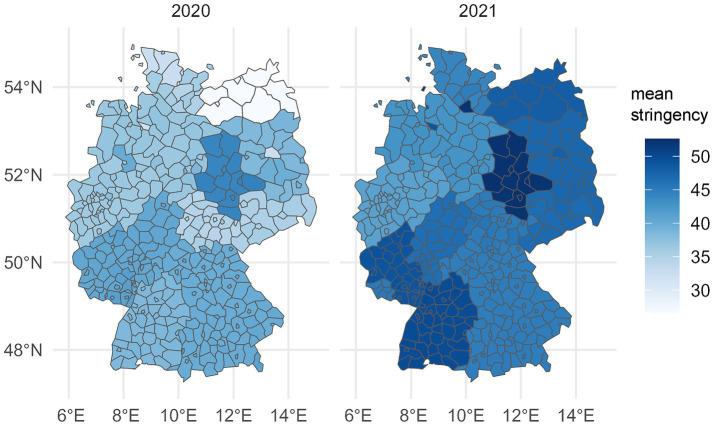
COVID-19 measures in Germany varied during the pandemic, and it seems natural that in addition to factors such as incidence, health system capacity, etc., these interventions and their social and economic consequences had an impact on the evolution of the population's well-being. Since the beginning of the pandemic, there has been a suspicion that the health burden would fall mainly on population groups with a lower socio-economic status, and that COVID-19, including the policy measures, could therefore contribute to increasing social inequalities in health. We examine several indicators of well-being over the course of the pandemic, analyze the effect of the stringency of the measures on subjective well-being and the extent to which certain social groups were particularly affected.
METHODS
Our analyses are based on 2020 and 2021 data from the German Socio-Economic Panel (SOEP), complemented by various regional indicators, including the COVID-19 measures. Data on subjective well-being during the pandemic phases were regressed on the phases, socio-demographic, economic and health-related indicators, stringency of measures and other regional indicators in multi-level models with the district as the top level. Up to = 29,871 observations in 401 districts were included.
RESULTS
Overall, there was little decline in well-being up to the end of the observation period, and even some increase. When the effect of the stringency of the measures was taken into account, the changes were partially attenuated. However, stringency had little direct effect on well-being. People with disabilities and chronic pre-existing conditions were particularly affected by a reduction in well-being. In some cases, COVID-19 measures had slightly different effects in these groups.
CONCLUSION
The effects of socio-economic indicators were not strong enough to suggest that lower social status is generally associated with a negative trend in well-being. According to our results, people with disabilities and chronic diseases, including severe obesity, should be given more attention in the future. A change in time-related outcomes when considering COVID-19 measures could indicate adjustment effects on well-being.
背景
在疫情期间,德国的新冠疫情防控措施有所不同。除发病率、卫生系统能力等因素外,这些干预措施及其社会和经济后果对民众福祉的演变产生影响似乎是自然而然的。自疫情开始以来,人们一直怀疑健康负担将主要落在社会经济地位较低的人群身上,因此新冠疫情,包括政策措施,可能会加剧健康方面的社会不平等。我们研究了疫情期间的几个福祉指标,分析了措施严格程度对主观福祉的影响以及某些社会群体受影响的程度。
方法
我们的分析基于德国社会经济面板(SOEP)2020年和2021年的数据,并辅以包括新冠疫情防控措施在内的各种区域指标。在以地区为最高层级的多层次模型中,将疫情阶段的主观福祉数据与阶段、社会人口、经济和健康相关指标、措施严格程度及其他区域指标进行回归分析。纳入了401个地区的多达29,871条观测数据。
结果
总体而言,在观察期结束前福祉几乎没有下降,甚至有所上升。考虑到措施严格程度的影响后,变化有所减弱。然而,严格程度对福祉的直接影响很小。残疾人和患有慢性基础疾病的人福祉下降受到的影响尤为明显。在某些情况下,新冠疫情防控措施对这些群体的影响略有不同。
结论
社会经济指标的影响不够强烈,不足以表明较低的社会地位通常与福祉的负面趋势相关。根据我们的结果,未来应更加关注残疾人和患有慢性疾病的人,包括重度肥胖者。在考虑新冠疫情防控措施时,与时间相关的结果变化可能表明对福祉的调整效应。
 Zotero 插件