
CD103+CD56+固有淋巴细胞与肿瘤微环境中CD8+ T细胞谱的改变有关。
CD103+CD56+ ILCs Are Associated with an Altered CD8+ T-cell Profile within the Tumor Microenvironment.
作者信息
Chung Douglas C, Shakfa Noor, Vakharia Jehan, Warner Kathrin, Jacquelot Nicolas, Sayad Azin, Han SeongJun, Ghaedi Maryam, Garcia-Batres Carlos R, Sotty Jules, Azarmina Arvin, Nowlan Ferris, Chen Edward L Y, Zon Michael, Elford Alisha R, Wang Ben X, Nguyen Linh T, Mrkonjic Miralem, Clarke Blaise A, Bernardini Marcus Q, Haibe-Kains Benjamin, Ferguson Sarah E, Crome Sarah Q, Jackson Hartland W, Ohashi Pamela S
机构信息
Department of Immunology, University of Toronto, Toronto, Canada.
Tumour Immunotherapy Program, Princess Margaret Cancer Centre, University Health Network, Toronto, Canada.
出版信息
Cancer Immunol Res. 2025 Apr 2;13(4):527-546. doi: 10.1158/2326-6066.CIR-24-0151.
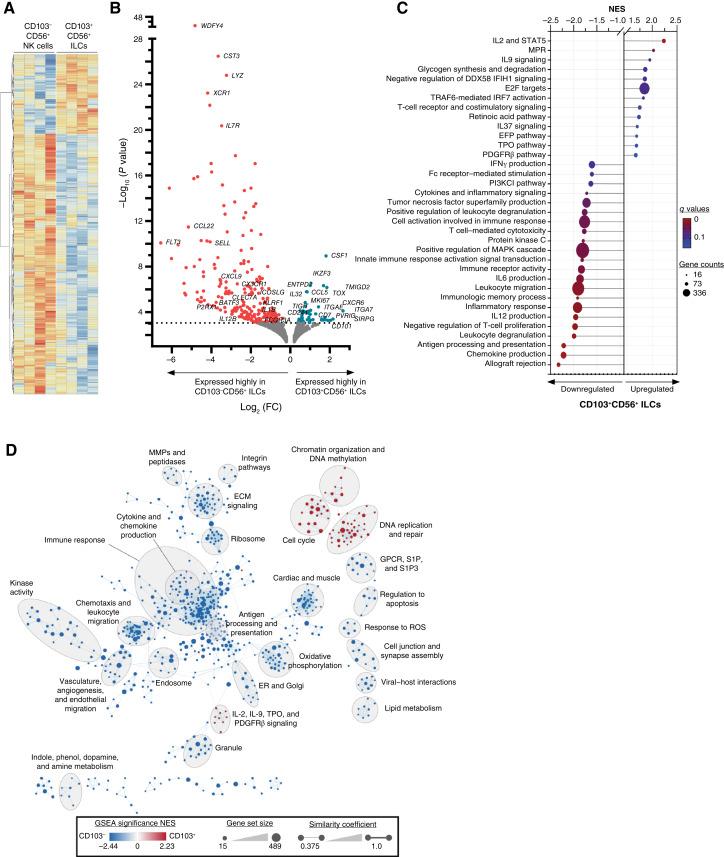
Immunotherapies have had unprecedented success in the treatment of multiple cancer types, albeit with variable response rates. Unraveling the complex network of immune cells within the tumor microenvironment (TME) may provide additional insights to enhance antitumor immunity and improve clinical response. Many studies have shown that NK cells or innate lymphoid cells (ILC) have regulatory capacity. Here, we identified CD103 as a marker that was found on CD56+ cells that were associated with a poor proliferative capacity of tumor-infiltrating lymphocytes in culture. We further demonstrated that CD103+CD56+ ILCs isolated directly from tumors represented a distinct ILC population that expressed unique surface markers (such as CD49a and CD101), transcription factor networks, and transcriptomic profiles compared with CD103-CD56+ NK cells. Using single-cell multiomic and spatial approaches, we found that these CD103+CD56+ ILCs were associated with CD8+ T cells with reduced expression of granzyme B. Thus, this study identifies a population of CD103+CD56+ ILCs with potentially inhibitory functions that are associated with a TME that includes CD8+ T cells with poor antitumor activity. Further studies focusing on these cells may provide additional insights into the biology of an inhibitory TME.
免疫疗法在多种癌症类型的治疗中取得了前所未有的成功,尽管反应率各不相同。揭示肿瘤微环境(TME)内复杂的免疫细胞网络可能会为增强抗肿瘤免疫力和改善临床反应提供更多见解。许多研究表明,自然杀伤细胞(NK细胞)或固有淋巴细胞(ILC)具有调节能力。在此,我们确定CD103是一种在CD56+细胞上发现的标志物,这些细胞与培养物中肿瘤浸润淋巴细胞的增殖能力较差有关。我们进一步证明,直接从肿瘤中分离出的CD103+CD56+ ILC代表了一个独特的ILC群体,与CD103-CD56+ NK细胞相比,它们表达独特的表面标志物(如CD49a和CD101)、转录因子网络和转录组谱。使用单细胞多组学和空间方法,我们发现这些CD103+CD56+ ILC与颗粒酶B表达降低的CD8+ T细胞有关。因此,本研究确定了一群具有潜在抑制功能的CD103+CD56+ ILC,它们与一个包含抗肿瘤活性较差的CD8+ T细胞的TME有关。对这些细胞的进一步研究可能会为抑制性TME的生物学特性提供更多见解。




 Zotero 插件