
用于实时和长期骨关节重建的原位组织工程活性关节假体。
Living joint prosthesis with in-situ tissue engineering for real-time and long-term osteoarticular reconstruction.
作者信息
Sun Wei, Wu Hongwei, Yan Yiyang, Zhang Xianzhu, Yao Xudong, Li Rui, Zuo Jingyi, Li Wenyue, Ouyang Hongwei
机构信息
Department of Sports Medicine of the Second Affiliated Hospital, and Liangzhu Laboratory, Zhejiang University School of Medicine, Hangzhou, China.
Dr. Li Dak Sum & Yip Yio Chin Center for Stem Cells and Regenerative Medicine, Zhejiang University School of Medicine, Hangzhou, China.
出版信息
Bioact Mater. 2025 Feb 26;48:431-442. doi: 10.1016/j.bioactmat.2025.01.036. eCollection 2025 Jun.
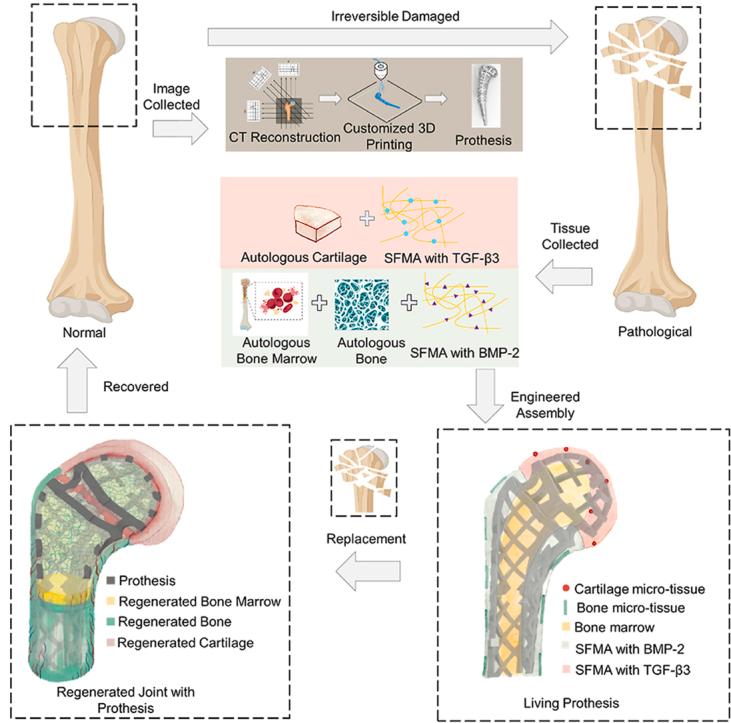
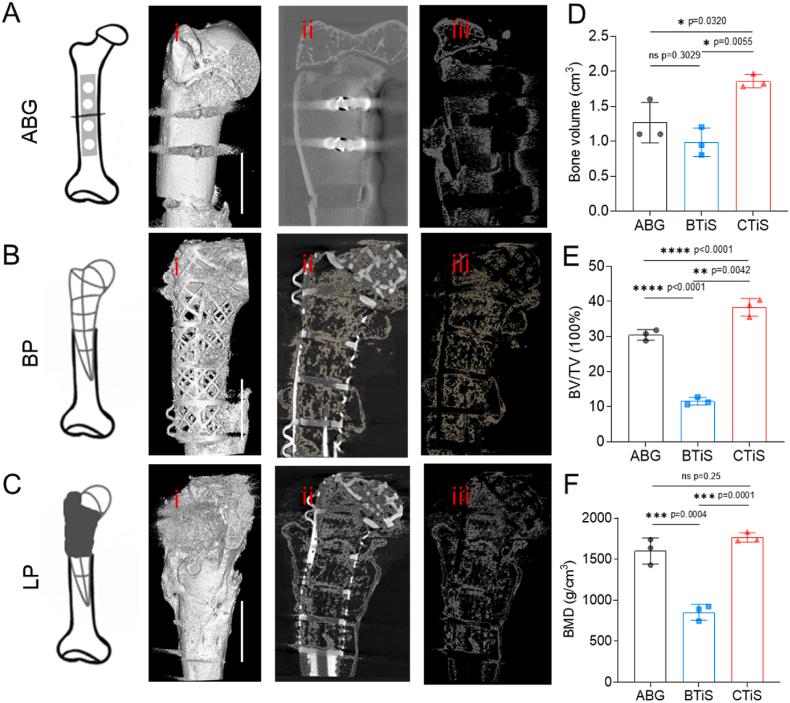
The reconstruction of large osteoarticular defects caused by tumor resection or severe trauma remains a clinical challenge. Current metal prostheses exhibit a lack of osteo-chondrogenic functionality and demonstrate poor integration with host tissues. This often results in complications such as abnormal bone absorption and prosthetic loosening, which may necessitate secondary revisions. Here, we propose a paradigm-shifting "living prosthesis" strategy that combines a customized 3D-printed hollow titanium humeral prosthesis with engineered bone marrow condensations presenting bone morphogenetic protein-2 (BMP-2) and transforming growth factor-β3 (TGF-β3) from encapsulated silk fibroin hydrogels. This innovative approach promotes endochondral defect regeneration of the entire humeral head while simultaneously providing immediate mechanical support. In a rabbit model of total humerus resection, the designed "living prosthesis" achieved weight, macroscopic and microscopic morphologies that were comparable to those of undamaged native joints at 2 months post-implantation, with organized osteochondral tissues were regenerated both around and within the prosthesis. Notably, the "living prosthesis" displayed significantly higher osteo-integration than the blank metal prosthesis did, as evidenced by a 3-fold increase in bone ingrowth and a 2-fold increase in mechanical pull-out strength. Furthermore, the "living prosthesis" restored joint cartilage function, with rabbits exhibiting normal gait and weight-bearing capacity. The successful regeneration of fully functional humeral head tissue from a single implanted prosthesis represents technical advance in designing bioactive bone prosthesis, with promising implications for treating extreme-large osteochondral defects.
肿瘤切除或严重创伤所致大的骨-关节缺损的重建仍是一项临床挑战。目前的金属假体缺乏骨-软骨生成功能,与宿主组织的整合性较差。这常常导致诸如异常骨吸收和假体松动等并发症,可能需要二次翻修。在此,我们提出一种具有范式转变意义的“活假体”策略,该策略将定制的3D打印中空钛肱骨假体与工程化骨髓凝块相结合,工程化骨髓凝块由包裹丝素蛋白水凝胶呈现骨形态发生蛋白-2(BMP-2)和转化生长因子-β3(TGF-β3)。这种创新方法促进整个肱骨头的软骨下缺损再生,同时提供即时的机械支撑。在全肱骨切除的兔模型中,设计的“活假体”在植入后2个月时实现了与未受损天然关节相当的重量、宏观和微观形态,假体周围和内部均再生出有组织的骨软骨组织。值得注意的是,“活假体”的骨整合明显高于空白金属假体,骨长入增加3倍,机械拔出强度增加2倍即证明了这一点。此外,“活假体”恢复了关节软骨功能,兔子表现出正常的步态和负重能力。单个植入假体成功再生出功能完全的肱骨头组织代表了生物活性骨假体设计方面的技术进步,对治疗超大骨软骨缺损具有广阔的应用前景。




 Zotero 插件